According to Friedrich Nietschze's theory in "The Birth of Tragedy", theatre emerged from Greek religious rituals. And even today, over 2,000 years later, the power of ritual casts a long shadow over the stories we read, hear and see.
Now, Nietschze is complicated stuff and I want to keep this blog as brief as possible (and don't get me started on much I loathe Wagner), but let's put it like this...
When you watch, say, a professional wrestling match (which I do sometimes), you'll notice how predictable these events are.
The pattern in a pro-wrestling match never changes:
-The "good" wrestler enters, greets the audience, projects his persona.
-The "evil" wrestler enters, sneers, offends the audience, projects arrogance.
-They fight; the "evil" wrestler cheats - and may win the first round;
-...but eventually the "hero" wrestler "reaches deeper down than ever before", beats the evil wrestler senseless, and wins.
Most popular fiction follows a similar pattern. You think James Bond movies are repetitive? Ian Fleming's James Bond novels were just as repetitive - he knew the winning formula and didn't change it one bit - and readers loved them that way.
Most readers have strict expectations and don't want to feel cheated. The ritual is supposed to be followed.
Good triumphs over evil.
Society is preserved.
A sequel is promised.
The Heroine marries the Hero at the end.
The detective Solves the Case.
The Dark Lord drops off a cliff.
The White Middle-Class Guy prevails, and the Darkies are Kept Down.
Would it kill the fans if, just once, the heroine said at the end of a paperback-romance like Her Outsourcing Prince: "You may be a rich alpha male, but I don't want to marry you. You have some personal issues that all the love in the world couldn't change. Bye... - The End" ...?
As it happens, there are successful exceptions to the rule: Gone With The Wind ends in divorce.
Writers should be aware of the rituals. If you follow them too rigidly, the story becomes mundane. There are always ways to put a fresh spin on the expected ending.
In the movie industry, films are test-screened with alternate endings. Maybe writers could also try to write several alternate endings, and "test-screen" them?
Wednesday, June 29, 2005


Tuesday, June 28, 2005
But Is It Funny?
You all know how bad writing is often unintentionally funny.
It is a hallmark of the really inept writer that when he/she tries really hard to be dramatic... or profound... or (God help us) "steamy"... the reader breaks out in loud guffaws.
On the other hand, being deliberately funny is not easy.
What makes fiction comical? What is funny?
1. Laughing at unpleasant things. Every culture and era has its taboos and anxieties.
The most basic form of humor centers around aggression and injury: the pratfall.
2. Making fun of human weaknesses. (Pick one...)
Humor has its own peculiar form of logic. It's great when a joke starts with a setup, goes through a series of elaborate steps, and then climaxes in a payoff or punchline. Start with a simple joke, and the more you can build on it, the funnier it gets.
I also think that a sense of humor is important even if you're not a comic writer, or even if you're not trying to write funny.
Why? Simple. Because a writer with a lacking (or non-existent) sense of humor won't notice when he's writing "unintentionally funny" - and is thus more likely to make a fool of himself.
I could quote many examples of writers of that kind... but they would only get mad at me. (That's another drawback of not having a sense of humor: high blood pressure...)
It is a hallmark of the really inept writer that when he/she tries really hard to be dramatic... or profound... or (God help us) "steamy"... the reader breaks out in loud guffaws.
On the other hand, being deliberately funny is not easy.
What makes fiction comical? What is funny?
1. Laughing at unpleasant things. Every culture and era has its taboos and anxieties.
The most basic form of humor centers around aggression and injury: the pratfall.
2. Making fun of human weaknesses. (Pick one...)
Humor has its own peculiar form of logic. It's great when a joke starts with a setup, goes through a series of elaborate steps, and then climaxes in a payoff or punchline. Start with a simple joke, and the more you can build on it, the funnier it gets.
I also think that a sense of humor is important even if you're not a comic writer, or even if you're not trying to write funny.
Why? Simple. Because a writer with a lacking (or non-existent) sense of humor won't notice when he's writing "unintentionally funny" - and is thus more likely to make a fool of himself.
I could quote many examples of writers of that kind... but they would only get mad at me. (That's another drawback of not having a sense of humor: high blood pressure...)
Thursday, June 02, 2005
Our Summer of First Draft Is Replaced By the Winter of Rewrite
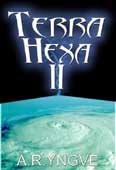 Last night I finished my next novel TERRA HEXA 2 ... and celebrated on the town with wine, women and song...
That's the fantasy version. Now the REAL version of events:
Last night I completed the writing of the first draft of my next novel TERRA HEXA 2 ... and took a rest before starting the lengthy process of proofreading, revising and rewriting.
Writing and finishing the first draft gives you a buzz. You think: "Yes! This is good! Best thing I ever wrote!" But you're not finished - the buzz is a side-effect of the writing process.
The work that remains AFTER the first draft makes all the difference.
After you finish the first draft, let it lie for a few days (or weeks, if you have time). Then re-read it, from beginning to end, fix the small errors, and take notes about what could be changed or omitted.
Often you will find that some character details are missing and should be fleshed out, or that there is too much exposition in some part, or some internal inconsistency.
EXAMPLES OF FIRST-DRAFT MISTAKES:
-You forgot to give the villain a motivation for his behavior.
Did he have a unhappy childhood? Is he stupid? What's in it for him? Don't automatically assume that anyone who disagrees with the hero is "bad". Follow the money. If anything else fails, greed - smart greed - is a perfectly good motivation.
-You got lazy.
Your protagonist is hanging from the edge of a cliff, and a horde of bad guys are charging in from all sides. What does he do?
Aha!
From out of nowhere, a cave opening suddenly shows up in the cliff wall. Your hero climbs into the cave, which leads to safety. Is this great plotting or what?
Or what.
The escape route would have made more sense if it had been presented or at least hinted at earlier - like, three chapters earlier. This is called "foreshadowing".
When important plot points are suggested/hinted in advance, the reader is more likely to accept them. Or it looks like you're just making stuff up as you go along (which you are, but you're not supposed to tell the reader).
-You wrote the characters of the opposite sex with much less personality (than those of your own gender).
Now, don't panic! Everyone does this, and I mean everyone. It's just how human beings behave. But it can be fixed, or at least patched up.
Go back to the characters of the opposite sex, and ask yourself the basic questions:
-Where did they come from?
-Who were their parents?
-How did they grow up?
-Have they got family? (Very common mistake: to write characters who have no past, no friends, no social role, no job except to assist the "hero" character.)
-What do they want out of life, and how do they expect to get it?
-You didn't do your research.
Poul Anderson, in his essay "On Thud And Blunder", points out that horses are not automobiles: you can't drive them at full gallop for miles without a pause. And yet, many writers treat horses like sports cars - wrooom! off you go, to the next plot stop.
Whenever a realistic detail is important to the plot, read up on it and make sure you've got it right. This is called research, and it pays to do it also after the first draft.
-You made spelling and grammar errors.
I shouldn't have to mention this... but every first draft is packed with misspellings and bad grammar. How many times will you have to re-read your manuscript to fix them all?
Five times.
Five.
Are you starting to regret that you wanted to write a book? Good. if you can get past that regret, you're on your way to becoming a real writer.
Saturday, May 28, 2005
Some Plots Can't Be Justified
What types of story plots really piss you off?
For example, when the hoary old plot twist "It was just a dream!" occurs, people react differently - some like it, some feel cheated. (The "It Was Just A Dream" plot CAN be used well, for instance in many of Philip K. Dick's stories and novels. But it can easily be abused.)
It's a very common misconception that the writer "gives away his soul" in the characters he writes, while the plot is just a framework on which to hang the characters.
I think it's the other way around: the plot gives away the real message between the lines, and the characters are of secondary importance. We tell stories not to admire the imaginary persons' personalities, but what they do and why they do it.
If you see it that way, certain plots become too disgusting to stomach, because they clash with your convictions. I can forgive flaws in the story's characters, but I can't forgive plots with flawed messages.
Here are some examples:
1. "Saddam Hussein Writes The Plot" plots:
Saddam Hussein wrote a novel (I kid you not) about a warmongering usurping tyrant whose actions and policies were justified. Any story where the protagonist is a warmongering usurper/tyrant/emperor but it's always justified as "Good For The Country" or "Part Of History's Great Plan" makes me cringe.
2. "Horny Old Man" Plots:
A middle-aged man (usually a white middle-class type) goes to bed with a much, MUCH younger person... and the plot creaks and strains to make this seem extraordinarily Noble and Romantic and Rebellious...
...but strip away all the huff and puff, and all you're left with is a Horny Old Man.
(Incidentally, these stories are almost always written by Horny Old Men who think they are being terribly "intellectual". There are also examples, though much fewer, of "Horny Old Woman" plots.)
3. "Genocide Is Cool" plots:
Any plot which hinges on the hero killing off 100,000-1,000,000,000 (or more) "enemies". There is no way I'm going to admire such an atrocity, no matter what the excuse is.
(However, such plots have the potential for becoming award-winning, bestselling cult books, a fact which makes me very very depressed.)
4. "The Gadget Saves The Day" plots:
What John Boorman did right with the movie EXCALIBUR (and so many others fail at) is that when King Arthur pulls the sword out of the stone, this does NOT automatically remove all obstacles or make everybody obey him.
In the real world, entire empires and peoples will not suddenly become enslaved by a magic trinket. That's just impossible. (Except in some SF and fantasy.)
5. "Talk About Your Feelings" plots:
A plot in which no resolution or significant change occurs, except that the protagonist gets to Talk About Her Feelings. Very Nice and Humane and Kumbaya... and So Boring.
This may seem merely like an example of a "weak" plot (i.e. it lacks an underlying message and is only under-written), but I think it does carry a message.
Namely, that feelings are SO important that as long as the character has the "right" feelings, she can do whatever the heck she wants and not be responsible for it!
I'm sure you can come up with other examples of Plots You Hate.
For example, when the hoary old plot twist "It was just a dream!" occurs, people react differently - some like it, some feel cheated. (The "It Was Just A Dream" plot CAN be used well, for instance in many of Philip K. Dick's stories and novels. But it can easily be abused.)
It's a very common misconception that the writer "gives away his soul" in the characters he writes, while the plot is just a framework on which to hang the characters.
I think it's the other way around: the plot gives away the real message between the lines, and the characters are of secondary importance. We tell stories not to admire the imaginary persons' personalities, but what they do and why they do it.
If you see it that way, certain plots become too disgusting to stomach, because they clash with your convictions. I can forgive flaws in the story's characters, but I can't forgive plots with flawed messages.
Here are some examples:
1. "Saddam Hussein Writes The Plot" plots:
Saddam Hussein wrote a novel (I kid you not) about a warmongering usurping tyrant whose actions and policies were justified. Any story where the protagonist is a warmongering usurper/tyrant/emperor but it's always justified as "Good For The Country" or "Part Of History's Great Plan" makes me cringe.
2. "Horny Old Man" Plots:
A middle-aged man (usually a white middle-class type) goes to bed with a much, MUCH younger person... and the plot creaks and strains to make this seem extraordinarily Noble and Romantic and Rebellious...
...but strip away all the huff and puff, and all you're left with is a Horny Old Man.
(Incidentally, these stories are almost always written by Horny Old Men who think they are being terribly "intellectual". There are also examples, though much fewer, of "Horny Old Woman" plots.)
3. "Genocide Is Cool" plots:
Any plot which hinges on the hero killing off 100,000-1,000,000,000 (or more) "enemies". There is no way I'm going to admire such an atrocity, no matter what the excuse is.
(However, such plots have the potential for becoming award-winning, bestselling cult books, a fact which makes me very very depressed.)
4. "The Gadget Saves The Day" plots:
What John Boorman did right with the movie EXCALIBUR (and so many others fail at) is that when King Arthur pulls the sword out of the stone, this does NOT automatically remove all obstacles or make everybody obey him.
In the real world, entire empires and peoples will not suddenly become enslaved by a magic trinket. That's just impossible. (Except in some SF and fantasy.)
5. "Talk About Your Feelings" plots:
A plot in which no resolution or significant change occurs, except that the protagonist gets to Talk About Her Feelings. Very Nice and Humane and Kumbaya... and So Boring.
This may seem merely like an example of a "weak" plot (i.e. it lacks an underlying message and is only under-written), but I think it does carry a message.
Namely, that feelings are SO important that as long as the character has the "right" feelings, she can do whatever the heck she wants and not be responsible for it!
I'm sure you can come up with other examples of Plots You Hate.
Thursday, May 26, 2005
Computers Are To Blame!
Before typewriters, authors wrote by hand (like, say, Charles Dickens).
Or they dictated (even later writers, such as Georges Simenon of the famous "Inspector Maigret" series, dictated to a secretary).
I wrote my first novel (unpublished, but available online here) on an electric Army Surplus typewriter.
It made a tremendous noise, like this: Hummmm... chakk-chakk-chakk KA-CHUNGG! Whizz... Chakk-chakk-chakk-chakk KA_CHUNGG!
(My neighbors must have hated it.)
And then came computers.
Have you noticed how long most novels are today? It's not just because publishers want them that way. (The strategy seems to be that if your books have thick spines they will visibly stand out from, and take shelf space from, competing books.)
The prime reason why books are so long today is that those evil, evil computers replaced typewriters. Suddenly, writers didn't have to think before they wrote. They could just pour out words and proofread on the fly, thanks to the Spellcheck function.
The computer-as-writing-tool makes us all self-indulgent. (I stand accused.) For instance, with a typewriter you would think twice before planting a three-page infodump in your manuscript. It forced the writer to be economic with words, to get to the point.
With a computer, it's so easy to show off every little irrelevant tidbit you dug up in research, you can't resist putting ALL of it in your manuscript.
So would I go back to using a typewriter?
Heck, no!
Too much bother with the paper and noise and correction fluid and typing-arms getting stuck...
;-)
Or they dictated (even later writers, such as Georges Simenon of the famous "Inspector Maigret" series, dictated to a secretary).
I wrote my first novel (unpublished, but available online here) on an electric Army Surplus typewriter.
It made a tremendous noise, like this: Hummmm... chakk-chakk-chakk KA-CHUNGG! Whizz... Chakk-chakk-chakk-chakk KA_CHUNGG!
(My neighbors must have hated it.)
And then came computers.
Have you noticed how long most novels are today? It's not just because publishers want them that way. (The strategy seems to be that if your books have thick spines they will visibly stand out from, and take shelf space from, competing books.)
The prime reason why books are so long today is that those evil, evil computers replaced typewriters. Suddenly, writers didn't have to think before they wrote. They could just pour out words and proofread on the fly, thanks to the Spellcheck function.
The computer-as-writing-tool makes us all self-indulgent. (I stand accused.) For instance, with a typewriter you would think twice before planting a three-page infodump in your manuscript. It forced the writer to be economic with words, to get to the point.
With a computer, it's so easy to show off every little irrelevant tidbit you dug up in research, you can't resist putting ALL of it in your manuscript.
So would I go back to using a typewriter?
Heck, no!
Too much bother with the paper and noise and correction fluid and typing-arms getting stuck...
;-)
Tuesday, May 24, 2005
There Ain't No Such Thing As Writer's Block
People have different work rhythms and cycles.
Some write in bursts of activity, lasting day and night, followed by extended periods of exhaustion. Others like to do it in the evenings (*cough*), some write in the morning... others work strict office hours, writing from 09:00 to 17:00.
But almost all writers find themselves at some point "unable" to write, even when there is time and energy to spare. You have the opportunity to sit down and write, nobody's pointing a gun at your head, your family's not starving... and yet you do not write. Why?
The late Douglas Adams was "late" also while he lived - he was notorious for not keeping deadlines. What was he up to? I don't know.
And there are people like Stephen King or Isaac Asimov, truly obsessive-compulsive writers - you couldn't stop them if you tried. But even they must have had their dry spells.
You can call it what you like - writer's block, fear of the Blank Page, procrastination, creative drought, waiting for inspiration... doesn't matter. Either you write, or you don't. "Writer's Block" is just a word. (OK, two words.) I'm not going to give you or myself any excuses.
Nothing gives me an ulcer like those poseurs who say (nasal tone): "Well you know, I want to be a writer..."
Well, who's stopping you, then? Are you waiting for your Official Writing Permit? Is Seinfeld on tonight? Just ****ing do it!
This little rant is aimed at myself too. Been procrastinating for several weeks. And I hate myself for it.
Some write in bursts of activity, lasting day and night, followed by extended periods of exhaustion. Others like to do it in the evenings (*cough*), some write in the morning... others work strict office hours, writing from 09:00 to 17:00.
But almost all writers find themselves at some point "unable" to write, even when there is time and energy to spare. You have the opportunity to sit down and write, nobody's pointing a gun at your head, your family's not starving... and yet you do not write. Why?
The late Douglas Adams was "late" also while he lived - he was notorious for not keeping deadlines. What was he up to? I don't know.
And there are people like Stephen King or Isaac Asimov, truly obsessive-compulsive writers - you couldn't stop them if you tried. But even they must have had their dry spells.
You can call it what you like - writer's block, fear of the Blank Page, procrastination, creative drought, waiting for inspiration... doesn't matter. Either you write, or you don't. "Writer's Block" is just a word. (OK, two words.) I'm not going to give you or myself any excuses.
Nothing gives me an ulcer like those poseurs who say (nasal tone): "Well you know, I want to be a writer..."
Well, who's stopping you, then? Are you waiting for your Official Writing Permit? Is Seinfeld on tonight? Just ****ing do it!
This little rant is aimed at myself too. Been procrastinating for several weeks. And I hate myself for it.
Saturday, May 21, 2005
What's In A Name?
Did you know, that while Margaret Mitchell was writing her epic novel GONE WITH THE WIND (not her first choice of book-title, by the way) at first she named her heroine "Pansy O'Hara"?
Ouch!
Luckily, the movie producer convinced Mitchell to choose another name - Scarlett O'Hara.
In fiction writing, names are important threefold:
1. The name of the story
2. The names of the principal characters in the story
3. The name of the writer.
If you find it hard to come up with varied and original names for your fictional characters, try the BabyNames index of names.
In my first draft of TERRA HEXA, the musician character was named "Pete". I am a little dyslexic with people names, and often mix up names in real life, and also when I write fiction. I kept mixing up "Pete" with another character's name, and misnamed them several times.
After I changed "Pete"'s name to "Mick", it became much easier to tell the two characters apart.
"Gulliver Foyle" is a cool character name. "Max Power" is not.
"Trapper John" is a cool character nickname. "Two Sheds" Jackson isn't.
Variations on Tolkien names - such as "Frodorithim" - are so lame, it's not even funny.
Picking a good title for a story or novel is even harder. I try to keep it short. The ideal title should be 2-4 words long, and memorable. And in the name of all things holy, do NOT try to cook up convoluted, pretentious titles like "DEATHSTORM: FATE OF MAN" (I made that one up, but there are many, many such titles around - especially in the Generic Fantasy genre!).
Finally, if your own name is very difficult to pronounce, you might consider a pseudonym. Many times I've thought that "Yngve" just isn't a very good writer's name... it's become a running joke in science-fiction fan circles.
Stephen King was lucky with the name he was born with.... it's excellently suited to put on book covers. It sings, you know?
And... if you're about to become a parent, you should really think twice about how you name your newborn baby. I mean, what kind of demented sadists name their offspring "Melvin" or "Pansy" or "Biff"?
Parents tend to be unbelievably shortsighted when they name babies. The rule of thumb shouldn't be "What sounds cool right now?" but "Am I certain that my kid will NOT be teased by other kids for his/her name?"
(Obviously, the same rule applies to the title of the book you write.)
Ouch!
Luckily, the movie producer convinced Mitchell to choose another name - Scarlett O'Hara.
In fiction writing, names are important threefold:
1. The name of the story
2. The names of the principal characters in the story
3. The name of the writer.
If you find it hard to come up with varied and original names for your fictional characters, try the BabyNames index of names.
In my first draft of TERRA HEXA, the musician character was named "Pete". I am a little dyslexic with people names, and often mix up names in real life, and also when I write fiction. I kept mixing up "Pete" with another character's name, and misnamed them several times.
After I changed "Pete"'s name to "Mick", it became much easier to tell the two characters apart.
"Gulliver Foyle" is a cool character name. "Max Power" is not.
"Trapper John" is a cool character nickname. "Two Sheds" Jackson isn't.
Variations on Tolkien names - such as "Frodorithim" - are so lame, it's not even funny.
Picking a good title for a story or novel is even harder. I try to keep it short. The ideal title should be 2-4 words long, and memorable. And in the name of all things holy, do NOT try to cook up convoluted, pretentious titles like "DEATHSTORM: FATE OF MAN" (I made that one up, but there are many, many such titles around - especially in the Generic Fantasy genre!).
Finally, if your own name is very difficult to pronounce, you might consider a pseudonym. Many times I've thought that "Yngve" just isn't a very good writer's name... it's become a running joke in science-fiction fan circles.
Stephen King was lucky with the name he was born with.... it's excellently suited to put on book covers. It sings, you know?
And... if you're about to become a parent, you should really think twice about how you name your newborn baby. I mean, what kind of demented sadists name their offspring "Melvin" or "Pansy" or "Biff"?
Parents tend to be unbelievably shortsighted when they name babies. The rule of thumb shouldn't be "What sounds cool right now?" but "Am I certain that my kid will NOT be teased by other kids for his/her name?"
(Obviously, the same rule applies to the title of the book you write.)
Tuesday, May 03, 2005
Scanned Images From Chinese Magazine KE HUAN
Monday, May 02, 2005
The Problem of Visualizing the Impossible (For Thousands of Chinese Readers)
The Chinese science-fiction magazine SCIENCE FICTION STORY/SCIENCE FICTION PICTORIAL MAGAZINE (.ak.a. "KeHuan") has published my short story "See" in its April 2005 issue.
(I just got a copy of the mag by snail-mail, and will post scanned images.)
"See" is fairly short - about 1500 words - and deals with my favorite subject: perception, how we perceive reality.
The plot is dead simple: the nameless protagonist, only referred to as "she," wakes up and finds that everybody's perception of reality has been profoundly altered. In fact, the change is SO profound, I couldn't draw a picture of it...
Why does this matter? Because as a writer, I put the highest emphasis on visualizing what you write, to "picture" it - or you won't be able to accurately describe it in words.
Even though I couldn't draw the story's weird and scary changes in visual perception, I could imagine them in my mind. And this alone made it possible to write them down with meticulous attention to detail - a mix of realism and surrealism that you might experience in a dream.
That the story was translated to Chinese, proves that its theme is not bound by my language or culture: it deals with imagery, not abstractions or conversations. Chinese, Swedish or New Zealander, you can "understand" what happens in "See", even though its events are impossible and surreal.
I also think that the story works on a metaphorical level: the change in perception mirrors the "flattening" effect of modern media and the Internet, that makes the whole world come "closer".
Another new Chinese magazine, WORLD SF (not to be confused with SF WORLD) is set to publish my short story "Telephone Conversations" in its June 2005 issue. (It was originally posted on my old homepage under the title "Keeping Up With the Cloneses", a pun which couldn't be translated to Chinese.)
This satirical story also deals with perception, but in terms of prejudice and bigotry... namely, how a narrow-minded housewife sees her neighborhood through the distorted "lens" of her preconceived notions and self-delusions. She's also a comic monster and was a fun character for me to write... because you can't trust anything she says.
(I'm planning to re-post both stories on my homepage, later.)
(I just got a copy of the mag by snail-mail, and will post scanned images.)
"See" is fairly short - about 1500 words - and deals with my favorite subject: perception, how we perceive reality.
The plot is dead simple: the nameless protagonist, only referred to as "she," wakes up and finds that everybody's perception of reality has been profoundly altered. In fact, the change is SO profound, I couldn't draw a picture of it...
Why does this matter? Because as a writer, I put the highest emphasis on visualizing what you write, to "picture" it - or you won't be able to accurately describe it in words.
Even though I couldn't draw the story's weird and scary changes in visual perception, I could imagine them in my mind. And this alone made it possible to write them down with meticulous attention to detail - a mix of realism and surrealism that you might experience in a dream.
That the story was translated to Chinese, proves that its theme is not bound by my language or culture: it deals with imagery, not abstractions or conversations. Chinese, Swedish or New Zealander, you can "understand" what happens in "See", even though its events are impossible and surreal.
I also think that the story works on a metaphorical level: the change in perception mirrors the "flattening" effect of modern media and the Internet, that makes the whole world come "closer".
Another new Chinese magazine, WORLD SF (not to be confused with SF WORLD) is set to publish my short story "Telephone Conversations" in its June 2005 issue. (It was originally posted on my old homepage under the title "Keeping Up With the Cloneses", a pun which couldn't be translated to Chinese.)
This satirical story also deals with perception, but in terms of prejudice and bigotry... namely, how a narrow-minded housewife sees her neighborhood through the distorted "lens" of her preconceived notions and self-delusions. She's also a comic monster and was a fun character for me to write... because you can't trust anything she says.
(I'm planning to re-post both stories on my homepage, later.)
Friday, April 15, 2005
Money, Money, Money...
Since I don't have to write for a living, it's not a matter of life-and-death that I get paid huge fortunes for my novels, short stories and whatnot...
But.
It's a matter of personal integrity and self-respect that I won't get shafted (ripped off, had, scammed, bushwacked, bamboozled, tossed in a ditch and left to die) by publishing people.
If you are trying to get published, you will sooner or later encounter people who
A) avoid paying you money, despite having promised to pay you;
B) ask for up-front "expenses" cash;
C) try to seize all rights to your work.
If you are offered a contract that contains any of the following items, throw it away:
1. The publisher claims all rights, forever. (Read: no time limit or geographical limit is set for the publishing rights.)
2. You, the writer, pledge to perform various services for the publisher, apart from having written the work.
3. Royalties are not offered for sales of your book.
4. You are asked to pay fees of some kind (for example, "editing fees").
5. The publisher/agent/middleman behaves in a dictatorial manner, as if the writer was some kind of serf.
Before I got published for real, I encountered dishonest agents, arrogant assistants, crooked publishers... and I shunned them all.
A helpful resource you must use is the Preditors & Editors index. It lists all known agents and publishers in the Western World, and contains warnings about specific agents/publishers with shady records or a criminal past.
But.
It's a matter of personal integrity and self-respect that I won't get shafted (ripped off, had, scammed, bushwacked, bamboozled, tossed in a ditch and left to die) by publishing people.
If you are trying to get published, you will sooner or later encounter people who
A) avoid paying you money, despite having promised to pay you;
B) ask for up-front "expenses" cash;
C) try to seize all rights to your work.
If you are offered a contract that contains any of the following items, throw it away:
1. The publisher claims all rights, forever. (Read: no time limit or geographical limit is set for the publishing rights.)
2. You, the writer, pledge to perform various services for the publisher, apart from having written the work.
3. Royalties are not offered for sales of your book.
4. You are asked to pay fees of some kind (for example, "editing fees").
5. The publisher/agent/middleman behaves in a dictatorial manner, as if the writer was some kind of serf.
Before I got published for real, I encountered dishonest agents, arrogant assistants, crooked publishers... and I shunned them all.
A helpful resource you must use is the Preditors & Editors index. It lists all known agents and publishers in the Western World, and contains warnings about specific agents/publishers with shady records or a criminal past.
Wednesday, April 13, 2005
Fiction & Fact...
Art imitates life.
Life imitates art.
Life inspires fiction.
Fiction inspires people's actions.
Fiction thrives on wild, unrealistic, contrived ideas.
Real events can seem wild, unrealistic and contrived.
You write a story and the readers say: "It's too far-fetched. I can't believe it."
Then a real-life event occurs, and you think: "It's too far-fetched. It doesn't feel real."
If life is a dream, why write down your dreams at all?
Alfred Hitchcock put it this way:
"Movies are like real life with all the boring parts taken out ."
Is that the secret of fiction: an edited version of reality?
I have no idea.
Life imitates art.
Life inspires fiction.
Fiction inspires people's actions.
Fiction thrives on wild, unrealistic, contrived ideas.
Real events can seem wild, unrealistic and contrived.
You write a story and the readers say: "It's too far-fetched. I can't believe it."
Then a real-life event occurs, and you think: "It's too far-fetched. It doesn't feel real."
If life is a dream, why write down your dreams at all?
Alfred Hitchcock put it this way:
"Movies are like real life with all the boring parts taken out ."
Is that the secret of fiction: an edited version of reality?
I have no idea.
Tuesday, April 12, 2005
Big Deals & Critics
This is one rare and special experience in my writing career:
As this is being written, a major publisher in a distant country is negotiating with a certain (*cough*) person to translate and publish his debut novel there.
I can't say more at this point... perhaps the deal will close, perhaps not. But I'm very excited.
Meanwhile, critics in my home country are mostly positive to my debut novel. A few reviews are VERY negative. (If you can read Swedish, the reviews can be found here and here.)
I am listening to the criticism, and it does have some minor influence on the sequel I'm writing now... (Yes, yes, I WILL pick up the loose plot ends... yes, yes, I WILL give a bit more space to characterization!)
However... any writer must learn this lesson, and painfully so: You can't please everybody. You never will.
Critics will always find something to nitpick about (Lousy rotten karmic retribution, muttered he, quoting Homer Simpson). Even when you're successful. Especially when you're successful.
I wouldn't say negative criticism is driven only by envy (it's not), but I have a theory about where it comes from...
---------------------------------
MY THEORY OF CRITICS:
1. The critical reader approaches a work of fiction with very specific personal needs.
2. The critic hopes that the reading experience will satisfy these needs.
3. Said needs are perhaps clothed in lofty language about "style" and "theme" and "principles" (yadda yadda), but those are only so much window-dressing. The critic's needs are at their core emotional, exactly in the way that the writer's emotional needs pushes the writer to write.
4. The critic's needs may vary, but often circle around
4 A) Loneliness.
EXAMPLE: "I want friends and love and connect with other people. I will experience these things vicariously, by identifying with the characters in this book. I don't think of myself as a critic, but as a reader."
4 B) Lack of self-esteem.
EXAMPLE: "Nobody listens to me! I can't write! I can't get published! I'll make'em listen. I'll show the world I'm good enough to be a writer."
4 C) Narcissism.
EXAMPLE: "All books should reflect my perfection. Any book that I fail to identify with is not a part of me, and therefore not perfect, and therefore beneath all respect."
4 D) Idealism.
EXAMPLE: "I follow the Sacred Principles of Art, and will inspect this book to make sure it follows slavishly my Sacred Principles."
5. If the critic fails to gain the anticipated (and perhaps fleeting) satisfaction, he/she will feel cheated, even resentful.
In some cases, the critic's reaction closely resembles that of a rejected lover ("How could she do this to me, that heartless strumpet!")
-------------------------------------
Please note that I'm not saying this is wrong. I'm only trying to understand critics as human beings (instead of just seeing them as heartless monsters, which is dishonest but more fun).
Loneliness (See point 4 B) is just as much a driving force for the average writer as for the average reader. We are human beings. We want to connect. That is why writing exists in the first place.
So, dear critic, if you fail to gain satisfaction from my fiction, please don't hate me. I'll try harder next time.
And if you do not listen... then to hell with you!*
(*Conan the Barbarian, 1982)
As this is being written, a major publisher in a distant country is negotiating with a certain (*cough*) person to translate and publish his debut novel there.
I can't say more at this point... perhaps the deal will close, perhaps not. But I'm very excited.
Meanwhile, critics in my home country are mostly positive to my debut novel. A few reviews are VERY negative. (If you can read Swedish, the reviews can be found here and here.)
I am listening to the criticism, and it does have some minor influence on the sequel I'm writing now... (Yes, yes, I WILL pick up the loose plot ends... yes, yes, I WILL give a bit more space to characterization!)
However... any writer must learn this lesson, and painfully so: You can't please everybody. You never will.
Critics will always find something to nitpick about (Lousy rotten karmic retribution, muttered he, quoting Homer Simpson). Even when you're successful. Especially when you're successful.
I wouldn't say negative criticism is driven only by envy (it's not), but I have a theory about where it comes from...
---------------------------------
MY THEORY OF CRITICS:
1. The critical reader approaches a work of fiction with very specific personal needs.
2. The critic hopes that the reading experience will satisfy these needs.
3. Said needs are perhaps clothed in lofty language about "style" and "theme" and "principles" (yadda yadda), but those are only so much window-dressing. The critic's needs are at their core emotional, exactly in the way that the writer's emotional needs pushes the writer to write.
4. The critic's needs may vary, but often circle around
4 A) Loneliness.
EXAMPLE: "I want friends and love and connect with other people. I will experience these things vicariously, by identifying with the characters in this book. I don't think of myself as a critic, but as a reader."
4 B) Lack of self-esteem.
EXAMPLE: "Nobody listens to me! I can't write! I can't get published! I'll make'em listen. I'll show the world I'm good enough to be a writer."
4 C) Narcissism.
EXAMPLE: "All books should reflect my perfection. Any book that I fail to identify with is not a part of me, and therefore not perfect, and therefore beneath all respect."
4 D) Idealism.
EXAMPLE: "I follow the Sacred Principles of Art, and will inspect this book to make sure it follows slavishly my Sacred Principles."
5. If the critic fails to gain the anticipated (and perhaps fleeting) satisfaction, he/she will feel cheated, even resentful.
In some cases, the critic's reaction closely resembles that of a rejected lover ("How could she do this to me, that heartless strumpet!")
-------------------------------------
Please note that I'm not saying this is wrong. I'm only trying to understand critics as human beings (instead of just seeing them as heartless monsters, which is dishonest but more fun).
Loneliness (See point 4 B) is just as much a driving force for the average writer as for the average reader. We are human beings. We want to connect. That is why writing exists in the first place.
So, dear critic, if you fail to gain satisfaction from my fiction, please don't hate me. I'll try harder next time.
And if you do not listen... then to hell with you!*
(*Conan the Barbarian, 1982)
Wednesday, March 30, 2005
Lessons in Life and Writing
Sometimes, you get good advice where you least expect it.
I'm reading such a book, thinking: "This guy writes rude, coarse, even obscene prose, he's done some truly despicable things... but - damn him! - he has his story to tell. And he knows how to tell it in the most direct, blunt manner possible. He knows stuff. He's spilling the beans about writing movie scripts, and reveals how it's actually done."
Even as I often try to be polite, I respect frankness.
Even when it comes from Joe Eszterhas.
I'm reading his autobiography, Hollywood Animal. It is totally unsuitable for young readers. The book contains too much violence, swearing, bad sex and bad behavior.
However, he also gives the reader a rare peek into the life of the Hollywood screenwriter. His horror stories of excess, inflated egos and corruption have permanently scared me away from working in that business.
OK, I wrote a script once, but I'll never go near Hollywood. It's too dangerous. Eszterhas describes how several of his friends literally DIED from the corruption, stress and heartbreak induced by the movie business. He writes:
"If you allowed Hollywood to infect your soul... not your brain, not even your heart, but your soul... you became vulnerable to the shiv with which Hollywood could kill you."
If you are over 18 and have film ambitions of any kind, I can recommend you read Hollywood Animal. If you're not, take this advice: stay the hell away from Hollywood!
I'm reading such a book, thinking: "This guy writes rude, coarse, even obscene prose, he's done some truly despicable things... but - damn him! - he has his story to tell. And he knows how to tell it in the most direct, blunt manner possible. He knows stuff. He's spilling the beans about writing movie scripts, and reveals how it's actually done."
Even as I often try to be polite, I respect frankness.
Even when it comes from Joe Eszterhas.
I'm reading his autobiography, Hollywood Animal. It is totally unsuitable for young readers. The book contains too much violence, swearing, bad sex and bad behavior.
However, he also gives the reader a rare peek into the life of the Hollywood screenwriter. His horror stories of excess, inflated egos and corruption have permanently scared me away from working in that business.
OK, I wrote a script once, but I'll never go near Hollywood. It's too dangerous. Eszterhas describes how several of his friends literally DIED from the corruption, stress and heartbreak induced by the movie business. He writes:
"If you allowed Hollywood to infect your soul... not your brain, not even your heart, but your soul... you became vulnerable to the shiv with which Hollywood could kill you."
If you are over 18 and have film ambitions of any kind, I can recommend you read Hollywood Animal. If you're not, take this advice: stay the hell away from Hollywood!
Thursday, March 24, 2005
Happy Easter!
I'll be away over Easter, so no new posts until Monday.
In the meantime, why don't you visit my homepage and read some short stories for free?
In the meantime, why don't you visit my homepage and read some short stories for free?
Monday, March 21, 2005
Isaac Asimov's Writing Secrets Uncovered!
Isaac Asimov, an extremely prolific (and enduringly successful) writer of hundreds of books, took part in a conference in the early 1980s.
Shannon Roe was there, and wrote down notes about what Asimov said about writing. Now, her notes have been presented in the article "How to write a lot" . A little gem, this document, which shows how Asimov saw himself and his work.
Typical of his self-deprecating humor is this quote:
"I can't tell you how to be a good writer," he had begun, "because nobody ever says that I'm a good writer. It's always 'prolific writer.' That's a polysyllabic term for 'hack.' "
Read the rest, and be a little wiser.
Shannon Roe was there, and wrote down notes about what Asimov said about writing. Now, her notes have been presented in the article "How to write a lot" . A little gem, this document, which shows how Asimov saw himself and his work.
Typical of his self-deprecating humor is this quote:
"I can't tell you how to be a good writer," he had begun, "because nobody ever says that I'm a good writer. It's always 'prolific writer.' That's a polysyllabic term for 'hack.' "
Read the rest, and be a little wiser.
Saturday, March 19, 2005
How To End Stories
On the ASIMOV'S Message Board are two interesting threads about endings in science fiction books and stories:
-Why are endings in science fiction so often disappointing?
-Why these interminable "series" and "sagas" instead of complete novels with definite endings?
In the threads, I offered these possible explanations for disappointing endings:
------------------------------------------
"Why do SF novels so often have weak endings?"
Answer 1: Because SF, with its emphasis on possibilities and new opportunities, tends to undercut or completely subvert many "traditional" endings. Resolutions don't come as easily as they do in, say, romance or detective stories.
Answer 2: The kind of SF that tends toward wish-fulfilment is dreamlike. And dreams don't have "real" endings... you just wake up from them.
Answer 3: SF writers often create imaginary worlds so complex and large, they create more loose ends than can be tied up in a single novel.
Answer 4: The fans are nitpicky. ;-)
------------------------------------------
As for the "sequel plague" in the genre, I wrote:
------------------------------------------
A series, for a writer, is like a trust fund. It ensures him a reasonably steady income. (And steady income is the Holy Grail of writers everywhere. I stand accused.)
Sure, a series becomes derivative sooner or later. But also, fans perpetuate them. If you personally don't like a series, you have my sympathy... but market forces keep them around.
(They will probably continue to crank out new "Foundation" and "Dune" sequels fifty years from now. Such is life.)
------------------------------------------
Gardner Dozois, longtime editor of ASIMOV'S, weighed in:
------------------------------------------
The bad part of the emphasis on series, for both science fiction and mystery, is that when series books don't earn up to expectations, the publishers drop the series without bringing out the rest of the books, so the landscape is left littered with broken series where you never are going to find out what happens next to the characters, no matter how much you might want to know.
Be nice if publishers would give the authors one last book to wrap all the loose ends up in once they've decided to drop the series--the fans would certainly be happier that way--but publishing isn't a business that can afford that sort of luxury.
------------------------------------------
Many more good points are made on these discussion threads - by readers and writers - so check them out, if you want to learn more about readers and writers.
Isn't it great that readers and writers can meet and discuss like equals on message boards? Personally, I love it!
-Why are endings in science fiction so often disappointing?
-Why these interminable "series" and "sagas" instead of complete novels with definite endings?
In the threads, I offered these possible explanations for disappointing endings:
------------------------------------------
"Why do SF novels so often have weak endings?"
Answer 1: Because SF, with its emphasis on possibilities and new opportunities, tends to undercut or completely subvert many "traditional" endings. Resolutions don't come as easily as they do in, say, romance or detective stories.
Answer 2: The kind of SF that tends toward wish-fulfilment is dreamlike. And dreams don't have "real" endings... you just wake up from them.
Answer 3: SF writers often create imaginary worlds so complex and large, they create more loose ends than can be tied up in a single novel.
Answer 4: The fans are nitpicky. ;-)
------------------------------------------
As for the "sequel plague" in the genre, I wrote:
------------------------------------------
A series, for a writer, is like a trust fund. It ensures him a reasonably steady income. (And steady income is the Holy Grail of writers everywhere. I stand accused.)
Sure, a series becomes derivative sooner or later. But also, fans perpetuate them. If you personally don't like a series, you have my sympathy... but market forces keep them around.
(They will probably continue to crank out new "Foundation" and "Dune" sequels fifty years from now. Such is life.)
------------------------------------------
Gardner Dozois, longtime editor of ASIMOV'S, weighed in:
------------------------------------------
The bad part of the emphasis on series, for both science fiction and mystery, is that when series books don't earn up to expectations, the publishers drop the series without bringing out the rest of the books, so the landscape is left littered with broken series where you never are going to find out what happens next to the characters, no matter how much you might want to know.
Be nice if publishers would give the authors one last book to wrap all the loose ends up in once they've decided to drop the series--the fans would certainly be happier that way--but publishing isn't a business that can afford that sort of luxury.
------------------------------------------
Many more good points are made on these discussion threads - by readers and writers - so check them out, if you want to learn more about readers and writers.
Isn't it great that readers and writers can meet and discuss like equals on message boards? Personally, I love it!
Thursday, March 17, 2005
Stephen King's Writing Advice Rocks!
Stephen King has produced two of my favorite books about the writing craft: Danse Macabre and On Writing. Both are honest, down-to-earth, funny and chock full of practical advice.
Craft. That's the thing. You can't do "art" until you know the craft. How do you structure sentences? How do you create a good ending? Do the characters work? Are there too many characters? What is the "theme" of your story or novel? King lays it all down. I'll take his advice over any arty-farty academic from some English Lit faculty.
(I wish, though, that King would follow his own advice and sometimes write shorter novels...)
Craft. That's the thing. You can't do "art" until you know the craft. How do you structure sentences? How do you create a good ending? Do the characters work? Are there too many characters? What is the "theme" of your story or novel? King lays it all down. I'll take his advice over any arty-farty academic from some English Lit faculty.
(I wish, though, that King would follow his own advice and sometimes write shorter novels...)
Wednesday, March 09, 2005
Rejection: The Part Of The Writing Job That Sucks
I could play cool, and pretend it doesn't hurt to receive a rejection slip from an editor.
But it does. It always hurts every time... like having your heart carved up with a rusty nail... like hearing your parents say "We wish you'd never been born!"... like having your legs run over by a truck while you hear Britney Spears singing "My Prerogative."
It softens the pain, though, to have an agent who receives the rejections and forwards them to me. (Thanks, Faye.)
When an editor rejects a manuscript, the worst part is knowing how arbitrary the publisher's review process really is. There is no objectivity.
You can polish a manuscript all you want... in the end, you may still be treated like J.K. Rowling, who was rejected by nine editors who thought Harry Potter And The Philosopher's Stone wouldn't sell. (Listed by The Sun as one of the 50 Worst Decisions Ever.)
If you bear in mind what happened to Rowling, your rule of thumb should be: Don't give up your manuscript until it has been rejected at least 10 times. Then you shelve it and start writing something else.
If you want to read other writers' acounts of rejections-before-success, this article has several.
If you just want to wallow in the misery of other writers being rejected, there is the Rejection Collection.
But why do that? You should rejoice in the regret, self-loathing and bitterness of the editors who rejected J.K.Rowling. Every time you meet a publishing professional, ask which person rejected Rowling. And if you ever come face-to-face with one of the editors who decided the rejection, ask him or her:
"How does it feel to be such a f***ing jerk?"
But it does. It always hurts every time... like having your heart carved up with a rusty nail... like hearing your parents say "We wish you'd never been born!"... like having your legs run over by a truck while you hear Britney Spears singing "My Prerogative."
It softens the pain, though, to have an agent who receives the rejections and forwards them to me. (Thanks, Faye.)
When an editor rejects a manuscript, the worst part is knowing how arbitrary the publisher's review process really is. There is no objectivity.
You can polish a manuscript all you want... in the end, you may still be treated like J.K. Rowling, who was rejected by nine editors who thought Harry Potter And The Philosopher's Stone wouldn't sell. (Listed by The Sun as one of the 50 Worst Decisions Ever.)
If you bear in mind what happened to Rowling, your rule of thumb should be: Don't give up your manuscript until it has been rejected at least 10 times. Then you shelve it and start writing something else.
If you want to read other writers' acounts of rejections-before-success, this article has several.
If you just want to wallow in the misery of other writers being rejected, there is the Rejection Collection.
But why do that? You should rejoice in the regret, self-loathing and bitterness of the editors who rejected J.K.Rowling. Every time you meet a publishing professional, ask which person rejected Rowling. And if you ever come face-to-face with one of the editors who decided the rejection, ask him or her:
"How does it feel to be such a f***ing jerk?"
Monday, March 07, 2005
Dr. Synopsis, Or How I Learned To Stop Worrying And Love Plotting
When my agent accepts to represent one of my books - or movie scripts - she asks me to deliver a snappy summary of the plot and characters. This is also called a "pitch".
How to pitch HAMLET: "They killed his father - now he's out for revenge! Who will be the last man standing?" (A pretty accurate plot summary.)
However: A snappy plot summary is NOT the same as a synopsis. If you want to write a full (and successful) novel, begin with the synopsis.
A writer's own private book synopsis needs to be very detailed. It can - and often should- provide the "back story" and information the writer needs to "make sense" of his imaginary world. (Neither the reader nor the editor need to see the writer's synopsis. The version they get to see is more like a pitch.)
I go so far as to draw sketches of the characters and locations in a book. (Of course, if the location also exists in the real world, you can look it up. For instance, you can find a variety of detailed maps of every country in the world.)
If there is a major inconsistency or plot-hole in the story I wish to tell, it's always better if it shows up in my synopsis and preparatory notes... so I can work it out in advance... instead of appearing much later, after the book is released, when the publisher asks me to write a sequel.
Almost no writer escapes making an error now and then. Luckily, readers are a forgiving lot... but watch your step! Legend has it that Frank Herbert was mercilessly taunted by nitpicky readers. They would sneak up on him during conventions and say "Oxygen!" (Meaning: where does the oxygen atmosphere on the plantless, waterless desert planet Arrakis in Dune come from?)
The readers and publishers wanted sequels to Dune (and did they get sequels)... so Herbert had to work out the oxygen issue in later books.
When I wrote Terra Hexa, I took a huge leave of my senses. (Or two. Or three...) Instead of working out in advance how the imaginary world of the story actually worked and where it came from, I decided to not give a damn. I was convinced the book would never be published in my home country anyway... and a sequel to that book was as likely as a flying pig... so who cares? Wheeee!!
But such was the whim of a capricious fate, that it tossed a giant-size humble pie in my face. The publisher asked me to write a sequel. I'm writing it now. And I have to work out the issues I ignored when I prepared the first book... and the readers and critics have been kind enough to point out all the loose ends and inconsistencies.
It's nice to know they care. :)
How to pitch HAMLET: "They killed his father - now he's out for revenge! Who will be the last man standing?" (A pretty accurate plot summary.)
However: A snappy plot summary is NOT the same as a synopsis. If you want to write a full (and successful) novel, begin with the synopsis.
A writer's own private book synopsis needs to be very detailed. It can - and often should- provide the "back story" and information the writer needs to "make sense" of his imaginary world. (Neither the reader nor the editor need to see the writer's synopsis. The version they get to see is more like a pitch.)
I go so far as to draw sketches of the characters and locations in a book. (Of course, if the location also exists in the real world, you can look it up. For instance, you can find a variety of detailed maps of every country in the world.)
If there is a major inconsistency or plot-hole in the story I wish to tell, it's always better if it shows up in my synopsis and preparatory notes... so I can work it out in advance... instead of appearing much later, after the book is released, when the publisher asks me to write a sequel.
Almost no writer escapes making an error now and then. Luckily, readers are a forgiving lot... but watch your step! Legend has it that Frank Herbert was mercilessly taunted by nitpicky readers. They would sneak up on him during conventions and say "Oxygen!" (Meaning: where does the oxygen atmosphere on the plantless, waterless desert planet Arrakis in Dune come from?)
The readers and publishers wanted sequels to Dune (and did they get sequels)... so Herbert had to work out the oxygen issue in later books.
When I wrote Terra Hexa, I took a huge leave of my senses. (Or two. Or three...) Instead of working out in advance how the imaginary world of the story actually worked and where it came from, I decided to not give a damn. I was convinced the book would never be published in my home country anyway... and a sequel to that book was as likely as a flying pig... so who cares? Wheeee!!
But such was the whim of a capricious fate, that it tossed a giant-size humble pie in my face. The publisher asked me to write a sequel. I'm writing it now. And I have to work out the issues I ignored when I prepared the first book... and the readers and critics have been kind enough to point out all the loose ends and inconsistencies.
It's nice to know they care. :)
Sunday, March 06, 2005
Short Stories Are Long Efforts
I've mentioned that books should not be too long. This gets even more crucial in short-story writing. I'm the wrong person to give advice about writing short stories, because frankly I'm not very good at it.
I have learned great patience when writing novels (One year's work to finish the 100,000-word book? Okeli-dokeli-do!).... but I get incredibly impatient when I sit and write a short story (Spend two whole WEEKS to polish that 1,500-word short? Never!).
Why is that? Feel free to offer explanations.
A recent short story I wrote - in an impatient rush, hastily revised - has now been posted on my homepage. "The Last Weblog Of Jonathan Lippincott" is a pastiche of H.P.Lovecraft's horror tales, set in a present-day environment. It's also a satire of weblogs, and can be read either as a morbid joke, or an "urban legend" type of horror story...
The main part of said story uses the weblog format - including the Comment field where readers can leave their feedback. (Note how the fictional "comments" to the fictional blog posts provides a sort of "Greek Chorus" to the story, and emphasize the spooky mood!)
This may seem like a new trick, but is actually quite old. A classic example of a story presented as a series of "found" documents - letters, diaries, newspaper clippings - is Bram Stoker's Dracula. An even older example, Samuel Richardson's Pamela (1740) is written as a series of letters. (Click those links - it's free literature online! Free books, damn it! What are you waiting for?)
I encourage any aspiring writer to use this "found document" stylistic device. It's a tremendously effective "infodump" technique, and brings a "you-are-there" urgency to any story.
Or how about combining this trick with an uncommon choice of genre: "The sole witness to the meeting, a housemaid, claims she heard Mr. Butler say: 'Frankly, my dear, I don't give a damn,' before he left the house. Ms. O'Hara has refused to make any statements to our Atlanta correspondent."
I have learned great patience when writing novels (One year's work to finish the 100,000-word book? Okeli-dokeli-do!).... but I get incredibly impatient when I sit and write a short story (Spend two whole WEEKS to polish that 1,500-word short? Never!).
Why is that? Feel free to offer explanations.
A recent short story I wrote - in an impatient rush, hastily revised - has now been posted on my homepage. "The Last Weblog Of Jonathan Lippincott" is a pastiche of H.P.Lovecraft's horror tales, set in a present-day environment. It's also a satire of weblogs, and can be read either as a morbid joke, or an "urban legend" type of horror story...
The main part of said story uses the weblog format - including the Comment field where readers can leave their feedback. (Note how the fictional "comments" to the fictional blog posts provides a sort of "Greek Chorus" to the story, and emphasize the spooky mood!)
This may seem like a new trick, but is actually quite old. A classic example of a story presented as a series of "found" documents - letters, diaries, newspaper clippings - is Bram Stoker's Dracula. An even older example, Samuel Richardson's Pamela (1740) is written as a series of letters. (Click those links - it's free literature online! Free books, damn it! What are you waiting for?)
I encourage any aspiring writer to use this "found document" stylistic device. It's a tremendously effective "infodump" technique, and brings a "you-are-there" urgency to any story.
Or how about combining this trick with an uncommon choice of genre: "The sole witness to the meeting, a housemaid, claims she heard Mr. Butler say: 'Frankly, my dear, I don't give a damn,' before he left the house. Ms. O'Hara has refused to make any statements to our Atlanta correspondent."
Subscribe to:
Posts (Atom)