Acclaimed SF writer Charles Stross has posted an essay on the perspective-problem in fiction writing:
"Conjugate Characters, Not Verbs"
Authors and would-be authors take note: Stross analyzes one of the most difficult stylistic issues ANY writer can come up against. I wholeheartedly recommend his essay.
-------------
And now for something completely different...
I love satire and parody, but I don't like "fan-fiction". I think it's a ******* immature thing to do. Grownups should not write fanfiction; if they are so ******* eager to be writers, they can ******* make up their own original ******* characters.
And now I read about this sad, sad, sad, sad... sad person who not only wrote her own fan-fiction novel set in the STAR WARS universe... but also published it on Amazon.com.
Someone called it an act of "weapons-grade stupidity". That pretty much sums it up, no?
Why do these things happen? I like to think that people are, on the whole, fairly sane. But apparently insanity can strike anyone, at any time. There you are, walking down the street with a clear eye and a sharp mind... and POW! you fall and hit your head.
When you wake up, dazed and confused, you find yourself possessed by a single hypnotizing notion: "I am INSPIRED! I must write a fan-fiction novel and readers will love it because I am so INSPIRED!"
Do not confuse "obsessed" with "inspired".
And don't even try to defend yourself with Special Pleading: "Yeah, of course I know about copyright and all that... but MY fanfic is different! It's as good as the original, in fact!" (Yadda yadda...)
ADDENDUM:
1. Robin Hobb explains why she is opposed to fanfiction.
2. A huge discussion about fanfiction over at Making Light.
Monday, April 24, 2006


Saturday, April 15, 2006
Mark Twain on Fenimore Cooper
The essay/polemic "Fenimore Cooper's Literary Offenses" (1895) by Mark Twain is a wonderful case of Karmic Retribution.
Have you ever thought that some books earn the author money and fame despite not being very good? Well, it happens. But please, this is no reason to get cynical and nihilistic. Awful books may surf the wave of the Zeitgeist for a while... but eventually the book's true qualities (or lack of them) will catch up. Many novels which were once praised as "masterpieces" and "art" and sold very well, have now fallen into into disrepute or been forgotten.
Take Fenimore Cooper, for example. Cooper's Western/frontier books Pathfinder, Last of the Mohicans and The Deerslayer were immensely popular in the 1800s and well into the 1900s.
But, as Mark Twain pointed out back in 1895, Cooper couldn't write worth ****. His essay is not only laugh-out-loud funny; it also provides several very good examples of writer pitfalls to avoid.
For example, lazy use of clichés:
"A favorite one was to make a moccasined person tread in the tracks of a moccasined enemy, and thus hide his own trail. Cooper wore out barrels and barrels of moccasins in working that trick. Another stage-property that he pulled out of his box pretty frequently was the broken twig. He prized his broken twig above all the rest of his effects, and worked it the hardest.
"It is a restful chapter in any book of his when somebody doesn't step on a dry twig and alarm all the reds and whites for two hundred yards around. Every time a Cooper person is in peril, and absolute silence is worth four dollars a minute, he is sure to step on a dry twig.
"There may be a hundred other handier things to step on, but that wouldn't satisfy Cooper. Cooper requires him to turn out and find a dry twig; and if he can't do it, go and borrow one. In fact, the Leatherstocking Series ought to have been called the Broken Twig Series."
(From "Fenimore Cooper's Literary Offenses" by Mark Twain)
There's more. Much more! Read and be wiser.
Have you ever thought that some books earn the author money and fame despite not being very good? Well, it happens. But please, this is no reason to get cynical and nihilistic. Awful books may surf the wave of the Zeitgeist for a while... but eventually the book's true qualities (or lack of them) will catch up. Many novels which were once praised as "masterpieces" and "art" and sold very well, have now fallen into into disrepute or been forgotten.
Take Fenimore Cooper, for example. Cooper's Western/frontier books Pathfinder, Last of the Mohicans and The Deerslayer were immensely popular in the 1800s and well into the 1900s.
But, as Mark Twain pointed out back in 1895, Cooper couldn't write worth ****. His essay is not only laugh-out-loud funny; it also provides several very good examples of writer pitfalls to avoid.
For example, lazy use of clichés:
"A favorite one was to make a moccasined person tread in the tracks of a moccasined enemy, and thus hide his own trail. Cooper wore out barrels and barrels of moccasins in working that trick. Another stage-property that he pulled out of his box pretty frequently was the broken twig. He prized his broken twig above all the rest of his effects, and worked it the hardest.
"It is a restful chapter in any book of his when somebody doesn't step on a dry twig and alarm all the reds and whites for two hundred yards around. Every time a Cooper person is in peril, and absolute silence is worth four dollars a minute, he is sure to step on a dry twig.
"There may be a hundred other handier things to step on, but that wouldn't satisfy Cooper. Cooper requires him to turn out and find a dry twig; and if he can't do it, go and borrow one. In fact, the Leatherstocking Series ought to have been called the Broken Twig Series."
(From "Fenimore Cooper's Literary Offenses" by Mark Twain)
There's more. Much more! Read and be wiser.
Wednesday, April 12, 2006
19th-Century Essay: "How To Fail in Literature
Here's a real gem! Back in 1890, Andrew Lang held a lecture on "How To Fail in Literature", and the book of the lecture is now available for free at the Gutenberg Project.
I cannot do justice to Lang's satirical, often hilarious lecture in a single blog post -- so I suggest you simply dive into it.
Here are a few choice quotes from How To Fail in Literature:
"I regard failure as the goal of ignorance, incompetence, lack of common sense, conceited dullness, and certain practical blunders now to be explained and defined."
"The young author generally writes because he wants to write, either for money, from vanity, or in mere weariness of empty hours and anxiety to astonish his relations. This is well, he who would fail cannot begin better than by having nothing to say."
"The less you observe, the less you reflect, the less you put yourself in the paths of adventure and experience, the less you will have to say, and the more impossible will it be to read your work. Never notice people’s manner, conduct, nor even dress, in real life. Walk through the world with your eyes and ears closed, and embody the negative results in a story or a poem."
"If your book does, in spite of all, get itself published, send it with your compliments to critics and ask them for favourable reviews. It is the publisher’s business to send out books to the editors of critical papers, but never mind that. "
"Go on telling critics that you know praise is only given by favour, that they are all more or less venal and corrupt and members of the Something Club, add that you are no member of a côterie nor clique, but that you hope an exception will be made, and that your volume will be applauded on its merits. You will thus have done what in you lies to secure silence from reviewers, and to make them request that your story may be sent to some other critic. This, again, gives trouble, and makes people detest you and your performance, and contributes to the end which you have steadily in view."
"Perhaps reviewing is not exactly a form of literature. But it has this merit that people who review badly, not only fail themselves, but help others to fail, by giving a bad idea of their works. You will, of course, never read the books you review, and you will be exhaustively ignorant of the subjects which they treat. But you can always find fault with the title of the story which comes into your hands, a stupid reviewer never fails to do this."
(All quotes from HOW TO FAIL IN LITERATURE, by Andrew Lang)
Happy Easter! :)
P.S.: But you don't have to be illiterate to be illiterate! This article points out that even the "highly educated" are often awful writers:
Language Crimes: A Lesson in How Not to Write,
Courtesy of the Professoriate
I cannot do justice to Lang's satirical, often hilarious lecture in a single blog post -- so I suggest you simply dive into it.
Here are a few choice quotes from How To Fail in Literature:
"I regard failure as the goal of ignorance, incompetence, lack of common sense, conceited dullness, and certain practical blunders now to be explained and defined."
"The young author generally writes because he wants to write, either for money, from vanity, or in mere weariness of empty hours and anxiety to astonish his relations. This is well, he who would fail cannot begin better than by having nothing to say."
"The less you observe, the less you reflect, the less you put yourself in the paths of adventure and experience, the less you will have to say, and the more impossible will it be to read your work. Never notice people’s manner, conduct, nor even dress, in real life. Walk through the world with your eyes and ears closed, and embody the negative results in a story or a poem."
"If your book does, in spite of all, get itself published, send it with your compliments to critics and ask them for favourable reviews. It is the publisher’s business to send out books to the editors of critical papers, but never mind that. "
"Go on telling critics that you know praise is only given by favour, that they are all more or less venal and corrupt and members of the Something Club, add that you are no member of a côterie nor clique, but that you hope an exception will be made, and that your volume will be applauded on its merits. You will thus have done what in you lies to secure silence from reviewers, and to make them request that your story may be sent to some other critic. This, again, gives trouble, and makes people detest you and your performance, and contributes to the end which you have steadily in view."
"Perhaps reviewing is not exactly a form of literature. But it has this merit that people who review badly, not only fail themselves, but help others to fail, by giving a bad idea of their works. You will, of course, never read the books you review, and you will be exhaustively ignorant of the subjects which they treat. But you can always find fault with the title of the story which comes into your hands, a stupid reviewer never fails to do this."
(All quotes from HOW TO FAIL IN LITERATURE, by Andrew Lang)
Happy Easter! :)
P.S.: But you don't have to be illiterate to be illiterate! This article points out that even the "highly educated" are often awful writers:
Language Crimes: A Lesson in How Not to Write,
Courtesy of the Professoriate
Friday, April 07, 2006
When Genre Prejudice Spits You In The Face, Spit Back
If you write what you WANT to write, you shouldn't give a damn what people think about it.
At least that's the ideal. Ideals won't pay the rent, though...
If you like to write any kind of "genre" fiction (science fiction, fantasy, horror, romance, crime/detective), you will find people who like those "genres"... and you will also encounter people who dislike your fiction simply because it carries a "genre" label.
Of course, tastes differ. I don't read romance novels (it's a guy thing -- you wouldn't understand)... and resent research seems to prove big differences in men's and women's literary tastes. You can't fight biology. I have no issue with that.
But despite differences in taste, I think "genre" labels are mostly a nuisance. They obscure just as much they illuminate. They perpetuate prejudices, and are often used as an excuse for shoddy workmanship.
Here's the skinny, dudes and dudettes: genre labels exist only to help readers and booksellers sort books by label. There is no inherent quality in the label itself!
It's a familiar complaint among science-fiction fans: as soon as a "mainstream" writer has success with a "genre" novel, the critics will pretend it's not "genre" fiction at all:
"If it's good, it can't be SF. If it's SF, it can't be any good."
But the fans are ALSO wrong. Let's look at genre prejudice from another angle.
There are "genre" fans who uncritically devour any crap that carries their favorite "label" -- be it SF, fantasy, crime, romance or "literary" fiction.
I find that totally unacceptable. Didn't I just tell you that there is no inherent quality in the label itself?
So I say: You cannot truly appreciate quality in fiction, unless you learn to rise above the idea of "genre labels". Someone tells you a book "belongs" to a genre. Why not simply ignore the label and ask: "Well, is the book any good?"
"Genre" fans, critics AND writers should stop being so narrow-minded: Genre is not important. Quality is. If you write pap, it's pap no matter what label you put on it.
Just because I write stories about time-travel, space aliens and supernatural terrors doesn't mean I want to get chummy with every person who writes lousy stories about time-travel, space aliens and supernatural terrors.
The same goes for "literary" fiction (just another "genre" label). I don't care if you won the Booker Prize: VERNON GOD LITTLE bored me and I couldn't drag myself through the entire first chapter.
But let's be nice. Tastes change, don't they? People change. They grow up. Our minds become more refined, more mature. Our favorite "themes" may not change much, but with age we require more depth, more realism... and above all, better grammar.
At least that's the ideal. Ideals won't pay the rent, though...
If you like to write any kind of "genre" fiction (science fiction, fantasy, horror, romance, crime/detective), you will find people who like those "genres"... and you will also encounter people who dislike your fiction simply because it carries a "genre" label.
Of course, tastes differ. I don't read romance novels (it's a guy thing -- you wouldn't understand)... and resent research seems to prove big differences in men's and women's literary tastes. You can't fight biology. I have no issue with that.
But despite differences in taste, I think "genre" labels are mostly a nuisance. They obscure just as much they illuminate. They perpetuate prejudices, and are often used as an excuse for shoddy workmanship.
Here's the skinny, dudes and dudettes: genre labels exist only to help readers and booksellers sort books by label. There is no inherent quality in the label itself!
It's a familiar complaint among science-fiction fans: as soon as a "mainstream" writer has success with a "genre" novel, the critics will pretend it's not "genre" fiction at all:
"If it's good, it can't be SF. If it's SF, it can't be any good."
But the fans are ALSO wrong. Let's look at genre prejudice from another angle.
There are "genre" fans who uncritically devour any crap that carries their favorite "label" -- be it SF, fantasy, crime, romance or "literary" fiction.
I find that totally unacceptable. Didn't I just tell you that there is no inherent quality in the label itself?
So I say: You cannot truly appreciate quality in fiction, unless you learn to rise above the idea of "genre labels". Someone tells you a book "belongs" to a genre. Why not simply ignore the label and ask: "Well, is the book any good?"
"Genre" fans, critics AND writers should stop being so narrow-minded: Genre is not important. Quality is. If you write pap, it's pap no matter what label you put on it.
Just because I write stories about time-travel, space aliens and supernatural terrors doesn't mean I want to get chummy with every person who writes lousy stories about time-travel, space aliens and supernatural terrors.
The same goes for "literary" fiction (just another "genre" label). I don't care if you won the Booker Prize: VERNON GOD LITTLE bored me and I couldn't drag myself through the entire first chapter.
But let's be nice. Tastes change, don't they? People change. They grow up. Our minds become more refined, more mature. Our favorite "themes" may not change much, but with age we require more depth, more realism... and above all, better grammar.
Monday, April 03, 2006
Short Stories Up For Review in the Baen Slushpile Messageboard
The new magazine BAEN'S UNIVERSE has created an original review system for stories submitted for review.
You might call it "outsourced editing": The writer posts a story on the Baen's Universe Slush messageboard.
Then the readers can log in, read the story and post their comments, suggestions and criticisms in the Slush Comments section. The writer reads the comments, posts revised versions of the story, and the process goes around until the story is deemed good enough for proper submission to the Editor.
The advantage of this system is that it provides writers with free editing. You get fast and specific feedback from readers, instead of waiting weeks or months for a brief reply from an editor.
Is this review system the wave of the future? You tell me...
I have recently posted THREE stories for review there:
"SEE", "The Five Fingers" and "The Battery Vanishes".
(You need to be logged in to read them, but it's free.)
UPDATE: a new, extended and somewhat changed version of "The Battery Vanishes" has been posted here:
http://bar.baen.com/WB/default.asp?action=9&read=80736&fid=65
You might call it "outsourced editing": The writer posts a story on the Baen's Universe Slush messageboard.
Then the readers can log in, read the story and post their comments, suggestions and criticisms in the Slush Comments section. The writer reads the comments, posts revised versions of the story, and the process goes around until the story is deemed good enough for proper submission to the Editor.
The advantage of this system is that it provides writers with free editing. You get fast and specific feedback from readers, instead of waiting weeks or months for a brief reply from an editor.
Is this review system the wave of the future? You tell me...
I have recently posted THREE stories for review there:
"SEE", "The Five Fingers" and "The Battery Vanishes".
(You need to be logged in to read them, but it's free.)
UPDATE: a new, extended and somewhat changed version of "The Battery Vanishes" has been posted here:
http://bar.baen.com/WB/default.asp?action=9&read=80736&fid=65
Thursday, March 23, 2006
My Short Story "Sins Of Our Fathers" in THE FIRST BEWILDERING STORIES ANTHOLOGY
The editors of the webzine BEWILDERING STORIES, Jerry Wright and Don Webb, have released THE FIRST BEWILDERING STORIES ANTHOLOGY: "Twenty-eight illustrated stories drawn from the first 180 issues of Bewildering Stories Magazine."
My story "Sins of Our Fathers" is included in the anthology.
"Sins of Our Fathers" originally appeared in the Indian webzine ADBHUT (February 2004), then in Bewildering Stories #113, then in my self-published collection THE FACE IN THE DOOR And Other Stories (2006).
It is a straightforward "extrapolation" type of story: take a current tendency and project it forward in time. "If people in Asia keep aborting unborn girls and favoring the birth of sons, how will the gender balance have changed a generation from now?"
This subgenre is also often called the "If This Goes On..." Story.
My story "Sins of Our Fathers" is included in the anthology.
"Sins of Our Fathers" originally appeared in the Indian webzine ADBHUT (February 2004), then in Bewildering Stories #113, then in my self-published collection THE FACE IN THE DOOR And Other Stories (2006).
It is a straightforward "extrapolation" type of story: take a current tendency and project it forward in time. "If people in Asia keep aborting unborn girls and favoring the birth of sons, how will the gender balance have changed a generation from now?"
This subgenre is also often called the "If This Goes On..." Story.
Tuesday, March 21, 2006
"From Which Hell-Pit Of Despair Do You Get Your Ideas?"
Check out the blog Query Letters I Love. It posts actual "pitch letters" from wannabe Hollywood scriptwriters.
In movie-industry slang, a "pitch" is the brief summary of the plot. I think the quotes on the blog are real... because you can't make this stuff up.
These beyond horrible quotes prove that creative incompetence, laziness and megalomania go hand in hand. Reading them, I realize that most of these wannabes aren't really TRYING to write fiction.
Their foremost concern is apparently to "make big money" while having absolutely no idea how. It's like playing the lottery and believing it will make you rich without effort.
"Where do you get your ideas?"
In this case, it's more like "From which hell-pit of despair do you get your ideas?"
In movie-industry slang, a "pitch" is the brief summary of the plot. I think the quotes on the blog are real... because you can't make this stuff up.
These beyond horrible quotes prove that creative incompetence, laziness and megalomania go hand in hand. Reading them, I realize that most of these wannabes aren't really TRYING to write fiction.
Their foremost concern is apparently to "make big money" while having absolutely no idea how. It's like playing the lottery and believing it will make you rich without effort.
"Where do you get your ideas?"
In this case, it's more like "From which hell-pit of despair do you get your ideas?"
Thursday, March 09, 2006
Nebula Nominee short "A Rocket For the Republic"
American writer Lou Antonelli's short story "A Rocket for the Republic" is one of the nominees for this year's Nebula Award.
The story was published in ASIMOV's Science Fiction Magazine last year, but the author has now kindly made "A Rocket for the Republic" available for free reading on his website, here.
It's a fun story, and a prime example of the most natural format (or style) of fiction: the first-person account. This is how the art of storytelling began: someone says "You should have seen what happened when I..."
Maybe this is how everyone who wants to be a writer should begin: don't bother with the fancy stuff -- start with what makes it fun! As an exercise, tell a story first-person. Even if the character in a story isn't YOU, you can open your mouth and speak it: "One day I was walking through the forest, on my way to see a sick relative, when I saw an animal caught in a bear trap..."
If you're the parent of a small child, you may already be this kind of storyteller: if you improvise a bedtime story for your kid. The next step is to write your tale down. (Don't laugh: J.K. Rowling started out by making up stories to entertain her kids.)
The story was published in ASIMOV's Science Fiction Magazine last year, but the author has now kindly made "A Rocket for the Republic" available for free reading on his website, here.
It's a fun story, and a prime example of the most natural format (or style) of fiction: the first-person account. This is how the art of storytelling began: someone says "You should have seen what happened when I..."
Maybe this is how everyone who wants to be a writer should begin: don't bother with the fancy stuff -- start with what makes it fun! As an exercise, tell a story first-person. Even if the character in a story isn't YOU, you can open your mouth and speak it: "One day I was walking through the forest, on my way to see a sick relative, when I saw an animal caught in a bear trap..."
If you're the parent of a small child, you may already be this kind of storyteller: if you improvise a bedtime story for your kid. The next step is to write your tale down. (Don't laugh: J.K. Rowling started out by making up stories to entertain her kids.)
Friday, March 03, 2006
The Science Fiction Plot Generator
Try this amazing (and very funny) Science Fiction Plot Generator and you'll never get stuck on the plotting again.
Speaking of which: Do you sometimes get the feeling "I've heard this plot before"? Chances are, you have. When all else fails, the writer can always fall back on clichés and plain cheating.
For further studies in Generic Science Fiction Plotting, read Nick Lowe's hilarious essay "The Well-Tempered Plot Device".
Speaking of which: Do you sometimes get the feeling "I've heard this plot before"? Chances are, you have. When all else fails, the writer can always fall back on clichés and plain cheating.
For further studies in Generic Science Fiction Plotting, read Nick Lowe's hilarious essay "The Well-Tempered Plot Device".
Thursday, March 02, 2006
Was, Was, Was...
Read this excellent post on Jonathan Sherwood's writing blog. It points out a problem I've had with my writing for a long time: excessive use of "was" and "were".
Quote: "Put the power of the sentence into the verbs."
Quote: "Put the power of the sentence into the verbs."
Thursday, February 23, 2006
"Sex, Sex, Sex... That's All You Ever Think About!"
OK, how does one write sex in fiction?
It's so easy to write sex awkwardly (or unintentionally comical)... and you might end up winning the Bad Sex Award. (Go ahead, look. There are no pictures.)
Two challenges of writing sex in fiction:
1. Knowing your audience.
Do you hope to win an all-ages audience? What genre are you writing in?
Readers tend to approach genres with strict genre expectations. Sex will only upset them if they are "surprised" by it.
(Will puberty wizard Harry Potter ever lose his virginity? Probably not. Most of the readers are just not ready for that.)
2. Realism Vs. Romanticism Vs. Pornography.
Real-life consensual sex is glamorous only in the subjective sense -- i.e. for the participants (hopefully). What the participants find "hot", the reader may not. Should you convey what the participants experience, or a give an "objective" seen-from-outside account? You must decide this yourself.
And of course there is non-consensual sex too -- even more difficult to write, since it is offensive and painful on several levels. (This subject is so thorny, I'm not even going to go into it.)
The writer who decides to write about sex, either the implicit or the explicit kind, should have a clear set of objectives:
A) Who is supposed to read this? (People my own age? People of all ages? Men? Women?)
B) Why should the reader want to read this? (To follow the plot? To understand the characters? To get aroused? Or a combination of all three?)
C) Why do I want to write this? (Does it matter to the plot? To the character development? Am I just trying to arouse myself?)
If you don't know why you're writing, if you're not thinking consciously, you will fall into "automatic writing", guided by hormones. The body takes over. The result could end up as pornography (that's "erotica" if you're a woman), and unintentionally comical -- "Bad Sex" writing.
Or you could chicken out, and not mention sex at all. (Chicken.)
It's so easy to write sex awkwardly (or unintentionally comical)... and you might end up winning the Bad Sex Award. (Go ahead, look. There are no pictures.)
Two challenges of writing sex in fiction:
1. Knowing your audience.
Do you hope to win an all-ages audience? What genre are you writing in?
Readers tend to approach genres with strict genre expectations. Sex will only upset them if they are "surprised" by it.
(Will puberty wizard Harry Potter ever lose his virginity? Probably not. Most of the readers are just not ready for that.)
2. Realism Vs. Romanticism Vs. Pornography.
Real-life consensual sex is glamorous only in the subjective sense -- i.e. for the participants (hopefully). What the participants find "hot", the reader may not. Should you convey what the participants experience, or a give an "objective" seen-from-outside account? You must decide this yourself.
And of course there is non-consensual sex too -- even more difficult to write, since it is offensive and painful on several levels. (This subject is so thorny, I'm not even going to go into it.)
The writer who decides to write about sex, either the implicit or the explicit kind, should have a clear set of objectives:
A) Who is supposed to read this? (People my own age? People of all ages? Men? Women?)
B) Why should the reader want to read this? (To follow the plot? To understand the characters? To get aroused? Or a combination of all three?)
C) Why do I want to write this? (Does it matter to the plot? To the character development? Am I just trying to arouse myself?)
If you don't know why you're writing, if you're not thinking consciously, you will fall into "automatic writing", guided by hormones. The body takes over. The result could end up as pornography (that's "erotica" if you're a woman), and unintentionally comical -- "Bad Sex" writing.
Or you could chicken out, and not mention sex at all. (Chicken.)
Saturday, February 11, 2006
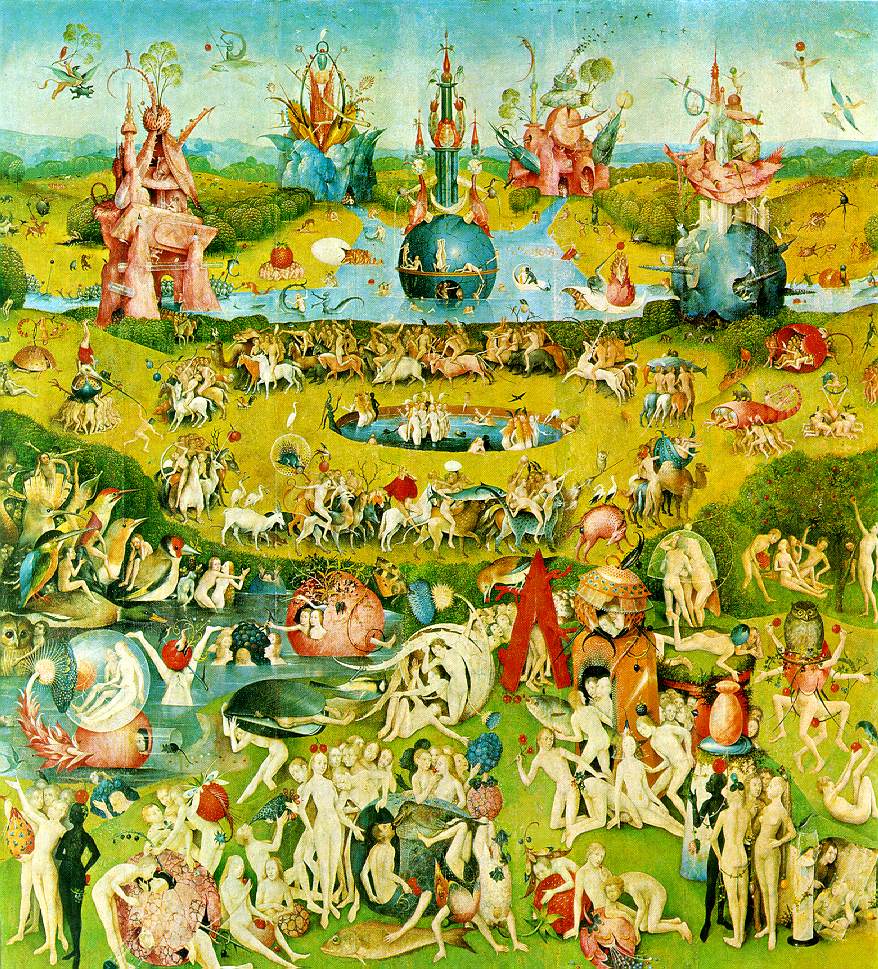
The Renaissance In European Art
During the European Renaissance, the depiction of the human form became more realistic. One could say this trend preceded the realism in fiction: before you could write "the human condition", you had to visualize it.
Here are some examples of Renaissance paintings. (Bear in mind that in those days there wasn't television or computers, so people gave these paintings a lot more attention than we'd do today.).
A 16th-century painting by Botticelli.
A 16th-century painting by Bosch.
A 16th-century painting by d'Aleccio.
Here are some examples of Renaissance paintings. (Bear in mind that in those days there wasn't television or computers, so people gave these paintings a lot more attention than we'd do today.).
A 16th-century painting by Botticelli.

A 16th-century painting by Bosch.
A 16th-century painting by d'Aleccio.
Thursday, February 09, 2006
The Frog And The Ox
There has been a lot of huffing and puffing in the media over some newspaper cartoons.
Let me tell you this fable by Aesop, and then ponder its meaning...
---------------------------
The Frog and the Ox
"Oh Father," said a little Frog to the big one sitting by the side of a pool, "I have seen such a terrible monster! It was as big as a mountain, with horns on its head, and a long tail, and it had hoofs divided in two."
"Tush, child, tush," said the old Frog, "that was only Farmer White's Ox. It isn't so big either; he may be a little bit taller than I, but I could easily make myself quite as broad; just you
see."
So the old Frog blew himself out, and blew himself out, and blew
himself out.
"Was he as big as that?" asked he.
"Oh, much bigger than that," said the young Frog.
Again the old one blew himself out, and asked the young one if the Ox was as big as that.
"Bigger, father, bigger," was the reply.
So the Frog took a deep breath, and blew and blew and blew,
and swelled and swelled and swelled.
And then he said: "I'm sure the Ox is not as big as --"
But at that moment he burst.
Self-conceit may lead to self-destruction.
---------------------------
Let me tell you this fable by Aesop, and then ponder its meaning...
---------------------------
The Frog and the Ox
"Oh Father," said a little Frog to the big one sitting by the side of a pool, "I have seen such a terrible monster! It was as big as a mountain, with horns on its head, and a long tail, and it had hoofs divided in two."
"Tush, child, tush," said the old Frog, "that was only Farmer White's Ox. It isn't so big either; he may be a little bit taller than I, but I could easily make myself quite as broad; just you
see."
So the old Frog blew himself out, and blew himself out, and blew
himself out.
"Was he as big as that?" asked he.
"Oh, much bigger than that," said the young Frog.
Again the old one blew himself out, and asked the young one if the Ox was as big as that.
"Bigger, father, bigger," was the reply.
So the Frog took a deep breath, and blew and blew and blew,
and swelled and swelled and swelled.
And then he said: "I'm sure the Ox is not as big as --"
But at that moment he burst.
Self-conceit may lead to self-destruction.
---------------------------
Monday, January 30, 2006
Quote: "Phony Review Writers Are The Dumbest On The Planet"
The above quote is taken from a discussion thread on the ASIMOV's Messageboard.
Phony book-reviews on Amazon.com are legion - but they are easy to spot. So why are they so badly written, so tacky, so transparently fake?
Because of stupidity. If a writer is so dumb as to not see the faults of his self-published books, he will be more than dumb enough to think he can write fake self-praise and get away with it.
It's like the old joke: "Why did the idiot jump from the Empire State Building? He wanted to be a big hit on Broadway."
How to spot phony reviews:
* Look for absurd comparisons like "Better than Harry Potter!", "up there with the Bible!";
* Fakers use weird phrasings like "the conclusion is implosive" or "this year's classic" or "philosophically action-packed";
* ANY book review that trumpets a book's great philosophical breakthroughs is a bit suspect;
* Fake or dubious credentials (i.e. referring to non-existent magazines or critics);
* Aggressive attacks on negative reviews;
* If you compare the reviewer's OTHER reviews, they are the same inflated praise of one single writer;
* The reviewer uses reviews of famous writers (such as J.K. Rowling) to sneak in "plugs" for the writer he fakes for (i.e. "Harry Potter is not as good as this book by X");
* The reviewer's name sounds phony, or he uses a pseudonym;
* He consistently gives 5 stars out of 5 for every book by a single writer.
If you are even THINKING of writing phony reviews of your own stuff... get out of my blog right now!
Phony book-reviews on Amazon.com are legion - but they are easy to spot. So why are they so badly written, so tacky, so transparently fake?
Because of stupidity. If a writer is so dumb as to not see the faults of his self-published books, he will be more than dumb enough to think he can write fake self-praise and get away with it.
It's like the old joke: "Why did the idiot jump from the Empire State Building? He wanted to be a big hit on Broadway."
How to spot phony reviews:
* Look for absurd comparisons like "Better than Harry Potter!", "up there with the Bible!";
* Fakers use weird phrasings like "the conclusion is implosive" or "this year's classic" or "philosophically action-packed";
* ANY book review that trumpets a book's great philosophical breakthroughs is a bit suspect;
* Fake or dubious credentials (i.e. referring to non-existent magazines or critics);
* Aggressive attacks on negative reviews;
* If you compare the reviewer's OTHER reviews, they are the same inflated praise of one single writer;
* The reviewer uses reviews of famous writers (such as J.K. Rowling) to sneak in "plugs" for the writer he fakes for (i.e. "Harry Potter is not as good as this book by X");
* The reviewer's name sounds phony, or he uses a pseudonym;
* He consistently gives 5 stars out of 5 for every book by a single writer.
If you are even THINKING of writing phony reviews of your own stuff... get out of my blog right now!
Saturday, January 28, 2006
The BONANZA Plot Problem
I'm sitting here by the computer, while the TV is showing an old BONANZA episode in the background... and suddenly it hits me:
The Cartwright Family is living in the most violent place on Earth.
I mean, people there get shot to death or otherwise killed EVERY WEEK! And it all happens in one small region of Nevada between Virginia City and the Ponderosa ranch.
Their ranch is supposed to be near Virginia City, Nevada, in the late 19th century.... but it looks much more like Bogota, Colombia, today. The Cartwrights are a regular death squad! They must have killed more people than Wyatt Earp. (If you're in a morbid mood, search on Wikipedia how many characters got killed over the course of the entire BONANZA series...)
If one watches a whole season of BONANZA, one gets the impression that every dysfunctional family with a violent patriarch, every gang of bank-robbers and cattle-thieves, every rapist, cutthroat, lowlife and scumbag, is just flocking to the Cartwrights' spacious back yard.
(Which begs the question: why don't the Cartwrights move to a more peaceful county?)
And if we were to take the BONANZA Situation realistically, all this violence would have consequences:
1. Law-abiding families and businesses would move out in droves, making Virginia City an
impoverished slum -- or worse, a ghost town;
2. The local Congressman would go to Washington, D.C. and ask for Federal intervention: "Every seven days it's the same -- The Cartwrights kill people! We need a permanent U.S. Cavalry base to keep the order in this den of crime and gunfire!"
3. Someone would start a criminal investigation of the Cartwrights: "The whole area is littered with spent casings from Colt cartridges. A firing test shows that they match the guns of the Cartwright brothers. Take'em in for questioning!"
4. The psychological stress of living in this world of almost constant shootings, beatings and deaths would cause the brothers to go crazy, suicidally depressed, or psychopathic. But considering the ease with which they kill people and shrug it off -- plus the fact that all their girlfriends get killed or escape -- they may always have been psychopaths.
Jokes aside... this is a generic plot problem with almost any TV series, and sometimes shows up in novels too. If you concentrate too many dramatic events in a very small time and space, the plot becomes too far-fetched. (*COUGH*24*COUGH*)
(The exception is if the story is meant to be comedy, spoof, send-up, camp or satire.)
Now, the real reason why TV shows have too little "space" for the action is that locations and sets cost money. Money is the big "hidden variable" of television, and causes TV scriptwriters great headaches:
"How can we afford to send our heroes to Paris this week? I know: Let's skip new locations and travel entirely! We'll have everything happen in L.A. in realtime!"
(And thus, 24 was born...)
Written fiction, on the other hand, can afford its characters to travel around a lot more. And travel itself extends the time of the story, which eliminates much of the "time-compression" problem seen in BONANZA and other shows. (*COUGH*24*COUGH*).
Even so: novel writers watch TV (I do -- way too much ;-)), and thus they might pick up some bad plotting habits from television writers.
You shouldn't compress too much action and plot into too little space and time.
In the real world, the space of a normal human lifetime includes very few dramatic events like fights, violent deaths, dramatic accidents and such.
If you want to write a plot full of action, you must set up a situation in which this makes sense. (War is one such situation where lots of drama and violence is credible. Other situations with dramatic potential are revolution, social upheaval, or natural disasters.)
The Cartwright Family is living in the most violent place on Earth.
I mean, people there get shot to death or otherwise killed EVERY WEEK! And it all happens in one small region of Nevada between Virginia City and the Ponderosa ranch.
Their ranch is supposed to be near Virginia City, Nevada, in the late 19th century.... but it looks much more like Bogota, Colombia, today. The Cartwrights are a regular death squad! They must have killed more people than Wyatt Earp. (If you're in a morbid mood, search on Wikipedia how many characters got killed over the course of the entire BONANZA series...)
If one watches a whole season of BONANZA, one gets the impression that every dysfunctional family with a violent patriarch, every gang of bank-robbers and cattle-thieves, every rapist, cutthroat, lowlife and scumbag, is just flocking to the Cartwrights' spacious back yard.
(Which begs the question: why don't the Cartwrights move to a more peaceful county?)
And if we were to take the BONANZA Situation realistically, all this violence would have consequences:
1. Law-abiding families and businesses would move out in droves, making Virginia City an
impoverished slum -- or worse, a ghost town;
2. The local Congressman would go to Washington, D.C. and ask for Federal intervention: "Every seven days it's the same -- The Cartwrights kill people! We need a permanent U.S. Cavalry base to keep the order in this den of crime and gunfire!"
3. Someone would start a criminal investigation of the Cartwrights: "The whole area is littered with spent casings from Colt cartridges. A firing test shows that they match the guns of the Cartwright brothers. Take'em in for questioning!"
4. The psychological stress of living in this world of almost constant shootings, beatings and deaths would cause the brothers to go crazy, suicidally depressed, or psychopathic. But considering the ease with which they kill people and shrug it off -- plus the fact that all their girlfriends get killed or escape -- they may always have been psychopaths.
Jokes aside... this is a generic plot problem with almost any TV series, and sometimes shows up in novels too. If you concentrate too many dramatic events in a very small time and space, the plot becomes too far-fetched. (*COUGH*24*COUGH*)
(The exception is if the story is meant to be comedy, spoof, send-up, camp or satire.)
Now, the real reason why TV shows have too little "space" for the action is that locations and sets cost money. Money is the big "hidden variable" of television, and causes TV scriptwriters great headaches:
"How can we afford to send our heroes to Paris this week? I know: Let's skip new locations and travel entirely! We'll have everything happen in L.A. in realtime!"
(And thus, 24 was born...)
Written fiction, on the other hand, can afford its characters to travel around a lot more. And travel itself extends the time of the story, which eliminates much of the "time-compression" problem seen in BONANZA and other shows. (*COUGH*24*COUGH*).
Even so: novel writers watch TV (I do -- way too much ;-)), and thus they might pick up some bad plotting habits from television writers.
You shouldn't compress too much action and plot into too little space and time.
In the real world, the space of a normal human lifetime includes very few dramatic events like fights, violent deaths, dramatic accidents and such.
If you want to write a plot full of action, you must set up a situation in which this makes sense. (War is one such situation where lots of drama and violence is credible. Other situations with dramatic potential are revolution, social upheaval, or natural disasters.)
Sunday, January 22, 2006
Listen To Jonathan Sherwood..
Jonathan Sherwood, an American writer who's been published in ASIMOV's, has a great column on writing. If you are the least bit serious about writing fiction, read it.
Here is a quote from Sherwood's column "Forget the Audience, Who Are You Writing For?" which ought to be required reading:
------------------------
1) You’re writing so readers will say, “You’re cool.”
2) You’re writing so readers will say, “This story is cool.”
3) You’re writing so readers will say, “Life is cool.”
------------------------
The 3 levels of a writer's maturity. Read the rest.
Here is a quote from Sherwood's column "Forget the Audience, Who Are You Writing For?" which ought to be required reading:
------------------------
1) You’re writing so readers will say, “You’re cool.”
2) You’re writing so readers will say, “This story is cool.”
3) You’re writing so readers will say, “Life is cool.”
------------------------
The 3 levels of a writer's maturity. Read the rest.
Thursday, January 12, 2006
The Soundtrack Of Our Lives
Tell you a secret: I don't really write stories.
I make music videos in my mind.
Then I try to transfer them into written text. (It doesn't always succeed.) The result is a novel, or short story.
That's why I almost never write a longer story or novel without listening to inspirational music. It's the soundtrack of the video I'm composing in my head.
(You should ask other people who write, if they also work this way... I'd really like to know.)
Right now I'm listening to Robyn's latest album, and thinking: "Now, what stories would go with these songs...?" I'm sure I'll think of something. (Thanks, Robyn.)
I make music videos in my mind.
Then I try to transfer them into written text. (It doesn't always succeed.) The result is a novel, or short story.
That's why I almost never write a longer story or novel without listening to inspirational music. It's the soundtrack of the video I'm composing in my head.
(You should ask other people who write, if they also work this way... I'd really like to know.)
Right now I'm listening to Robyn's latest album, and thinking: "Now, what stories would go with these songs...?" I'm sure I'll think of something. (Thanks, Robyn.)
Sunday, January 08, 2006
Actual Quotes From The Slushpile...
Whenever my confidence in my writing abilities gets low (such as when I proofread my own stuff), it helps to think that many others are more confident but less talented...
Look at these actual quotes from the slushpile of magazine ASIMOV's Science Fiction. You can't make this stuff up! (From the blog of Miss Snark, the literary agent.)
My favorite quotes from the collection:
"Weston was known for the firm but genital hold he had on his men. It was one of the reasons he was chosen for this mission over six other equally qualified men. "
(Ouch!)
"The two naked bodies, which were lying beneath the satin sheets, were no longer the people whom everyone, who was anyone, knew whenever reality was in existance. "
(Say what??)
"Sudenly, all the eyes in the room rose from their fixed positions on the floor to stare at him. "
(That last one MIGHT have been quoted from a science-fiction story about a planet of living floors... but I'm not sure. ;-))
Look at these actual quotes from the slushpile of magazine ASIMOV's Science Fiction. You can't make this stuff up! (From the blog of Miss Snark, the literary agent.)
My favorite quotes from the collection:
"Weston was known for the firm but genital hold he had on his men. It was one of the reasons he was chosen for this mission over six other equally qualified men. "
(Ouch!)
"The two naked bodies, which were lying beneath the satin sheets, were no longer the people whom everyone, who was anyone, knew whenever reality was in existance. "
(Say what??)
"Sudenly, all the eyes in the room rose from their fixed positions on the floor to stare at him. "
(That last one MIGHT have been quoted from a science-fiction story about a planet of living floors... but I'm not sure. ;-))
Wednesday, January 04, 2006
Humiliation Of Writers
Writers who are experiencing their first success must be prepared for humiliating experiences.
Well-meaning persons will ask you things like, "So you'll be rich now?" (Though I think that's thinly disguised sarcasm.)
Tobias S. Buckell and Justine Larbalestier share their humiliations with us. I salute their courage.
Well-meaning persons will ask you things like, "So you'll be rich now?" (Though I think that's thinly disguised sarcasm.)
Tobias S. Buckell and Justine Larbalestier share their humiliations with us. I salute their courage.
Sunday, January 01, 2006
Happy New Year!
My 2006 New Year's resolutions:
1. Lose 10 kilos overweight.
2. Finish my first "military SF" novel, THE TALE OF THE SOLDIESSE.
3. Get more fiction published in China.
4. Start working on my third TERRA HEXA novel to come out in Sweden.
5. Sell my first TERRA HEXA novel to a publisher outside Sweden (perhaps China???)
6. Sell my SF movie script, THE FATHER MACHINE.
7. Start working on an SF novel for the India market.
8. Piss on Saddam Hussein's grave. ;-)
9. Get a new girlfriend.
Aaand...
10. Read through my pile of unread books and magazines.
Happy New Year, folks!
1. Lose 10 kilos overweight.
2. Finish my first "military SF" novel, THE TALE OF THE SOLDIESSE.
3. Get more fiction published in China.
4. Start working on my third TERRA HEXA novel to come out in Sweden.
5. Sell my first TERRA HEXA novel to a publisher outside Sweden (perhaps China???)
6. Sell my SF movie script, THE FATHER MACHINE.
7. Start working on an SF novel for the India market.
8. Piss on Saddam Hussein's grave. ;-)
9. Get a new girlfriend.
Aaand...
10. Read through my pile of unread books and magazines.
Happy New Year, folks!
Thursday, December 29, 2005
King Kong As A Dirty Old Man
During the Xmas holidays, I and some of my relatives went to the cinema. My sister and her hubby went to see Disney's NARNIA movie, while me and my old mother went to see Peter Jackson's KING KONG remake.
Mom walked out halfway through KING KONG, saying out loud: "This is ridiculous."
(That was a bad sign. Normally she loves science fiction films.)
When the heroine started climbing after Kong up the skyscraper, I was tempted to walk out, too.
And just before Kong fell off the skyscraper, when Kong and the heroine exchanged looooooong teary-eyed looks, I thought: "If they start French-kissing, I'm OUTTA here." But, having paid good money (and being a cheapskate) I stayed through the entire film. It didn't improve.
Why does this remake fail as a coherent piece of storytelling? The easy answer is, it's too badly pieced together, overlong, and full of inconsistencies. (For example, how did the natives suddenly disappear from Skull Island?)
But personally, I reacted most strongly to the significance of making Kong an old, aging gorilla instead of a monster-as-primal-force-of-nature. Briefly put, Peter Jackson's KING KONG is a "Horny Old Man" plot.
Look: here you've got this hot young thing visibly and explicitly falling in love with a grumpy, scarred old gorilla with a human personality. This is a completely different Kong from the 1933 and 1976 versions. Both previous versions made Kong a beast in his prime, a larger-than-life figure.
Also, in Jackson's version, the young heroine is more in love with than she's sensibly afraid of a giant hungry monster who might kill her just as well as play with her.
In other words, when you ask yourself "What's it all about?" you think "It's about an ugly old man needing the love of a much younger and prettier person, and how to make this seem noble, romantic and rebellious - despite the fact that it's so overwrought, self-righteous and downright perverse."
It's the kind of plot that Bernardo Bertolucci did in LAST TANGO IN PARIS, or perhaps Thomas Mann with DEATH IN VENICE.
I loathe "Horny Old Man" plots! They pander to dirty old men, and I'm not one.
Also, the ending of Jackson's KING KONG is a big stinking lie. It wasn't "Beauty killed the Beast" in this version. It's the director Carl Denham - a metaphor for the director of KING KONG if there ever was one - who, against the forceful protests of the heroine, captured Kong and brought him to New York. And yet he says "It was Beauty killed the Beast" and we're supposed to believe it. I didn't.
So what went wrong?
Well, it appears the scriptwriters and the director got confused about what their story is "about"... and precisely for that reason, because they didn't really know the meaning of the story they wanted to tell, it turned into a "Horny Old Man" story. How exactly this came to pass is beyond me (Peter Jackson isn't that old) ... but maybe they took the "Kong" character too literally - he's supposed to be a monster, not a real person.
And what are monsters? Emblems of fear and guilt...
When you miss the point of a metaphor and interpret it literally - "he's this big gorilla, and there's just one of him, so logically he must be old and lonely"- you get fundamentalism, shallowness and ultimately stupidity.
Now go see the original version. It makes more sense - and it's less racist, too. Yes, it's true. Watch that scene in the 1933 version, where the Skull Island natives and Denham's expedition work together to block the gate that keeps Kong out. It shows, without the need for lofty speeches, that the natives and the "whites" are in the same boat.
But in Jackson's version, the natives are monsters - mindless, vicious murderers, totally without redeeming features, barely human - and so Jackson tacks on an idiotic, phony "message" bit just at the end, and thinks he's taken a stand against racism.
(Yeah, it's the scene where a bystander says Kong pointlessly climbed the tower because he was one of those dumb animals who can't think... while a single African-American man walks past to imply that the bystander is "really" talking about him. The pot calling the kettle black, eh, Mr. Jackson?)
-----------------------------
UPDATE:
Lucius Shepard has a very good (negative) review of the film here:
"Everybody Loves-a Da Big Monkey"
Mom walked out halfway through KING KONG, saying out loud: "This is ridiculous."
(That was a bad sign. Normally she loves science fiction films.)
When the heroine started climbing after Kong up the skyscraper, I was tempted to walk out, too.
And just before Kong fell off the skyscraper, when Kong and the heroine exchanged looooooong teary-eyed looks, I thought: "If they start French-kissing, I'm OUTTA here." But, having paid good money (and being a cheapskate) I stayed through the entire film. It didn't improve.
Why does this remake fail as a coherent piece of storytelling? The easy answer is, it's too badly pieced together, overlong, and full of inconsistencies. (For example, how did the natives suddenly disappear from Skull Island?)
But personally, I reacted most strongly to the significance of making Kong an old, aging gorilla instead of a monster-as-primal-force-of-nature. Briefly put, Peter Jackson's KING KONG is a "Horny Old Man" plot.
Look: here you've got this hot young thing visibly and explicitly falling in love with a grumpy, scarred old gorilla with a human personality. This is a completely different Kong from the 1933 and 1976 versions. Both previous versions made Kong a beast in his prime, a larger-than-life figure.
Also, in Jackson's version, the young heroine is more in love with than she's sensibly afraid of a giant hungry monster who might kill her just as well as play with her.
In other words, when you ask yourself "What's it all about?" you think "It's about an ugly old man needing the love of a much younger and prettier person, and how to make this seem noble, romantic and rebellious - despite the fact that it's so overwrought, self-righteous and downright perverse."
It's the kind of plot that Bernardo Bertolucci did in LAST TANGO IN PARIS, or perhaps Thomas Mann with DEATH IN VENICE.
I loathe "Horny Old Man" plots! They pander to dirty old men, and I'm not one.
Also, the ending of Jackson's KING KONG is a big stinking lie. It wasn't "Beauty killed the Beast" in this version. It's the director Carl Denham - a metaphor for the director of KING KONG if there ever was one - who, against the forceful protests of the heroine, captured Kong and brought him to New York. And yet he says "It was Beauty killed the Beast" and we're supposed to believe it. I didn't.
So what went wrong?
Well, it appears the scriptwriters and the director got confused about what their story is "about"... and precisely for that reason, because they didn't really know the meaning of the story they wanted to tell, it turned into a "Horny Old Man" story. How exactly this came to pass is beyond me (Peter Jackson isn't that old) ... but maybe they took the "Kong" character too literally - he's supposed to be a monster, not a real person.
And what are monsters? Emblems of fear and guilt...
When you miss the point of a metaphor and interpret it literally - "he's this big gorilla, and there's just one of him, so logically he must be old and lonely"- you get fundamentalism, shallowness and ultimately stupidity.
Now go see the original version. It makes more sense - and it's less racist, too. Yes, it's true. Watch that scene in the 1933 version, where the Skull Island natives and Denham's expedition work together to block the gate that keeps Kong out. It shows, without the need for lofty speeches, that the natives and the "whites" are in the same boat.
But in Jackson's version, the natives are monsters - mindless, vicious murderers, totally without redeeming features, barely human - and so Jackson tacks on an idiotic, phony "message" bit just at the end, and thinks he's taken a stand against racism.
(Yeah, it's the scene where a bystander says Kong pointlessly climbed the tower because he was one of those dumb animals who can't think... while a single African-American man walks past to imply that the bystander is "really" talking about him. The pot calling the kettle black, eh, Mr. Jackson?)
-----------------------------
UPDATE:
Lucius Shepard has a very good (negative) review of the film here:
"Everybody Loves-a Da Big Monkey"
Thursday, December 22, 2005
My Short Story in BYZARIUM
The webzine BYZARIUM bought and published my short horror story "Nightmare Number Six" in it December 2005 issue.
Read it for free here.
(The story's title was inspired by Robert Bloch's story-poem "Nightmare Number Four".)
Read it for free here.
(The story's title was inspired by Robert Bloch's story-poem "Nightmare Number Four".)
Films About Writers & Writing
I like film just as much as reading and writing. Trying to depict the writing process on film is rarely successful, since most of the "action" takes place in the writer's mind.
But here are some interesting, entertaining (and scary) movies about writers and the writing process:
WONDER BOYS (2000) - Based on the novel by Michael Chabon, this movie is really about procrastination and aging. The protagonist has been stuck on his unfinished Great American Novel for years, while younger and hungrier colleagues are experiencing their first major success. How does one fail gracefully? A love song to the loser in every writer.
IN THE MOUTH OF MADNESS, (a.k.a. JOHN CARPENTER'S IN THE MOUTH OF MADNESS (1994)) - This is a guilty pleasure. A horror hackwriter, inspired by Stephen King and H.P.Lovecraft, becomes so successful that his books become real. Silly, yes, but makes you think about what fiction means to people.
MISERY (2000) - based on Stephen King's novel, this is a writer's own personal nightmare: the crazed fan who won't let him "bury" a popular character - she'd rather bury him!
BARTON FINK (1991) - may not be to everyone's taste, but it has several interesting things to say. First, this writer protagonist is an unpleasant, pretentious character - he thinks he's writing for "the common man" but he's not. Second, it portrays a writer who sells out to Hollywood - and fails. Third, it deals with writer's block.
Enjoy these movies when you're stuck in your own writing...
But here are some interesting, entertaining (and scary) movies about writers and the writing process:
WONDER BOYS (2000) - Based on the novel by Michael Chabon, this movie is really about procrastination and aging. The protagonist has been stuck on his unfinished Great American Novel for years, while younger and hungrier colleagues are experiencing their first major success. How does one fail gracefully? A love song to the loser in every writer.
IN THE MOUTH OF MADNESS, (a.k.a. JOHN CARPENTER'S IN THE MOUTH OF MADNESS (1994)) - This is a guilty pleasure. A horror hackwriter, inspired by Stephen King and H.P.Lovecraft, becomes so successful that his books become real. Silly, yes, but makes you think about what fiction means to people.
MISERY (2000) - based on Stephen King's novel, this is a writer's own personal nightmare: the crazed fan who won't let him "bury" a popular character - she'd rather bury him!
BARTON FINK (1991) - may not be to everyone's taste, but it has several interesting things to say. First, this writer protagonist is an unpleasant, pretentious character - he thinks he's writing for "the common man" but he's not. Second, it portrays a writer who sells out to Hollywood - and fails. Third, it deals with writer's block.
Enjoy these movies when you're stuck in your own writing...
Wednesday, December 21, 2005
Feedback - Rules Of Thumb
Not all editors give you a pre-written rejection slip.
Some offer substantial constructive feedback, and suggestions for improvement. I'm glad when I receive such feedback, even when I don't agree with all suggestions.
Now, receiving reader/editor feedback is a test of your true character....
If you can't bring yourself to listen to ANY suggestion, no matter how trivial, you're a crank. Cranks rarely write stuff that others want to read.
If you mindlessly accept ANY suggestion, no matter how absurd, you're spineless. You'll become a rich, successful Hollywood script-hack -- but you'll never be a good writer. (Cry all the way to the bank.)
So how do you know if a suggestion is worth listening to? A few rules of thumb:
1. Always, ALWAYS take spelling advice seriously. I don't care if you've got a degree in linguistics, I don't care if you won the 1994 national spelling bee - look it up in a dictionary.
2. When someone suggests that a character name or the story/novel title should be changed, it could be either good or bad advice. People can show unbelievably bad judgment in their choice of names - just look at the names some people give their own babies! Trust your instincts.
3. Plot changes: If the suggested change makes the plot more difficult to follow, REJECT it. If the suggested change makes the plot easier to follow, CONSIDER or ACCEPT it.
4. Never take writing advice from your parents. (Never ask them.)
Some offer substantial constructive feedback, and suggestions for improvement. I'm glad when I receive such feedback, even when I don't agree with all suggestions.
Now, receiving reader/editor feedback is a test of your true character....
If you can't bring yourself to listen to ANY suggestion, no matter how trivial, you're a crank. Cranks rarely write stuff that others want to read.
If you mindlessly accept ANY suggestion, no matter how absurd, you're spineless. You'll become a rich, successful Hollywood script-hack -- but you'll never be a good writer. (Cry all the way to the bank.)
So how do you know if a suggestion is worth listening to? A few rules of thumb:
1. Always, ALWAYS take spelling advice seriously. I don't care if you've got a degree in linguistics, I don't care if you won the 1994 national spelling bee - look it up in a dictionary.
2. When someone suggests that a character name or the story/novel title should be changed, it could be either good or bad advice. People can show unbelievably bad judgment in their choice of names - just look at the names some people give their own babies! Trust your instincts.
3. Plot changes: If the suggested change makes the plot more difficult to follow, REJECT it. If the suggested change makes the plot easier to follow, CONSIDER or ACCEPT it.
4. Never take writing advice from your parents. (Never ask them.)
Tuesday, November 29, 2005
Men Writing Women, Women Writing Men
Should you expect male writers to be better at depicting male characters than female characters? What about women writers? Does every writer reveal his/her gender bias in prose?
This is a fascinating subject - read the discussion thread on the ASIMOV's Messageboard, where I put in a comment.
The gist of my argument in that thread is that any character must be placed in a believable context(setting) to make sense. Stereotypes become all the more glaring if they occur in a setting where you wouldn't expect to find them in the first place.
Of course a female character can be wimpy, helpless and neurotic - if you put her in a credible setting. For example in the upper middle class, a mental institution, or in serious trouble.
But if you place her in a spaceship crew going to Mars, she's a stereotype. (Helpless, neurotic persons can't become astronauts.)
Another common example is when characters in a historical context behave in a way that is too modern for the setting. I read one of Jean M. Auel's novel Stone Age romances (as a teenager, you learned to find the sexy parts), I reacted to this: one Stone Age character talks about being "depressed".
The term "depressed" implies a whole apparatus of knowledge, culture and ideas of the human psyche which plain couldn't exist 30-50,000 years ago. Prehistoric people didn't know what a "mind" was, and the earliest written stories (THE ILIAD, GILGAMESH etc.) suggest very different concept of the "soul".
Homer would not speak of "depression". With that word, the character reveals itself as out-of-place in the Stone Age setting, just as if she had said "Got some Prozac?"
When you write a character, remember: the more out-of-place your characters seem, the more your story resembles comedy. If it is comedy you want to write, that's fine...
This is a fascinating subject - read the discussion thread on the ASIMOV's Messageboard, where I put in a comment.
The gist of my argument in that thread is that any character must be placed in a believable context(setting) to make sense. Stereotypes become all the more glaring if they occur in a setting where you wouldn't expect to find them in the first place.
Of course a female character can be wimpy, helpless and neurotic - if you put her in a credible setting. For example in the upper middle class, a mental institution, or in serious trouble.
But if you place her in a spaceship crew going to Mars, she's a stereotype. (Helpless, neurotic persons can't become astronauts.)
Another common example is when characters in a historical context behave in a way that is too modern for the setting. I read one of Jean M. Auel's novel Stone Age romances (as a teenager, you learned to find the sexy parts), I reacted to this: one Stone Age character talks about being "depressed".
The term "depressed" implies a whole apparatus of knowledge, culture and ideas of the human psyche which plain couldn't exist 30-50,000 years ago. Prehistoric people didn't know what a "mind" was, and the earliest written stories (THE ILIAD, GILGAMESH etc.) suggest very different concept of the "soul".
Homer would not speak of "depression". With that word, the character reveals itself as out-of-place in the Stone Age setting, just as if she had said "Got some Prozac?"
When you write a character, remember: the more out-of-place your characters seem, the more your story resembles comedy. If it is comedy you want to write, that's fine...
Friday, October 28, 2005
"Nobody Sleeps With The Writer"(2)
Well, the script reader turned down THE FATHER MACHINE... but she had lots of really good advice on how to improve it, and encouraged me to do so.
Considering it was my first movie script ever, I'm upbeat. I'll rewrite the script... :)
Considering it was my first movie script ever, I'm upbeat. I'll rewrite the script... :)
Saturday, October 22, 2005
"Nobody Sleeps With The Writer"
There's a saying in Hollywood: "Nobody sleeps with the writer."
I try to bear that in mind while I wait for the response from a minor movie-production company.
Said company asked my agent to send over my movie script THE FATHER MACHINE.
The script was based on a comic-strip I published in the 1990s in the defunct Swedish comic-book SVENSKA SERIER (literally "Swedish Comics"). A plot summary can be found here.
Will they buy the script? I'm not going to lose sleep over that! But it was fun to try and write a script... I Googled the websites that post classic movie manuscripts, so I could learn how the pros write.
I try to bear that in mind while I wait for the response from a minor movie-production company.
Said company asked my agent to send over my movie script THE FATHER MACHINE.
The script was based on a comic-strip I published in the 1990s in the defunct Swedish comic-book SVENSKA SERIER (literally "Swedish Comics"). A plot summary can be found here.
Will they buy the script? I'm not going to lose sleep over that! But it was fun to try and write a script... I Googled the websites that post classic movie manuscripts, so I could learn how the pros write.
Monday, October 03, 2005
Notes From The BOK & BIBLIOTEK 2005 Tradeshow
I was in the booth of Wela Förlag at the BOK & BIBLIOTEK book tradeshow during the last days of September+first days of October. It's a pretty big event held in Gothenburg, Sweden every year.
I'm rather tired after standing there in the booth for 4 days straight, but some memories are still vivid:
-A woman told me that both her husband AND daughter are reading my novel TERRA HEXA with equal enthusiasm... from a portable computer (PDA) screen. (They wanted her to buy the printed book, though.)
-An old man in a dirty overcoat asked me whether the title "TERRA HEXA" has something to do with witches ("häxa" in Swedish means "witch").
When I gently explained that "Hexa" is Latin for "six"(pronounced "sex" in Swedish), he then said the book must have "sexy" content. I asked him (not so gently) to leave.
-A young woman who had read my novel and liked it, asked me when the sequel would be out. (Next year.)
-A strange, fat young man said I should hire him to draw a comic-book based on my novel. He showed me drawings that would have embarrassed a 7-year-old. When I gently (honestly!) told him I'd prefer a more experienced artist, he walked three steps to the booth right next to ours, and repeated his sales pitch!
-People really liked the marzipan I had made for the occasion and was giving away for free. (It was supposed to be blue, like my book-cover, but turned out poison-green.)
-A sales rep from the big distributor Richters (a.k.a. Damm) was impressed by hearing I'd been published in China, and received a copy of TERRA HEXA for review.
-I met some people I hadn't seen in a while, and located an old classmate I had been trying to find for several years. (He has a very common name. Imagine trying to find "Tom Smith" in a U.S. phonebook.)
All in all a nice experience, and I'll be there again next year.
:)
I'm rather tired after standing there in the booth for 4 days straight, but some memories are still vivid:
-A woman told me that both her husband AND daughter are reading my novel TERRA HEXA with equal enthusiasm... from a portable computer (PDA) screen. (They wanted her to buy the printed book, though.)
-An old man in a dirty overcoat asked me whether the title "TERRA HEXA" has something to do with witches ("häxa" in Swedish means "witch").
When I gently explained that "Hexa" is Latin for "six"(pronounced "sex" in Swedish), he then said the book must have "sexy" content. I asked him (not so gently) to leave.
-A young woman who had read my novel and liked it, asked me when the sequel would be out. (Next year.)
-A strange, fat young man said I should hire him to draw a comic-book based on my novel. He showed me drawings that would have embarrassed a 7-year-old. When I gently (honestly!) told him I'd prefer a more experienced artist, he walked three steps to the booth right next to ours, and repeated his sales pitch!
-People really liked the marzipan I had made for the occasion and was giving away for free. (It was supposed to be blue, like my book-cover, but turned out poison-green.)
-A sales rep from the big distributor Richters (a.k.a. Damm) was impressed by hearing I'd been published in China, and received a copy of TERRA HEXA for review.
-I met some people I hadn't seen in a while, and located an old classmate I had been trying to find for several years. (He has a very common name. Imagine trying to find "Tom Smith" in a U.S. phonebook.)
All in all a nice experience, and I'll be there again next year.
:)
Monday, September 19, 2005
Avast, mates! 'Tis Talk Like A Pirate Day!
Ahoy, landlubbers! If ye happen to see many pirates in yer town today, it be because September 19 be Talk Like A Pirate Day.
So be a mate, lads and lasses, and talk like a pirate today! Arrr!
:)
So be a mate, lads and lasses, and talk like a pirate today! Arrr!
:)
Saturday, September 03, 2005
All Writers Are Liars, Especially If They Claim To Be Exiled Nigerians
I get a load of Nigerian Banking Scam e-mails every day... today I received the first one which actually used my name.
I was insulted and annoyed, that a fellow writer of outrageous fictions could think I wouldn't be able to tell a fiction from the truth. How unprofessional! How gauche!
Now, I'm not saying the "Banking Scam" people aren't gifted writers, in their narrow field. They have a certain skill in coming up with variations on the tired theme "I can make you rich tomorrow if you send me money today." And it's hard to really feel sorry for the fools who are greedy enough to fall for such an obvious lie.
I even wrote a satire of the email scam, in the horror story "The Last Weblog Of Jonathan Lippincott."
But I would never go so far as to suggest, as in this bizarre tale, that a paid agent should seek out the scammers and... make them go away.
No, I'm convinced that a little voodoo curse I picked up from my relatives in Kap Verde will suffice. Soon, grave and inexplicable misfortune will befall the Nigerian Banking scammers who tried to approach me. Their teeth will rot and fall out. Their children will fall sick. Their parents will die in mysterious accidents. The scammer who wrote the email to me will suffer the greatest curse of all: his genitals will shrivel and die away, and his body will emit a disgusting smell which drives away all people around him.
This will happen, and nothing can stop it. Would I lie to a con artist?
I was insulted and annoyed, that a fellow writer of outrageous fictions could think I wouldn't be able to tell a fiction from the truth. How unprofessional! How gauche!
Now, I'm not saying the "Banking Scam" people aren't gifted writers, in their narrow field. They have a certain skill in coming up with variations on the tired theme "I can make you rich tomorrow if you send me money today." And it's hard to really feel sorry for the fools who are greedy enough to fall for such an obvious lie.
I even wrote a satire of the email scam, in the horror story "The Last Weblog Of Jonathan Lippincott."
But I would never go so far as to suggest, as in this bizarre tale, that a paid agent should seek out the scammers and... make them go away.
No, I'm convinced that a little voodoo curse I picked up from my relatives in Kap Verde will suffice. Soon, grave and inexplicable misfortune will befall the Nigerian Banking scammers who tried to approach me. Their teeth will rot and fall out. Their children will fall sick. Their parents will die in mysterious accidents. The scammer who wrote the email to me will suffer the greatest curse of all: his genitals will shrivel and die away, and his body will emit a disgusting smell which drives away all people around him.
This will happen, and nothing can stop it. Would I lie to a con artist?
Wednesday, August 31, 2005
Happy Blog Day!
Today, Aug.31 2005, is Blog Day - so here are five links to weblogs which I think deserve attention (and which relate to the theme of this blog - the craft of writing).
Have a Bloggerful Day!
1. GapingVoid: "How To Be Creative"
2. 14theditch - the weblog of writer Jeffrey Ford
3. Iowahawk: "Ingmar Bergman's 'Hazardous Dukes'" (a parody in which the Swedish film classic THE SEVENTH SEAL is crossed with the redneck TV-show THE DUKES OF HAZZARD)
4. MoorishGirl - the weblog of writer Laila Lalami
5. Conversational Reading - the weblog of writer Scott Esposito
Have a Bloggerful Day!
1. GapingVoid: "How To Be Creative"
2. 14theditch - the weblog of writer Jeffrey Ford
3. Iowahawk: "Ingmar Bergman's 'Hazardous Dukes'" (a parody in which the Swedish film classic THE SEVENTH SEAL is crossed with the redneck TV-show THE DUKES OF HAZZARD)
4. MoorishGirl - the weblog of writer Laila Lalami
5. Conversational Reading - the weblog of writer Scott Esposito
Tuesday, August 30, 2005
Losing Your Nerve
You're probably familiar with the myth that drugs and drink "stimulate creativity."
I think the myth confuses "creativity" with "nerve." When a man has to get drunk before he dares to approach a woman and talk to her, he might tell himself and others: "Alcohol shtimulates my libido!" But his real problem is, he's afraid. And we know what alcohol really does to the libido.
The issue, then, is fear. Fear of failure, fear of rejection, fear of imperfection (the most paralyzing of all anxieties), fear of ridicule. Writing skill is a combination of abilities, but losing your nerve can wreck your writing life completely.
It fascinates me how individuals are prepared to risk their health in the most reckless manner possible - drunk driving, bungee jumping, walking on the edges of rooftops, paintball fights... but ask them to read a speech (or sing a song) before a live audience, and they freeze up with terror.
Talk about keeping your priorities straight! :)
Ditto with writing fiction: would-be writers and active writers alike are gripped by paralyzing fear. What to do?
I'm no psychiatrist... but why not try this:
1. Write under a pen name. If you're afraid of having your name associated with (and shamed by) your novel, use a pseudonym. Like a clown mask, it provides a measure of ego protection. And in any case, "Rex Mackenzie" is a cooler writer name than "Melvin Poznovski."
2. Regression therapy. Imagine yourself as a kid playing with crayons or Lego. You're eight years old, and you write. See what happens. (Then grow up. You can't remain a child forever.)
3. Listen to really loud rock music while you write. It works for others. It can work for you. (Be careful so you don't damage your ears, though.)
I think the myth confuses "creativity" with "nerve." When a man has to get drunk before he dares to approach a woman and talk to her, he might tell himself and others: "Alcohol shtimulates my libido!" But his real problem is, he's afraid. And we know what alcohol really does to the libido.
The issue, then, is fear. Fear of failure, fear of rejection, fear of imperfection (the most paralyzing of all anxieties), fear of ridicule. Writing skill is a combination of abilities, but losing your nerve can wreck your writing life completely.
It fascinates me how individuals are prepared to risk their health in the most reckless manner possible - drunk driving, bungee jumping, walking on the edges of rooftops, paintball fights... but ask them to read a speech (or sing a song) before a live audience, and they freeze up with terror.
Talk about keeping your priorities straight! :)
Ditto with writing fiction: would-be writers and active writers alike are gripped by paralyzing fear. What to do?
I'm no psychiatrist... but why not try this:
1. Write under a pen name. If you're afraid of having your name associated with (and shamed by) your novel, use a pseudonym. Like a clown mask, it provides a measure of ego protection. And in any case, "Rex Mackenzie" is a cooler writer name than "Melvin Poznovski."
2. Regression therapy. Imagine yourself as a kid playing with crayons or Lego. You're eight years old, and you write. See what happens. (Then grow up. You can't remain a child forever.)
3. Listen to really loud rock music while you write. It works for others. It can work for you. (Be careful so you don't damage your ears, though.)
Wednesday, August 24, 2005
THE LAST MAN ON EARTH (who hasn't read THE DA VINCI CODE)
Yep, that's me. I'll wait for the movie. Got other books to read. No, I'm not Catholic, not fanatically devoted to the Pope, not part of the Spanish Inquisition... just not interested in yet another conspiracy theory involving the Vatican.
To further convince me that I should remain The Last Man On Earth who hasn't read that bestselling novel, here is Geoffrey K. Pullum's analysis (or should I say evisceration) of the mangled language, style and syntax in THE DA VINCI CODE:
"The Dan Brown code"
Update:
By the way, I have a theory about the success of that book: let's call it "Displaced Paranoia." For obvious reasons, many people today fear a certain form of religious extremism which can lead to terrorism and oppression. But since this fear is so great, people are scared even to express it.
And when the pressure of this anxiety becomes almost unbearable, people will find a "safe" outlet for it: the fear and paranoia that they cannot digest or express, is projected onto the Vatican - a religious/political institution which was once feared and powerful.
To put it bluntly, THE DA VINCI CODE offers a perfect straw man for today's anxiety about religious fanatics. Do you want to sell millions of books? Do you worry that your writing skills just aren't good enough? Find that perfect target for displaced paranoia, and your success is guaranteed!
For example: if there is a widespread fear of, say, global warming, you don't write about the subject directly. Instead, find a "straw man" subject with a conspiracy theory attached. Your novel might be about a Russian supervillain who threatens to change the climate by artificial means... or an ancient conspiracy of Freemasons to cause the flooding of European cities.
The plot of your novel doesn't have to make too much sense, as long as it
A) Presents a metaphor for what the public really worries about;
B) Offers a paranoid conspiracy theory which blames a harmless institution/group as "behind it all."
To further convince me that I should remain The Last Man On Earth who hasn't read that bestselling novel, here is Geoffrey K. Pullum's analysis (or should I say evisceration) of the mangled language, style and syntax in THE DA VINCI CODE:
"The Dan Brown code"
Update:
By the way, I have a theory about the success of that book: let's call it "Displaced Paranoia." For obvious reasons, many people today fear a certain form of religious extremism which can lead to terrorism and oppression. But since this fear is so great, people are scared even to express it.
And when the pressure of this anxiety becomes almost unbearable, people will find a "safe" outlet for it: the fear and paranoia that they cannot digest or express, is projected onto the Vatican - a religious/political institution which was once feared and powerful.
To put it bluntly, THE DA VINCI CODE offers a perfect straw man for today's anxiety about religious fanatics. Do you want to sell millions of books? Do you worry that your writing skills just aren't good enough? Find that perfect target for displaced paranoia, and your success is guaranteed!
For example: if there is a widespread fear of, say, global warming, you don't write about the subject directly. Instead, find a "straw man" subject with a conspiracy theory attached. Your novel might be about a Russian supervillain who threatens to change the climate by artificial means... or an ancient conspiracy of Freemasons to cause the flooding of European cities.
The plot of your novel doesn't have to make too much sense, as long as it
A) Presents a metaphor for what the public really worries about;
B) Offers a paranoid conspiracy theory which blames a harmless institution/group as "behind it all."
Friday, August 19, 2005
Story As Process of Events, Vs. Story As Character Development
There are two basic ways you can depict history - real history, that is - and they also apply to writing fiction:
A) History as a process of events.
Why bother with individuals? Let's just look at "the system" - all peoples, all institutions, the world as a whole - and watch them interact. In the greater scheme of things, what the individual thinks, feels, says and decides matters not.
The forces of history are supreme. We're just going with the flow of things. If Hitler hadn't been, somebody just as vile would have been there instead, doing roughly the same things. It was that time of the century.
Apply this principle to a novel, and you get a very grand panorama of nations, factions, groups and nature's forces (the Sun, the Earth, the cosmos, the echosphere), clashing mightily over time. It can be awe-inspiring, if done right, but may also come across as cold and impersonal (which it probably is).
And if you're not up to the task, the story is guaranteed to turn out utter crap. There's a thin line indeed between the sublime and the pompous.
B) History as Character Development.
Why bother with the big events? Focus on the individual - how she grows up, how she is shaped by genes and environment, and what becomes of her.
By understanding one person, we will understand the whole of The Human Condition.
Many novels are written with this approach, and you have to be a real schmuck to fail at it. Because this is how every single human being perceives history: as "The Story of My Life" - the early years, the adolescence, maturity, and old age. This story is intensely personal, and universal.
But it has severe limitations. Does everything have to be about YOU? Galaxies collide, stars are born - what's that got to do with YOUR ingrown toenail? (Or with my receding hairline?) Absolutely nothing!
So it's perfectly valid to write a story where characters don't get into play at all. (A classic example would be Olaf Stapledon's STAR MAKER. )
But... who will read it? And you can bet your ass the critics will despise it. The cultural paradigm is still "We are all individuals!" (-Monty Python's Life of Brian)
Try to seriously express the notion that human individuals are not (and cannot be) in control of their own lives, and you will be shunned... also by people who claim they are the instruments of Fate/God/History, but really are just narcissists with a God complex.
OK, enough with the philosophy. What I'm getting at here is that is dead simple.
Your chosen point-of-view in fiction-writing -- impersonal/distanced, or personal/intimate -- will, whether you mean it or not, reflect a certain view of the world. Do you wish to depict "how things work?" Are you focusing on "how does this person work?" Can you fuse both perspectives? You can, but you don't have to.
The choice is yours (assuming there is a choice, he-he!)...
A) History as a process of events.
Why bother with individuals? Let's just look at "the system" - all peoples, all institutions, the world as a whole - and watch them interact. In the greater scheme of things, what the individual thinks, feels, says and decides matters not.
The forces of history are supreme. We're just going with the flow of things. If Hitler hadn't been, somebody just as vile would have been there instead, doing roughly the same things. It was that time of the century.
Apply this principle to a novel, and you get a very grand panorama of nations, factions, groups and nature's forces (the Sun, the Earth, the cosmos, the echosphere), clashing mightily over time. It can be awe-inspiring, if done right, but may also come across as cold and impersonal (which it probably is).
And if you're not up to the task, the story is guaranteed to turn out utter crap. There's a thin line indeed between the sublime and the pompous.
B) History as Character Development.
Why bother with the big events? Focus on the individual - how she grows up, how she is shaped by genes and environment, and what becomes of her.
By understanding one person, we will understand the whole of The Human Condition.
Many novels are written with this approach, and you have to be a real schmuck to fail at it. Because this is how every single human being perceives history: as "The Story of My Life" - the early years, the adolescence, maturity, and old age. This story is intensely personal, and universal.
But it has severe limitations. Does everything have to be about YOU? Galaxies collide, stars are born - what's that got to do with YOUR ingrown toenail? (Or with my receding hairline?) Absolutely nothing!
So it's perfectly valid to write a story where characters don't get into play at all. (A classic example would be Olaf Stapledon's STAR MAKER. )
But... who will read it? And you can bet your ass the critics will despise it. The cultural paradigm is still "We are all individuals!" (-Monty Python's Life of Brian)
Try to seriously express the notion that human individuals are not (and cannot be) in control of their own lives, and you will be shunned... also by people who claim they are the instruments of Fate/God/History, but really are just narcissists with a God complex.
OK, enough with the philosophy. What I'm getting at here is that is dead simple.
Your chosen point-of-view in fiction-writing -- impersonal/distanced, or personal/intimate -- will, whether you mean it or not, reflect a certain view of the world. Do you wish to depict "how things work?" Are you focusing on "how does this person work?" Can you fuse both perspectives? You can, but you don't have to.
The choice is yours (assuming there is a choice, he-he!)...
Saturday, August 13, 2005
Quotes From the INTERCON 2005 Panel (3, Final Part)
Intercon 2005 Panel "Militarism and Space Opera - Why Are These Themes So Popular in SF?" - 3rd and Final Part
(Continued from the previous post)
(Continued from the previous post)
 From right to left: A.R.Yngve, Elizabeth Moon, Öyvind Myhre, Heikki Sörum, and Gunnar Bakken(?).
Myhre:
In the Einsteinian universe of course we cannot have any sort of intergalactic war. It takes too long a time. You cannot reach Alpha Centauri in less than 4.3 years, stationary time. Then you'll need another 4.3 years going back.
We will in all likelihood have various local conflicts of a military nature between ourselves (in the future)... but nothing like intergalactic war. Unless, of course, there's some flaw in the Einsteinian universe that allows us to travel faster than light. I doubt it...
Now, interplanetary conflict is possible - it takes only a couple of months to go to Mars - and there's a real possibility of a war between the powers of the Earth and the colonies on Mars sometime during this century.
(An audience members talks about Peter F. Hamilton: in his books, future colonists on other planets change genetically, in order to survive in the alien environment.)
The evolution of the human brain from Homo Habilis until early modern humans took at least 1 million years for the brain to triple in size. Now, that is fantastically fast... and if you have less than a million years to change a human organ, evolution itself will not do it. You have to modify people artificially.
Yngve:
In Peter Hamilton's book, was this genetic operation artificial or natural?
(Audience member replies: A combination of both.)
Moon:
A combination is (of artificial and natural genetic change) is certainly possible. What was the name of this island in the Southern Atlantic... where there was a small population - and it didn't have sufficient genetic variety to survive long term. It dwindled and dwindled, its fertility dwindled with too much inbreeding. And it got down to a very small number of people, who were finally evacuated, if I remember correctly.
When you have a small population, which any space colony is likely to be for a while, you're going to run into the problem of insufficient genetic variability. It would be reasonable to carry along some extra variability that you could then add in.
But probably, as you (Myhre) are saying, you're not going to get a species - speciation - in historical time. What you could do, however, is to add a few things artificially - which we now are getting the capacity to do. Which might actually produce humans who could not interbreed.
(Someone asks: Are the supersoldiers of military science fiction realistic?)
Yngve:
Yesterday I bought the DVD of the movie RAMBO: FIRST BLOOD PART II. And it struck me - as I watched Rambo decimate the entire Russian and Vietnamese army, singlehanded: "This is a science-fiction film!" (Audience laughter)
He's got weapons that don't exist yet! Those fantastic little nitroglycerin-tipped arrows he uses to blast choppers out of the sky... where did he get those toys?
(Heikki (?) makes a comment about how the Russian soldiers in that movie always shot and missed.)
Yngve:
Yeah, they're all cross-eyed.
(An audience member makes a comment about the perceived lunacy and disorder of the Vietnam war and/or any real battlefield.)
Moon:
There is lunacy. Definitely. I think it may depend somewhat on unit structure. I know that when I was in, my branch was considered much more disciplined than my husband's branch, for instance.
And I would be appalled when I went home on leave, looking at the way those people wore their uniforms. Like, "Hmf! Ridiculous."
Yngve:
You would've hated my platoon. We were a bunch of slackers.
Moon:
There are slackers. There was disorder on a level of nobody quite knowing what was supposed to be going on. The level I'm speaking of was the difference between the soldier and the warrior.
Everybody that I knew, in the units I served in, were certainly obedient to discipline - with the exception of Saturday night and a few other times - going wild occasionally but only occasionally.
And the people I know - that I've known since, who consider themselves warriors, were never under anybody's control. At all. I certainly saw enough of what we call FUBARs. When things go totally wrong and the whole division, the whole group...
We spent 2 years (in Moon's Marine Corps unit) doing some programming one time... and were told - at the end of it - that we'd been doing it in the wrong language! So you know, stuff goes wrong... but my experience was fairly disciplined within the branch I was in.
Yngve:
But programming requires discipline.
Moon:
No, the Marine Corps requires discipline.
(An audience member asks about how the unforeseen "human factor" affects military planning.)
Moon:
The human element is definitely one of the spanners in the works.
(An audience member comments: so much of war is mostly about waiting.)
Yngve:
That's perhaps the most unrealistic thing about Military SF: something happens all the time. (Audience laughs)
Moon:
But you know what happens with readers, if you don't have something happen all the time! (More laughter)
(An audience member comments: in real military life, things frequently don't work: for instance, ordnance that doesn't go off - this rarely happens in fiction.)
Moon:
(Agrees) How many of you have read David Drake's work? The difference between his "Hammer's Slammer's" work and a couple of short stories that he wrote - I think, fairly soon after he came back from Vietnam - is astounding!
And it is so realistic that you can smell it, the hairs stand up on your arm, and you're ducking and saying "Please God, get me out of this place, I don't want to be here!"
(In contrast to these short stories) the "Hammer's Slammers" stuff is exciting and bloody... and if you don't mind a certain bloody-mindedness, it makes a good page-turning read... but it's just "military SF." This other thing he wrote, is good military fiction - for any war, for any writer. It's brilliant.
REDSHIFT is another (short-story collection of his), that has a lot of that reality - I think one of his later ones - he got away from writing slam-bang things for a while... and REDSHIFT is brilliant.
(Heikki makes a comment about depicting the human side of war.)
Moon:
I think there are some people who aren't that interested in the human side (of war). There is a market for military fiction - not just science fiction - which appears to be entirely for the "guns and glory" crowd.
They're purely masculine-oriented, purely about "the soldier as the hero," the soldier as the person of courage, as the person of honor - and it's all fighting and killing and fornicating.
Yngve:
By the way... I have to mention a special subgenre of War/Military SF, that's Alternate History.
Where you make up an imaginary historical conflict - "what if... "
And there is one particular sub-subgenre (of Alternate History) that is sort of "the bottom of the barrel" (Moon laughs)...
There are people who actually write war fantasies about say, World War II, where the bad guys win. I've heard that in Japan, there's a very popular type of books where Japan wins World War II - heroically... (NOTE: Yngve here said "World War III" then corrected himself)
And I have seen American comic-books titled "Luftwaffe 1945" - which have these sort of masturbatory fantasies about the glorious high-tech weapons of the Third Reich. And my jaw just dropped: "Americans write comic-books glorifying the Nazi war machine??"
Moon:
The young ones do... How many of you read Newt Gingrich's "1945"?
If that isn't a wish-fulfilment fantasy... I'm sorry: I do not think that's a good book, I do not think it's good military SF. Although there are people who come up to me and say "Why don't you write something like that?"
(An audience member(?) suggests he'd like to see a military SF book where a major character is unexpectedly killed in action.)
Moon:
If you kill off the protagonist you don't have readers for very long. That is one of the facts of publishing.
Yngve:
Yeah, I heard that from my former agent: "You can't kill off the hero; the readers will hate that."
Moon:
You can kill off some of the heroes. You should kill off an important person now and then. (Much laughter) But you can't kill your main character and have a consistent readership... because they become highly annoyed with you and they go away.
Yngve:
They become attached to the character.
Moon:
Well, I get attached to the character! But I can't get too attached. Then on the other hand, you've got writers who will pick their character apart in pieces... like David Weber did with Honor Harrington. You know - first you lose this body part, then you lose that body part...
(Audience laughs) Okaay...
Yngve:
But in SF, you can always attach new body parts...
Moon:
Well, remember she can't have some of the attachments. She can't have regeneration.
But there was one horrible one - this is really, really bad. It was supposed to be a fight against an intergalactic alien that came down to conquer Earth ever so often... and Earth people had to fight them every time.
And one book of this type I read - the heroine is specially trained in all these ways - she gets up to the alien ship... and in the course of the fighting she loses three limbs: both legs, and one arm.
And she had a special suit that cuts off the circulation, so she doesn't immediately bleed out. But at one point the author comments that "she (the heroine) found it easier to roll across the floor, now that she didn't have legs."
(Audience laughs)
And at that point I burst into laughter, and had to show it to my husband - oh no - we had to read on and find out how she got out of there, how she killed the alien with one arm left. She lost part of that arm on the way out.
(And there was much rejoicing among the audience.)
Yngve:
Like the Black Knight in MONTY PYTHON AND THE HOLY GRAIL? (Yngve makes a very poor impersonation of The Black Knight)
Moon:
I don't know what this person (writer) was thinking! They wrote it as if it were dead serious.
It was hysterically funny - and yet at the same time, when I think about a writer who could write that scene and not understand it was hilariously funny... that was someone with a deficient sense of reality.
The psychology has to be real, and the physicality has to be real. I remember reading a book where someone was shot in the chest. And the author got rid of that by saying the character's breastbone was very thick. (Audience laughs) And he was just knocked out for a while.
I have dealt with chest wounds for gunshots. No, that doesn't work!
(An audience member - Heidi Lyshol? - asks about the "repeating plot clichès" in stories about war. Certain things always seem to happen in this type of fiction.)
Moon:
Well, most of the situations we write about have a "set" format.
If you write about somebody who's unhappy in their job, you know there's going to be a bad middle manager. We know there's going to be other employees who are disgruntled, and other employees who are trying to fight their way up the ladder, and are backstabbing the one who's not happy with his job.
Most of the stories we tell do have a common structure and are fairly repetitive. Military fiction makes it pretty obvious - but I see this in other books... consider mysteries: somebody's dead, and somebody's going to figure out who did it! You have the detective, the detective's friend or subordinate, the people around the dead person, the police...
Yngve:
And people like the predictability?
Moon:
Oh yes!
Yngve:
Could you mention one Military SF story where a human person fights a war... and then suddenly realizes that he wants to belong to the other side? That he defects and starts a new life among aliens?
Moon:
Bujold has written some characters like that. There's one in, I think, her last Miles book...
A character who falls in love with someone from a totally different culture, and deserts. And causes a diplomatic problem. It's a good story.
The reality is, there are people who want to change sides, and there are people who just want to get out of it. And if your publisher gives you the space - enough books, enough wordage - you can make it more and more complex.
If you have to write 80,000 words in one story, there's a limit to how much additional stuff you can put in.
(Here a discussion ensues between panel members and audience, about predictable "fairy-tale" style plot patterns with stereotypical heroes. Bad sound quality made it impossible to transcribe this part of the recording faithfully.)
Moon:
Which reminds me: recently, listening to the story again of Lance Armstrong's life - you couldn't write that and sell it; nobody would believe it! But it really happened.
And it's affected a lot of people (who heard the story of Lance Armstrong), because that's the kind of story that many of us tell ourselves inside: We started as nothing much, we're making a life, we're making progress...
When little children want to play games in the backyard, they want to be the "good guy."
My childhood playmates had to remind me that I couldn't be Robin Hood all the time. Sometimes I had to be the sheriff of Nottingham. We all wanted to be the hero.
And for a lot of children there's a "savior" aspect to it. As well as wanting to be the hero who fights, we want to help somebody else.So many people are built that way - I think it's part of the human hardwiring.
Yngve:
There is always this inherent danger in Military SF, and it often happens, that it degenerates into basically a power-fantasy. You give people (in books) these invincible miracle weapons...
Moon:
Yeah, Stirling's books, for instance.
Yngve:
Or that book which I won't mention, where someone simply presses a button, and a whole planet explodes...
Moon:
I thought that was a movie.
Yngve:
Yeah, that one too. (Laughter) Then it becomes a fairy-tale.
(Myhre talks about a novel/series where aliens at war with humanity breed human-killing monsters, created to kill.)
Myhre:
When finally there is peace, what do we do with these monsters?
Yngve:
That's always a problem - what do we do with the soldiers after the war? They can become a "political liability."
Myhre:
These are monsters (in the books he describes) that have been bred specifically to kill...
Moon:
Yeah, they can't do anything else.
Yngve:
Is that an argument against "super-soldiers" in science fiction?
Take one of the very first war stories... Odyssevs. He's a war veteran! A half-crazed war veteran who comes home from a long war with Troy... people are trying to take his property on Ithaca - it's almost like FIRST BLOOD.
(Ominous voice) "They pushed him too far."
(Elizabeth Moon laughs)
Moon:
It's a problem, but - it's kinda funny... You know, my husband came back from combat and settled back into life, and doesn't have bad dreams.
Maybe it's because both he and I are military, we could talk about it - and the fact that we could discuss it, helped him. He was a primarily involved in the medical corps, but he did get involved in some fairly difficult things.
So not all veterans are "liabilities" - but some certainly can be, and part of it has to do with how society treats them when they get back. A lot of Vietnam veterans, because they got so much flak when they got back, did turn into liabilities. I don't know if they would've been (that) otherwise. A lot of World War II veterans were not.
(Someone - Heikki? - talks about the importance of returning soldiers to "have something to come back to," to be integrated into society.)
Yngve:
A problem with many Military SF stories is that they basically paint the situation of perpetual war. There is no peace. There's just -
(And there the tape ran out... only a minute before Yngve made a sophomoric joke about trying to find the bathroom on the Death Star.)
Wednesday, August 10, 2005
Quotes From the INTERCON 2005 Panel (2)...
Intercon 2005 Panel "Militarism and Space Opera - Why Are These Themes So Popular in SF?" - Part 2
(Continued from the previous post)
Moon:
I met one woman who wanted to talk to me about something military, and I told her "I'm not active duty anymore, you need to talk to someone who is." And she said "I don't want to talk to a soldier."
Well, gee, I'm sorry, that's the only way to find out. Be one, or be close to one. I think that those who are close to or actually themselves have been in the military as I am, we have a better feel for what a soldier's mind is like, for the kinds of conflicts you get into.
I've been in situations myself that were very conflicted, very difficult to deal with, and that I still think about 30-40 years later.
Heikki:
Is there any place in the modern military for the warrior personality, rather than the soldier personality?
Moon:
In a regular war, definitely. Guerrilla war, any irregular force has its place for them (warriors). Special Forces of different kinds, SEALs, SAS, all that sort of things.
The warrior personality does not have the same approach to discipline that a soldier does.
For instance, one woman said to me, when she found out I've been in the Marine Corps: "Oh, you must be a warrior!"
I'm not a warrior, I'm a soldier! The soldier is completely disciplined, in the terrifying sense, that you become the tool and you do not have the right make certain kinds of decisions yourself.
The warrior is independent. It's what makes a warrior fantasy different from military fantasy.
Because a warrior can go out there, take a dislike to some tyrant, go chop heads off his guards, undermine his castle or whatever. It's all entirely up to him, he's an independent actor.
The soldier does what he or she is told. Up to the point where there is a conflict with your training - which unfortunately some of our people have not learned, but we certainly had a lot of training in that specific thing - exactly when it was legal to disobey, what you had to do to make your disobedience legal. And the fact that you were supposed to take the consequences (of disobedience) - there would probably be a court-martial.
But that is a difference; you don't hear about "court-martial warriors."
Myhre:
The warrior is responsible for his own acts. The soldier is a tool and doesn't expect to be held accountable or responsible for his acts. The Nurnberg Trials taught us otherwise -
Moon:
They were supposed to teach us otherwise.
Myhre:
Yeah. But except for that, the soldier is under somebody else's responsibility.
Moon:
If you are a commanding officer, you are responsible for what you told your troops to do. And if you are a Commander-in-Chief you are also responsible for what you told your troops to do - although bringing that fact home to commanders-in-chief has been quite difficult!
Myhre:
I want to talk more about the conflict in the soldier's mind... these conflicts would not be nearly as strong, as long you'd only been killing "bad-guy monsters" - rather than other human beings.
For instance, you can't find much remorse among the soldiers in STARSHIP TROOPERS.
Yngve:
That's a seminal example of inventing a dehumanized enemy (Yngve is speaking metaphorically - or he's mixing up the metaphors?). They're insects, so you just want to stomp on them.
By the way, STARSHIP TROOPERS has of course been sent up as parody by other writers. Even the movie is in some sense a satire of the book. My favorite example is Harry Harrison's novel BILL, THE GALACTIC HERO... where the hero is basically press-ganged into the imperial army, to fight the supposedly evil alien lizards.
And when he finally finds one of the enemy, the enemy lizard is about this tall (Yngve shows with his fingers: 6 centimeters). And he was told they were 7 feet! But the War Office decided that no soldier would be afraid of an enemy who was this tall (6 cm), so they had to tell the soldiers they were 7 feet tall.
Moon:
There's a book titled ON KILLING. It talks specifically about what it takes to train people to kill, and what it does to people when they have killed. The common reactions of soldiers who have killed in combat, the problems they have for 20-30 years after.
It talks about the need to dehumanize the enemy, to make them into bugs, or lizards or something, in order to get people to kill them.
Shortly before I left the United States, I saw a TV documentary - interviews with Kosovans and Albanians (from the Yugoslavian Civil War). And on both sides, young men - quite nice-looking young men with families, they looked like normal people - but on both sides, they would say of the other: "Oh, they're just animals. It doesn't matter how many of them we kill."
That ability to dehumanize has been in the species for a while. It is still being used, still being forced on people. The child warriors that are kidnapped in Africa, and turned into fighters at age 12-13... they come to believe that the people they kill aren't really people.
But the odd thing is, that underneath they know it's a lie.
When these men get to be 60, they will be thinking: "What did I do?" The faces of those they killed, the cries, will come back to them. You can try that (the lie), but it will take more and more energy to hold that fantasy - that the enemy is not real.
There's a minority of people, who discover when they're being trained to kill people, that they like it.
And most of those people... become insane. Their entire background has said killing is wrong. If they go to war and kill because they were ordered to take the village, and they feel bad about it afterwards... fine. But what do you do, if you discover that you are the monster? You are the monster who likes it.
It happens to a minority. They can go two ways: either they become completely inhuman, acknowledge themselves as "I no longer feel part of the human race. I am the alien, the nonhuman one, and therefore I can kill them, because we're not the same species."
Or they can be struggling for years until they finally lose it - and often commit suicide - to realize that they are the person they've been warned about for their entire childhood.
A very few - a tiny memory - are able to integrate that with the military discipline. And even though they enjoy killing, they discipline themselves; they never allow themselves to be angry in a situation, to be tempted to kill except in a military situation. They avoid things like the Special Forces, because they know that would tempt them.
Heikki:
Have these people been warrior types?
Moon:
No, I don't think so. Because they accept the discipline of the conventional military.
Yngve:
During the civil war in Rwanda in the early 90s, the Hutu-controlled government media used this analogy that the "others," the Tutsis, were "cockroaches." So the Hutu population was basically instructed by radio to go out and kill "the cockroaches."
Now, is it coincidence that a government's propaganda likens people to insects when it wants to enforce a genocide... and that science-fiction writers tend to, when they want a completely dehumanized enemy, to describe them as insects?
Moon:
I think that changes through history. In the Pre-Civil War South, black people were shown as "monkeys." That was the choice, not "insects."
And that continued even after the Civil War, through the Reconstruction and the very bad years in the 20s and 30s particularly - and even a bit into my childhood: "We weren't killing people, they were just monkeys. They were subhuman."
So whether it's dogs, rats, or pigs... whatever is considered vile by that culture, will be chosen to dehumanize them (the target).
--------------------------------
(The third and final part of the panel will be posted on this blog.)
(Continued from the previous post)
Moon:
I met one woman who wanted to talk to me about something military, and I told her "I'm not active duty anymore, you need to talk to someone who is." And she said "I don't want to talk to a soldier."
Well, gee, I'm sorry, that's the only way to find out. Be one, or be close to one. I think that those who are close to or actually themselves have been in the military as I am, we have a better feel for what a soldier's mind is like, for the kinds of conflicts you get into.
I've been in situations myself that were very conflicted, very difficult to deal with, and that I still think about 30-40 years later.
Heikki:
Is there any place in the modern military for the warrior personality, rather than the soldier personality?
Moon:
In a regular war, definitely. Guerrilla war, any irregular force has its place for them (warriors). Special Forces of different kinds, SEALs, SAS, all that sort of things.
The warrior personality does not have the same approach to discipline that a soldier does.
For instance, one woman said to me, when she found out I've been in the Marine Corps: "Oh, you must be a warrior!"
I'm not a warrior, I'm a soldier! The soldier is completely disciplined, in the terrifying sense, that you become the tool and you do not have the right make certain kinds of decisions yourself.
The warrior is independent. It's what makes a warrior fantasy different from military fantasy.
Because a warrior can go out there, take a dislike to some tyrant, go chop heads off his guards, undermine his castle or whatever. It's all entirely up to him, he's an independent actor.
The soldier does what he or she is told. Up to the point where there is a conflict with your training - which unfortunately some of our people have not learned, but we certainly had a lot of training in that specific thing - exactly when it was legal to disobey, what you had to do to make your disobedience legal. And the fact that you were supposed to take the consequences (of disobedience) - there would probably be a court-martial.
But that is a difference; you don't hear about "court-martial warriors."
Myhre:
The warrior is responsible for his own acts. The soldier is a tool and doesn't expect to be held accountable or responsible for his acts. The Nurnberg Trials taught us otherwise -
Moon:
They were supposed to teach us otherwise.
Myhre:
Yeah. But except for that, the soldier is under somebody else's responsibility.
Moon:
If you are a commanding officer, you are responsible for what you told your troops to do. And if you are a Commander-in-Chief you are also responsible for what you told your troops to do - although bringing that fact home to commanders-in-chief has been quite difficult!
Myhre:
I want to talk more about the conflict in the soldier's mind... these conflicts would not be nearly as strong, as long you'd only been killing "bad-guy monsters" - rather than other human beings.
For instance, you can't find much remorse among the soldiers in STARSHIP TROOPERS.
Yngve:
That's a seminal example of inventing a dehumanized enemy (Yngve is speaking metaphorically - or he's mixing up the metaphors?). They're insects, so you just want to stomp on them.
By the way, STARSHIP TROOPERS has of course been sent up as parody by other writers. Even the movie is in some sense a satire of the book. My favorite example is Harry Harrison's novel BILL, THE GALACTIC HERO... where the hero is basically press-ganged into the imperial army, to fight the supposedly evil alien lizards.
And when he finally finds one of the enemy, the enemy lizard is about this tall (Yngve shows with his fingers: 6 centimeters). And he was told they were 7 feet! But the War Office decided that no soldier would be afraid of an enemy who was this tall (6 cm), so they had to tell the soldiers they were 7 feet tall.
Moon:
There's a book titled ON KILLING. It talks specifically about what it takes to train people to kill, and what it does to people when they have killed. The common reactions of soldiers who have killed in combat, the problems they have for 20-30 years after.
It talks about the need to dehumanize the enemy, to make them into bugs, or lizards or something, in order to get people to kill them.
Shortly before I left the United States, I saw a TV documentary - interviews with Kosovans and Albanians (from the Yugoslavian Civil War). And on both sides, young men - quite nice-looking young men with families, they looked like normal people - but on both sides, they would say of the other: "Oh, they're just animals. It doesn't matter how many of them we kill."
That ability to dehumanize has been in the species for a while. It is still being used, still being forced on people. The child warriors that are kidnapped in Africa, and turned into fighters at age 12-13... they come to believe that the people they kill aren't really people.
But the odd thing is, that underneath they know it's a lie.
When these men get to be 60, they will be thinking: "What did I do?" The faces of those they killed, the cries, will come back to them. You can try that (the lie), but it will take more and more energy to hold that fantasy - that the enemy is not real.
There's a minority of people, who discover when they're being trained to kill people, that they like it.
And most of those people... become insane. Their entire background has said killing is wrong. If they go to war and kill because they were ordered to take the village, and they feel bad about it afterwards... fine. But what do you do, if you discover that you are the monster? You are the monster who likes it.
It happens to a minority. They can go two ways: either they become completely inhuman, acknowledge themselves as "I no longer feel part of the human race. I am the alien, the nonhuman one, and therefore I can kill them, because we're not the same species."
Or they can be struggling for years until they finally lose it - and often commit suicide - to realize that they are the person they've been warned about for their entire childhood.
A very few - a tiny memory - are able to integrate that with the military discipline. And even though they enjoy killing, they discipline themselves; they never allow themselves to be angry in a situation, to be tempted to kill except in a military situation. They avoid things like the Special Forces, because they know that would tempt them.
Heikki:
Have these people been warrior types?
Moon:
No, I don't think so. Because they accept the discipline of the conventional military.
Yngve:
During the civil war in Rwanda in the early 90s, the Hutu-controlled government media used this analogy that the "others," the Tutsis, were "cockroaches." So the Hutu population was basically instructed by radio to go out and kill "the cockroaches."
Now, is it coincidence that a government's propaganda likens people to insects when it wants to enforce a genocide... and that science-fiction writers tend to, when they want a completely dehumanized enemy, to describe them as insects?
Moon:
I think that changes through history. In the Pre-Civil War South, black people were shown as "monkeys." That was the choice, not "insects."
And that continued even after the Civil War, through the Reconstruction and the very bad years in the 20s and 30s particularly - and even a bit into my childhood: "We weren't killing people, they were just monkeys. They were subhuman."
So whether it's dogs, rats, or pigs... whatever is considered vile by that culture, will be chosen to dehumanize them (the target).
--------------------------------
(The third and final part of the panel will be posted on this blog.)
Tuesday, August 09, 2005
Quotes From the INTERCON 2005 Panel (1)...
 The above photo is from INTERCON 2005, Norway, the panel debate on "Militarism & Space Opera - Why Are These Themes So Popular in SF?".
From right to left (no pun intended): A.R.Yngve, Elizabeth Moon, Öyvind Myhre, Heikki Sörum, and Gunnar Bakken(?).
I have not yet transcribed the whole 1-hour tape from this panel (which occurred on July 31), but here are some quotes:
---------------------------------------
Elizabeth Moon:
I'm not sure the line is always that firm (between military SF and Space Opera).
One of my books might start out an adventure story, some military creeps into it, you get interested in that, it leans toward military SF, you think that is too serious; you throw in something as idiotic as a hot-air balloon, or a horse; it wanders back toward being Space Opera, and then gradually - for me - the series is going to end up being military SF - but it can take six books for me to get there.
Heikki Sörum:
We can't really imagine a past, our future, without serious conflict.
Öyvind Myhre:
Primitive man didn't have war - there wasn't the resources for it.
In a well-organized society, we have an accumulation of power and riches - things to catch hold of - and there's no way to take away these resources from anyone without force.
Moon:
Early literature was all about this fight for power: who's going to come on top.
A.R.Yngve:
There's one thing that makes science-fictional war stories unique from "mainstream" war stories: in this genre we have a complete freedom to shape the conflict situation and how it is fought.
You can invent weapons, enemies and situations that don't or can't exist. And there's the inherent danger of the genre, of inventing a straw-man enemy who represents whatever the writer is against.
You can set up the odds, so that either it seem impossible for the "good" side to win - or you start cheating by inventing a miracle weapon at the last possible minute - push a button and Kaboom! the enemy just vaporizes - Jack Williamson did that in THE LEGION OF SPACE.
Moon:
I think there's a thin line between science fiction and mainstream war fiction. Take Tom Clancy's books: He will invent what he claims are weapons presently under development - and while these books seem realistic, there is a strong element of fantasy in them, from my point of view.
You have no doubt in old war stories - non-SF - the people who write them always know who is good, who is bad. That's how they're written, and it's one of the attractions, like cowboys-and-indians movies. You know which side is supposed to win. In real life that may not be the "right" side, there may not be a clear victory.
This kind of of story is very satisfying, very comforting to people, and that's why it can be very dangerous - if you become comfortable with something that is not real, and you expect the world to be like that - you're out of luck.
Yngve:
STARSHIP TROOPERS, THE FOREVER WAR, ENDER'S GAME... what makes these books so popular?
Moon:
The ones that are popular are ripping good stories. They have all the characteristics of an excellent story: you have a main character who is faced with a serious dilemma; has to fight their way through it; characters you can attach to and care about.
Most people would not characterize Lois McMaster Bujold's books as military SF - and yet, through all the Miles Vorkosian books, the main characters are military people; they're either veterans or active duty.
Her handling of the military aspects is good, her handling of how it affects Miles and the other is excellent, it's very realistic... and yet people continuously refer to these books as romances, because some of the characters fall in love with each other.
Soldiers do fall in love each other! Here's a marine (Elizabeth Moon) who married an Army guy. I know all about falling in love with military.
Yngve:
I'd like to quote Steven Francis Murphy, a real Gulf War veteran, what he wrote on the ASIMOV's Message Board...
"Why is it that so many writers seem to focus on the pyro, the technical, and the doctrinal/tactical, while glossing over the human side with a patina of their own personal views?"
And he describes the peculiar schizoid nature of a soldier's mind:
"I'm proud to be a soldier; I hate to kill people; I have to kill to protect my buds; I feel guilty about what I've done; I'm proud to have taken part."
That's a very complex psychology, and would be interesting to write or read about. But how many writers succeed with that?
Moon:
A few do. If a person has not been a veteran, or has not known one closely, in the family usually, and listened to stories, to understand what veterans are going through, then you can't write it.
I think a lot of the (gung-ho, military-glorifying) sort of books are written by people with no military background. They may have read other writers' military SF, but they haven't themselves ever been around soldiers that much.
-------------
There's more, but I'll post it later. Thanks to Steven Francis Murphy for letting me quote him.
Monday, August 01, 2005
ELIZABETH MOON On "Autism & Science Fiction"
As Guest of Honor during Intercon 2005 in Oslo, Norway (July 28-July 31), Elizabeth Moon held a lecture about her experience with an autistic family member... and how there is a connection between autism, Science Fiction, and aliens in Science Fiction.
The experience clearly inspired her writing of the Nebula Award-winning novel THE SPEED OF DARK (2002).
This is a compressed account of Elizabeth Moon's lecture - and the conversation which followed in the cafeteria afterward.
--------------------------------
Elizabeth Moon's autistic son was unable to speak at age 2 1/2, but he could read and write.
Psychologists told her that her son's condition was incurable.
But Moon, who had worked as a computer programmer for the U.S. Marine Corps, decided to approach her son the way a computer programmer does: "Don't blame the CPU if the program can't process all the input!"
She studied the then-available knowledge about the human brain (which she found lacking), compared it with the studies of animal behavior... and arrived at the insight that "behavior is communication." While the psychologists at the time did not adequately try to analyze the behavior of autistic children, Moon mantained that "all behavior has meaning" and studied it as if it were animal behavior.
Moon mentions as an example, how a horse grazes in a field - it takes one bite, walks around, takes a bite at another spot, and so on. Instead of dismissing the horse's behavior as "random," we understand it is "sampling" the grass - just as humans "sample" tidbits of the different foods on a plate. So why condemn autistic behavior as "random" or "pointless"?
She studied her son's behavior to see what it communicated, and found that he couldn't perceive patterns in motion - but he was interested in patterns that stood still.
He also showed a delayed reaction to speech. Instead of simply assuming he was "retarded," Moon analyzed the way he processed information (i.e. speech).
The son could read words well - but if you spoke the same word, he couldn't hear it. And like other autistics, he didn't understand the meaning of pointing.
Many autistics can't perceive brief sounds - i.e. consonants (b, c, d, f, g, h, etc...), but vowels are long enough for them to perceive (aaa, ooo, eee, etc.). Naturally, this impedes their learning of language.
So Moon started to train her son to recognize consonants, for instance in the facial expression of the speaker. She made great progress, taught him to process and use speech, worked with other autistic children... and realized that her son was normal.
Moon asks: "What do autistic children want out of life?" The same things as any other person: They want friends, they want to be comfortable... they want a good life.
They are very sensitive. (As an example, Moon mentions how a neck collar tag can irritate an autistic child much more than a non-autistic child.)
But they meet much rejection and prejudice - especially from "experts" - or from frustrated parents/relatives who don't understand their behavior - and so many autistics, who are treated as "aliens," come to believe they aren't human.
We make autism worse by treating autistic behavior as "pathological" (i.e. "sick").
It is our choice to either accept or alienate people whose perception-patterns are different from ours... which leads us to fandom and science fiction.
In (science-fiction) fandom, Moon says, she finds people who are comfortable and relaxed among each other.
There is a high quota of science-fiction fans with Asperger's Syndrome - a form of "mild autism."
Typical of Asperger's Syndrome is to be
1. socially awkward,
2. very verbal (can talk obsessively about one particular subject for a long while),
3. intensely interested in certain "pet" subjects (fly-fishing, fountains...)
4. showing other autistic-like symptoms.
Autism symptoms may vary, but are all in the area of perception difficulties. More research is needed - and better research.
It's not all bad to be in the "borderlands" of autism. It is possible to understand and communicate with autistic people.
Moon says she herself had Asperger's symptoms as a kid ("I was pigheaded, bossy, insensitive"). But she reminds the audience: whatever your behavior is, you're not "bad in your own mind." The same goes for different cultures.
How many of us, Moon asks, are ambassadors for cultural understanding? She likes to write about how different people perceive the world.
Having said that fandom is an environment where people with Asperger's can feel at home, Moon also warns: "Any group can become a comfortable hiding-hole." You should give people a little nudge - without being judgmental - to "try other things" too. Then you can help people out of their hiding-holes.
Is autism increasing? Rather, it's NOT going up - but people who once would have been classified as "retarded," now get diagnosed as autistic or Asperger's.
There are social environments where people with autistic/Asperger's behavior fit right in - such as nuns in a convent! But in an army platoon, the members need to "bond" well, so Asperger's doesn't really work there... except possibly as a single "mascot" member with highly specialized skills.
There seems to be a connection between Asperger's Syndrome and synesthesia. Moon herself has mild synesthesia: she associates certain numbers with specific colors.
We compared Moon's mental "color chart" for numbers with those of some audience members, and came up with interesting variation patterns.
At this point in the conversation, sitting in the cafeteria after the lecture, Moon had to declare herself "wiped" and retired for the evening. (Seeing as she was surrounded by eager people with Asperger's symptoms, we could have continued talking until she collapsed... )
-A.R.Yngve
August 1, 2005
--------------------------
The experience clearly inspired her writing of the Nebula Award-winning novel THE SPEED OF DARK (2002).
This is a compressed account of Elizabeth Moon's lecture - and the conversation which followed in the cafeteria afterward.
--------------------------------
Elizabeth Moon's autistic son was unable to speak at age 2 1/2, but he could read and write.
Psychologists told her that her son's condition was incurable.
But Moon, who had worked as a computer programmer for the U.S. Marine Corps, decided to approach her son the way a computer programmer does: "Don't blame the CPU if the program can't process all the input!"
She studied the then-available knowledge about the human brain (which she found lacking), compared it with the studies of animal behavior... and arrived at the insight that "behavior is communication." While the psychologists at the time did not adequately try to analyze the behavior of autistic children, Moon mantained that "all behavior has meaning" and studied it as if it were animal behavior.
Moon mentions as an example, how a horse grazes in a field - it takes one bite, walks around, takes a bite at another spot, and so on. Instead of dismissing the horse's behavior as "random," we understand it is "sampling" the grass - just as humans "sample" tidbits of the different foods on a plate. So why condemn autistic behavior as "random" or "pointless"?
She studied her son's behavior to see what it communicated, and found that he couldn't perceive patterns in motion - but he was interested in patterns that stood still.
He also showed a delayed reaction to speech. Instead of simply assuming he was "retarded," Moon analyzed the way he processed information (i.e. speech).
The son could read words well - but if you spoke the same word, he couldn't hear it. And like other autistics, he didn't understand the meaning of pointing.
Many autistics can't perceive brief sounds - i.e. consonants (b, c, d, f, g, h, etc...), but vowels are long enough for them to perceive (aaa, ooo, eee, etc.). Naturally, this impedes their learning of language.
So Moon started to train her son to recognize consonants, for instance in the facial expression of the speaker. She made great progress, taught him to process and use speech, worked with other autistic children... and realized that her son was normal.
Moon asks: "What do autistic children want out of life?" The same things as any other person: They want friends, they want to be comfortable... they want a good life.
They are very sensitive. (As an example, Moon mentions how a neck collar tag can irritate an autistic child much more than a non-autistic child.)
But they meet much rejection and prejudice - especially from "experts" - or from frustrated parents/relatives who don't understand their behavior - and so many autistics, who are treated as "aliens," come to believe they aren't human.
We make autism worse by treating autistic behavior as "pathological" (i.e. "sick").
It is our choice to either accept or alienate people whose perception-patterns are different from ours... which leads us to fandom and science fiction.
In (science-fiction) fandom, Moon says, she finds people who are comfortable and relaxed among each other.
There is a high quota of science-fiction fans with Asperger's Syndrome - a form of "mild autism."
Typical of Asperger's Syndrome is to be
1. socially awkward,
2. very verbal (can talk obsessively about one particular subject for a long while),
3. intensely interested in certain "pet" subjects (fly-fishing, fountains...)
4. showing other autistic-like symptoms.
Autism symptoms may vary, but are all in the area of perception difficulties. More research is needed - and better research.
It's not all bad to be in the "borderlands" of autism. It is possible to understand and communicate with autistic people.
Moon says she herself had Asperger's symptoms as a kid ("I was pigheaded, bossy, insensitive"). But she reminds the audience: whatever your behavior is, you're not "bad in your own mind." The same goes for different cultures.
How many of us, Moon asks, are ambassadors for cultural understanding? She likes to write about how different people perceive the world.
Having said that fandom is an environment where people with Asperger's can feel at home, Moon also warns: "Any group can become a comfortable hiding-hole." You should give people a little nudge - without being judgmental - to "try other things" too. Then you can help people out of their hiding-holes.
Is autism increasing? Rather, it's NOT going up - but people who once would have been classified as "retarded," now get diagnosed as autistic or Asperger's.
There are social environments where people with autistic/Asperger's behavior fit right in - such as nuns in a convent! But in an army platoon, the members need to "bond" well, so Asperger's doesn't really work there... except possibly as a single "mascot" member with highly specialized skills.
There seems to be a connection between Asperger's Syndrome and synesthesia. Moon herself has mild synesthesia: she associates certain numbers with specific colors.
We compared Moon's mental "color chart" for numbers with those of some audience members, and came up with interesting variation patterns.
At this point in the conversation, sitting in the cafeteria after the lecture, Moon had to declare herself "wiped" and retired for the evening. (Seeing as she was surrounded by eager people with Asperger's symptoms, we could have continued talking until she collapsed... )
-A.R.Yngve
August 1, 2005
--------------------------
Subscribe to:
Posts (Atom)