I was reading this discussion thread from a messageboard about science fiction and writing, when it struck me (and not for the first time): There are some seriously crazy people out there. And some of them aspire to be writers.
There's no space here for a philosophical treatise on "what constitutes madness," or researching its biological roots, so I'll just go on gut feeling: I know madness when I see it.
Paranoia is fairly easy to recognize. Schizophrenia is more subtle, but there are obvious clues (like seeing things that are not there, or referring to "voices telling me to do X"). Obsessive single-mindedness calls attention to itself (to put it lightly). Chronically depressive or aggressive people are... well, chronically obvious.
And when crazy people write, or write about their writing... boy, does madness show through.
:-(
My pet theory about crazy writers goes like this:
The less talented a writer is, the more blatantly his/her mental "issues" show through in his/her fiction writing.
You know the old cliché about "inspired madness"? It ain't true. Of all the crazy people in the world, only a small minority are creative or inspired in a positive sense. Most of them are mediocre, untalented and narrow-minded.
The truly mad and talented - like, say, Philip K. Dick or Vincent van Gogh - are very, very few.
Now, I'm not saying crazy people shouldn't be writing! Maybe it's therapeutic. I don't know. It's better than murdering people in the streets, I suppose. What really annoys me about crazy writers is just one thing: they insist on being taken seriously.
No matter what the specific madness is - a crank invention that doesn't work, conspiracy theories, persecution manias, psychotic bigotry, feverish hallucinations, or just bipolar mood swings - crazy writers demand that you keep a straight face, that their causes are Sacred, Gravely Serious Matters and Not To Be Taken Lightly.
(Isn't a sane pompous blowhard annoying enough?)
It's funny that the cliché of the laughing, cackling, wise-cracking, comedic madman ISN'T true. Most mad writers are guaranteed to bore you out of your skull.
Friday, September 29, 2006


Thursday, September 28, 2006
TERRA HEXA III - The Early Days
I am now in the process of writing the first synopsis for the third TERRA HEXA book.
This got going only once I had figured out a suitable "theme" for the story, something that can hold the plot and its threads together. And the theme is... but that would be telling. ;-)
I like to think of a novel in terms of levels:
-Theme (i.e. "idea")
-Plot
-Environment
-Character arc
... in that order. Theme and plot are more important than character arc. While characters matter, they alone do not carry a story. But that's just my opinion...
Wednesday, September 27, 2006
The Hero With A Thousand Wrong Names
Let the Mystery Science Theater 3000 gang teach you how NOT to name a fictional character... in this hilarious MST3K clip: "The Many Names Of David Ryder".
"Butch Deadlift!!"
"Blast Hardcheese!!"
"Punch Rockgroin!!"
"Dirk Hardpec!!"
"Big McLargeHuge!!"
(etc.)
:)
"Butch Deadlift!!"
"Blast Hardcheese!!"
"Punch Rockgroin!!"
"Dirk Hardpec!!"
"Big McLargeHuge!!"
(etc.)
:)
Monday, September 25, 2006
My Report From The BOK & BIBLIOTEK Book Tradeshow (Gothenburg, Sept. 21-24)

The BOK & BIBLIOTEK 2006 book tradeshow was a fun and inspiring experience. I met and talked to other writers - Richard Morgan, K G Johansson, Jorun Modén (pictured left), and Cecilia Wennerström.
I also met people who write about or publish my writings - Kent Björnsson from publisher Schakt; Lilian Wiberg and Robert Andersson from the magazine MITRANIA - and the very nice personnel from the shop SF-Bokhandeln (based in Gothenburg and Stockholm). People from the website Sci-Fi Nytt also dropped by say hello.
But most importantly... in my publisher's booth, and at the book-signing event at the booth of SF-Bokhandeln, I got to meet my readers face to face.
Most of the TERRA HEXA readers I met and talked to were in their lower teens - some no older than 10. It's my hope that they will follow the book series as they grow up.
I want to emphasize here, how important it is what readers say about books from small publishers.
Every reader matters!
Many of them think, "Nobody cares about my opinion."
Not true! Every little comment or mini-review of TERRA HEXA affects its sales and success. Only through the continued support of its fans can a book series reach a "critical threshold" where it becomes seriously profitable.
So if you want the TERRA HEXA series to continue past the third book, then please make your voice heard - on weblogs, messageboards, to your friends and libraries.
P.S.: And just like at last year's book fair, we had the traditional Weirdo Visit to the publisher's booth. (If a weirdo doesn't show up, I get worried... it doesn't feel like a real tradeshow without one.)
Tall Old Lady: "Have you got Märta Louise's (the Norwegian crown princess') book?"
Me/Publisher: "No, this is Wela. We don't publish her books."
Tall Old Lady: "I thought I heard you speak Norwegian. Do you sell Märta Louise's book?"
Me/Publisher: "No, sorry... but you could ask in the bigger publishers' booths, over there."
Tall Old Lady: "I'm looking for Märta Louise's book."
Me/Publisher: "Sorry, we don't know anything about it. But maybe the big publishers can help you."
Tall Old Lady: "You sounded like you came from Norway. Do you sell Märta Louise's book? I'm looking for her book."
Eventually she left, visibly disappointed that we wouldn't admit our secret Norwegian citizenship. That was a close call. She nearly uncovered the Norwegian conspiracy to infiltrate Sweden's publishing industry!!
;-)
First Photos And Movies From The BOK & BIBLIOTEK Book Tradeshow
Wednesday, September 20, 2006
Update on the Scandinavian Book Tradeshow This Weekend
My publisher Wela's booth at Bok & Bibliotek lies next to the café in the middle of the convention floor.
See you there on Friday, Saturday and Sunday!
:)
See you there on Friday, Saturday and Sunday!
:)
Sunday, September 17, 2006
Avast, Mates! Be Ye prepared For "Talk Like A Pirate" Day?
Ahoy! Don't ye forget, mates, that September 19 be TALK LIKE A PIRATE Day!
Be ye buccaneers, scurvy dogs, salty seafarers, wee jim lads, wenches or lasses, bring ye cutlasses and eye-patches... or ye be scurvy landlubbers, not even fit for Davy Jones' locker!
For the beginner pirate, here be the essential instruction film:
HOW TO TALK LIKE A PIRATE.
Harrr!
Be ye buccaneers, scurvy dogs, salty seafarers, wee jim lads, wenches or lasses, bring ye cutlasses and eye-patches... or ye be scurvy landlubbers, not even fit for Davy Jones' locker!
For the beginner pirate, here be the essential instruction film:
HOW TO TALK LIKE A PIRATE.
Harrr!
Saturday, September 16, 2006
It Was A Dark And Stormy Homepage Update...
This week's homepage update:
1. A new "Precinct 20" story, "Natural Enemy" (GRANDCHILDREN ADVISORY: Offensive To Little Old Ladies).
2. The READING BOOK, Chapter 14: "Old Age" (GRANDCHILDREN ADVISORY: Offensive To Old Farts).
3. A new greeting-card service.
The next homepage will come in two weeks, not one: I'll be busy with the Bok & Bibliotek tradeshow in Gothenburg (Sept. 21-24). Come visit our booth!
Meet Me At The Scandinavian Book Fair (Sept. 21-24)
If you are in Sweden during Sept.21-24, come visit the booth of my publisher Wela.
I will be there Sept.22-24 (Friday to Sunday) to sign books during lunch hours, meet readers, schmooze, hawk TERRA HEXA II, and check out other books.
Also present in Wela's booth will be the Swedish fantasy writers Jorun Modén (making a very impressive debut with the novel SAMAEL), K G Johansson (GLASTORNEN) and Cecilia Wennerstrom (SAGAN OM RAND).
Monday, September 11, 2006
Elizabeth Bear On Letting Go
Best-selling writer Elizabeth Bear blogs about when to quit working your manuscript.
Quote:
"They're all broken. Every one of them. Every novel I've published, every novel I've sold, every novel I've ever read has something wrong with it. Every novel I've ever loved is irretrievably [****]ing broken, all right?
Broken in ways that can't be fixed. It doesn't matter.
And no matter what you do, there will be people who dislike your work.
That's okay. In fact, I would venture to say that you can't write a book that some people will love unless there are also other people who will hate it. Strong emotion is not raised for the bland, my darlings."
Read the rest.
Tuesday, September 05, 2006
TERRA HEXA Books In A Book Club
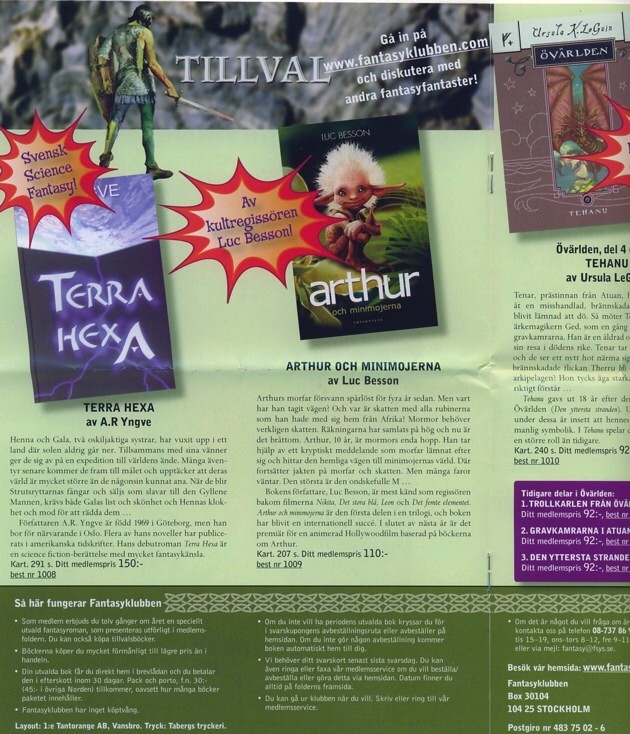
 My first TERRA HEXA novel was picked up by Swedish publisher Wahlstroms' fantasy book-club (see brochure image), and the sequel TERRA HEXA II has been included in the book-club's selection (see other brochure image) for this year. Thank you, Wahlstroms.
Monday, September 04, 2006
Jenn Reese On The "Growth Cycle of a Writer"
Read Jenn Reese's list "Growth Cycle of a Writer".
Where are YOU in the 8 stages of the writer's growth cycle?
(Personally, I feel like I'm bouncing around between Stage 5: Chrysalis and Stage 6: Awakening...)
Where are YOU in the 8 stages of the writer's growth cycle?
(Personally, I feel like I'm bouncing around between Stage 5: Chrysalis and Stage 6: Awakening...)
Sunday, September 03, 2006
"Oh No! We've Got Homepage Update Sign!"
Being a longtime fan of MST3K (Mystery Science Theater 3000) , I had a lot of fun when I read this MST3K-style "riff" of the infamous story THE EYE OF ARGON:
MSTing The Eye Of Argon
And to be honest, I'm a bit behind in my fiction-writing schedule. So in the spirit of my favorite TV comedy series, and in a desperate attempt to stall for time, I have made a MST3K-style "riff" on my own novel DARC AGES.
Snide comments and cheap jokes are inserted into the novel, as if some smartass was commenting on the story while you read. Without further ado, I give you...
The MSTing of DARC AGES
If you appreciate this kind of humor, and want me to continue the "MSTing" of DARC AGES, please drop me a note. :)
Thursday, August 31, 2006
How Writers Should Behave In Public
If you start to see a bit of recognition and success (and perhaps, eventually, some financial profit) as a writer, you will also discover a new and strange change in your life:
You have become two persons.
1. The Private You - the person who eats, sleeps, works, lives, goes to the bathroom and is pretty much like everybody else.
2. The Public You - the figure appearing in the media, who most people associate with your writer name/pseudonym.
Why is it important to keep these two roles apart? Why not simply insist, like Popeye, that "I yam what I yam and that's all I yam!"
Because you risk going insane.
Your "public persona" will be subjected to scrutiny of a kind that never happens to "ordinary" people. Complete strangers will make absurd claims about your personality as if they were close friends. This can be frustrating. If you do not explain to yourself, "They are talking about my public persona, a role, not the real private me," then you'll lose your grip of who you are.
Always assume about "well-known" people: "I don't really know this person. This is really a stranger to me."
Between the reader and the successful writer lies a veil of prejudices, hearsay, gossip, unrealistic expectations, fears, projections and desires. And the more successful a writer becomes, the worse this problem becomes.
Nobody expects Mr. Totally Unknown Writer to outdo himself with every new book. But Mrs. Bestselling Writer will always struggle against ever-rising expectations; no matter how well she does, someone will try to spin it that she's "not doing as well as expected" or is already a has-been.
Now, about the "public persona," the "you" who appears at conventions, book fairs, conferences and interviews.... I think that regardless of fame, it is possible to project a public "you" which combines parts of your genuine character with certain rules of conduct.
10 Rules of Thumb for your Public Persona:
1. Be sincere about your beliefs and convictions.
2. Avoid self-destructive behavior.
3. Be polite.
4. Be consistent.
5. Show a sense of humor (if you have any).
6. Do not lie.
7. Be considerate of other people's feelings (to a point).
8. Only lose your temper when no other recourse is possible.
9. Dress and groom your public persona with care.
10. Always keep your teeth clean and your breath fresh.
When I see photos of writers during various gatherings and functions, certain kinds of writers stand out from the crowd:
A) Those who are well groomed and smartly dressed;
B) Those who look like homeless people;
C) Those who have horrible beards.
What IS it about writers and beards?
In 90 cases out of 100, a beard does not make you look distinguished. Those few who do, look distinguished also without beards.
Big, stripy beards that seem like they're trying to escape your face are even worse.
Goatees should be reserved for the lead singer of Metallica.
A well-kept three-day stubble is OK, but four days marks the beginning of a beard.
Women's mustaches should be shaved at all times.
Shaving your head bald may work - but then again, only if you have a handsome cranium.
Keep a spare shirt available at public occasions. If you happen to spill something on your shirt, you don't want the big unsightly stain to follow you around the entire event.
Some people sweat a lot. (I'm one of them.) Industrial-strength deodorant, black shirts and frequent face-wiping might lessen the impression that you're enacting "Richard Nixon Losing His TV Debate Against JFK."
And please, do not grope women on stage.
Sunday, August 27, 2006
Now Let Us Praise Homepage Updates
This week's homepage update is small... but not insignificant: the 13th installment of my ongoing serial of satirical verse, "A.R.Yngve's READING BOOK".
Chapter 13 is titled "Men In Uniform"... have a look.
Chapter 13 is titled "Men In Uniform"... have a look.
Saturday, August 26, 2006
Snappy Dialogue Or Cliché Hell?
Some sample dialogue from the Precinct 20 story I'm writing on:
------------------
They went to the local McDonald’s. She ordered a burger, salad and coffee; he ordered three Filet’O Fish, salad, a mug of coffee and ice cream.
“Your stomach must be made of pig-iron,” she remarked as Garris began to eat.
“You’re not scolding me for eating after a colleague just died?”
“I think you’re into comfort food. You didn’t drink much at the party.”
“So what’s your vice?” he said, and gulped down the last bite of his first fish burger.
Her face froze momentarily. Then, with a wry smile: “I’d never tell a colleague.”
-------------------
Yes, I know people don't talk like that in real life. But kitchen-sink realism can only get a story so far.
Thursday, August 24, 2006
How Do You Choose What To Read?
There's the Gutenberg Project, with an online catalog of over 18,000 free books (and growing, as ever more old books enter the Public Domain)...
There's Amazon.com, the world's biggest (and most accessible) bookstore...
There's all the good, established authors who are not only releasing a lot of new novels, but also releasing older books for free reading online...
And in addition to that, there are so many well-stocked bookshops near you - in train stations, shopping centers, convenience stores, and kiosks.
So I ask you, the average reader: How do you do it? Faced with this fantastic range of available books, all old books plus the recent and present ones... how do you choose what to read? More and more, I'm being overwhelmed by all this limitless choice.
And I'm starting to seriously wonder if it's pointless that I should write new fiction, when I'll have to compete with both the sum of all books written plus the flood of other new releases.
How do you do it? Please tell.
:-S
Saturday, August 19, 2006
Stuff I'm Writing...
I'm writing on several things right now:
-Work on my "Military SF" novel THE TALE OF THE SOLDIESSE is going very slowly. At least I have written over 70,000 words so far...
-I just completed a new short story (2,900 words) and sent it to this new zine. It got rejected about five hours later - a new personal record! - and I'm wondering whether I should rewrite it or toss it.
-Another "Precinct 20" horror-mystery story in progress, "Natural Enemy," is turning out much longer than I thought -- primarily because it involves more character development and scene-setting than previous stories in the cycle.
Perhaps I'll split it into two parts...
(I am already thinking of creating a chapbook collection of all the "Precinct 20" stories, to be sold here.)
-The third TERRA HEXA novel is still in the early planning stages. I am trying to figure out how much plot I should cram into it -- I have a tendency to put in a lot of plot.
I recently saw TRISTRAM SHANDY: A COCK AND BULL STORY, the film based on the comic novel (or "meta-novel"). Great fun! See it.
Friday, August 04, 2006
Charlie Stross On Genre And Zeitgeist
The awarded and lauded science-fiction writer Charlie Stross has an interesting post on his weblog: "Genre Neurosis 101."
The central thesis of the post (and do read the debate in the Comments section) is that after the terrorist attacks on the U.S. on September 11, 2001, American Science Fiction lost some (or much?) of its previous optimism about the future.
Stross notes:
"This turning away from the near future is going to be remembered as one of the hallmarks of the post-9/11 decade in American science fiction, as the chill wind of change blows through the hitherto cosy drawing room of the American century.
"The Brits aren't drinking the Kool-Aid — well, some of them are serving it up in pint glasses, but most of them have got better things to do with their time — and this is why just about all the reviewers in the field are yammering about a British Invasion or a British New Wave or something: it's not what the British are doing, but what the American writers aren't doing that is interesting. "
Read the rest.
What about countries that are not only lacking in optimism, but have none at all? Are there any active SF writers in, say, Iraq? (Or North Korea? Or Sudan?) I'd love to learn about people who try to write science fiction in the countries where you'd least expect it...
Tuesday, August 01, 2006
On Mel Gibson And Evil Stories
Mel, this is God: What the hell were you thinking?
Jokes aside... I don't think being a drunk, or even a pampered celebrity drunk, is any excuse for vile bigotry. "In vino veritas," and this sure confirms any suspicions raised by that icky film THE WHIPPING OF THE CHRIST -- sorry, THE PASSION OF THE TORTURER.
(By the way, my mother -- who comes from a Catholic family and volunteers for a church charity in her retirement -- thought THE PASSION OF THE CHRIST was a sick movie. I agreed: it was an exercise in sadism that completely missed the point of what Jesus preached.)
One dark truth about any sort of creative endeavor -- such as writing -- is that anger can be a driving force. Even hate.
I'll admit that some of my own books and stories were written in anger. (Anger against corruption in politics, against war, bigotry, oppression and stupidity...) Authorial fury is no guarantee of quality -- rather the opposite -- but a big psychic "push" of anger can fuel the writer and make him or her accomplish more than usual.
But what happens when the hate overwhelms the work -- or the artisan? (I don't want to use the word "artist" here because it's so loaded with pretensions.) When does the creative passion go too far and become downright pathological? Can stories hurt people?
They can.
There are books that should never have been written -- evil stories that contain evil messages and try to poison the reader with hate. Many political and religious pamphlets are of that sort. But you can also find evil in fiction -- myths masquerading as fact, stories claiming to be based on fact, stories that warp history to suit a bigoted agenda.
One particularly evil type of fiction is the "scapegoat myth":
1. Some atrocity, wrong or slight is committed against a people tagged as "good." (Not because they do good things, they just are.)
2. The "good" people quickly find that they have been wronged by representatives of another people, who are somehow, magically, a single entity -- and therefore all equally responsible for the wrong.
(This blame extends to those who have no knowledge of the deed, or were born after the wrong was done, but are related to the "guilty" people.)
3. The "good" people, having thus justified themselves, try their hardest to persecute and annihilate the "scapegoat" people.
Scapegoat myths are toxic: they have killed people throughout human history, and still do.
I'm convinced that our species has evolved from hairier and stupider primates, and that we share many of the worst traits of chimps. So I've come to suspect that "scapegoating" derives from ape behavior. Anyone who writes or tells stories that spread scapegoat myths, tries to tempt us: "Don't think. Just find the weaker opponent, kill him and take his females. Your might is your right."
Deep down, the bigot who spouts myths about "evil peoples" longs to cast off his humanity and become an ape -- a murderous, unrepentant primate. Do not listen to his stories. Do not read them. They are evil.
--------
ADDENDUM: Denis Leary sings the "Mel Gibson Blues" (Caution: explicit lyrics, but this is humor, satire... don't listen if you don't understand satire.)
Sunday, July 30, 2006
The Never Ending Story ("Aaaa-ah, aaa-ah, aa-ah...")
Nothing upsets a reader as much as a book that doesn't end on the last page.
Nothing upsets a viewer as much as a motion-picture that is abruptly cut off before the story ends properly.
If an episode of COLUMBO stopped before Lt. Columbo had solved the case, I would be upset.
But... have you ever wondered? Why do we expect a story to neatly fit into the limits of
A) the 200-500 pages of a single book
B) the 50-60 minute duration of a single TV-show episode
C) a 90-120 minute movie?
D) a stageplay lasting 1-4 hours?
(No offense to Lt. Columbo, but how does he ALWAYS manage to solve a case in 3-5 days? Many murder cases take months, years, even decades to crack.)
Real life won't fit into a 90-minute movie.
The practical explanation is that most media - such as print, movies on film rolls and television - impose strict boundaries on the story's length. The full complexity of life is simplified and abridged for the sake of the medium. (Again with the McLuhan reference!)
You won't find single 10,000-page novels in the bookshop, because the publishing industry can't physically print, edit and distribute a book that's 1 meter thick and weighs 10 kilos. If you wanted to tell a story which required that length, you'd have to break it up into several volumes - and even that wouldn't be without its problems.
Also, the reader's patience and stamina impose limits to story length. If you've ever sat through a "Director's Cut" movie, and had to go to the bathroom during the middle of the film, you know what I mean.
And of course, the author's patience with a single story isn't limitless either.
In practical terms for the individual writer, you may have run into the Limit Problem when you try to cram too much plot into a 100,000-word novel. (I have!) Consider breaking up your plot into individual novels. You don't like doing so? Well, what can you do? Even J.R.R. Tolkien had to see his first U.S. printing of THE LORD OF THE RINGS broken up into three books.
However...
Digital technology now makes it possible to make stories - novels, motion pictures, comic-strips (see Scott McCloud's "Carl") of greatly extended length and complexity.
You could - if you were ambitious or mad enough - post an incomplete book online, and just keep adding to its length for the rest of your life... until, with your very last breath, you completed it with the ending.
("Behold: The World's Longest Novel! Bigger than The Bible! Longer than War And Peace! Lengthier than *GAAGHH*....")
Or, if you were utterly insane, you could digitally cut-and-paste together every single episode of the TV soap DALLAS into a single, gigantic movie ("DALLAS - THE COMPLETE SAGA") and post it online. Behold, the world's longest film!
Then again... most writers barely muster a single 100,000-word novel. So why should they worry about the Limit Problem?
One worry is Posterity. Many of the ancient classics of literature are probably surviving fragments of even bigger epics. THE ILIAD and THE ODYSSEY seem to end abruptly, but we can't say for sure the Greeks ended the story of Odysseys when he returned to Ithaca.
Perhaps the Internet will give birth to Never Ending Stories... movies and books that get extended endlessly, over entire generations.
And here this blogpost runs into a Limit Problem of its own... so I should stop here.
Friday, July 21, 2006
On "Unspoken Assumptions" In Writing
The late great Alice Sheldon (a.k.a. "James Tiptree Jr.") wrote this observation about how male writers tend to describe reality with themselves as point-of-reference: "Impenetrable Swamps, Loyal Dogs, Short Women". Read the whole text!
Quote:
"Consider how odd it would be if all we knew about elephants had been written by elephants. Would we recognise one? What elephant author would describe — or perhaps even perceive — the features which are common to all elephants?
"We would find ourselves detecting these from indirect clues; for instance, elephant-naturalists would surely tell us that all other animals suffer from noselessness, which obliges them to use their paws in an unnatural way."
Think about it when you write, whatever your gender may be. Are you putting unspoken assumptions into your prose?
Are forests always supposed to be "penetrated"?
Are dogs always supposed to be "loyal"(i.e. obedient)? "Loyalty" implies the dog is loyal to someone. Who?
What constitutes a "short" woman? (Relative to what?)
OK, if the narrator is a 7-foot Ethiopian native and casually thinks the visiting Japanese tourist is short, that makes perfect sense within the context of the story.
But the writer shouldn't automatically assume that his/her reference point always makes sense in the context of the narrative.
Another example (my favorite): In one of Jean M. Auel's Stone Age novels, one of the characters talk about someone being depressed. Depressed? 40,000 years ago? The mere word carries assumptions about modern psychology, models of the human mind and theories which seem a tad out of place in the story's Neolithic, pre-literate context.
It can be difficult to picture yourself as being someone else, to describe someone else's point-of-view. It may even require that you question some (or all) of your assumptions about yourself.
But if you can't, your writing will always be limited to a predictable, repetitive set of ideas and prejudices - invisible to you, but obvious to everyone who reads your prose.
Thursday, July 20, 2006
The Medium Is... The Massage?
When I first started to post my fiction on a webpage, I had a vague idea that maybe the text could become available also for mobile phones...
Around 2000 I made an early experimental "sampling" of my fiction for mobile phones - with black-and-white screens, before the Internet became available on those devices. It looked awful, so I decided to set mobile phones aside until the technology and software had improved...
...and boy, has it improved.
Today a friend showed me what my homepage looks like on a state-of-the-art Qtek 8310 smartphone, using the Web browser Opera Mini.
He could set the size of the text to whatever suited him.
Wide images were automatically resized to fit the screen.
The screen resolution was crisp and clear.
It amazed me how good the webpage looked on that small 240x320 display.
I looked at the screen and thought: Soon, this will be the standard for all mobile phones. People will be using them instead of PCs to read books.
When I ask people what they think about reading fiction from a screen - any screen - I still encounter a widespread skepticism against it.
Maybe people take a pragmatic "I'll-believe-it-when-I-see-it" attitude. Or maybe they have been burned by bad experiences with flickering cathode-ray screens... I don't know and I don't care. I have seen the future.
So: what does the mobile-phone-as-book-reading-device imply for writers?
For starters, any specific medium has its own strengths and weaknesses. (Printed books have many weaknesses, but they've been around for so many hundreds of years that we've become accustomed to the weaknesses.)
The obvious strengths of writing fiction for a mobile phone, of the top off my head, would be:
1. Eliminate the middlemen (editor, bookstore, publisher, printer, distributor, access to PC) - the writer reaches the reader directly and (almost) instantly, even where bookstores are scant or non-available.
2. Instant editing - if you find an error in your text after it's been posted, or think you it needs some on-the-spot editing, you do it right away... and the update reaches the reader immediately.
3. The mobile format is well suited for short fiction - the mobile reader will hardly be able to read through WAR AND PEACE without being interrupted by phonecalls, text-messages and conversations... But if the story is short enough, time won't be an issue.
4. The mobile format is well suited for serials - in the 19th and early 20th century, it was typical of novels to be published as serials (in magazines and newspapers) before they were released as complete print books.
The serial, with its cliffhangers and "To Be Continued"s, could get a renaissance on mobile devices. (Thanks to L. Lee Lowe for the correction.)
Of course, the medium has its weaknesses, but they are not a big problem unless you think of it as just another form of paper books. It is not. When television was new, it took the producers some time to figure out how TV was different from radio. Old TV shows often featured an announcer's voice-over, an old cliché from radio broadcasts.
I think that as people try to figure out how to present fiction on mobile devices, they will go through a phase of repeating clichés from an older medium... and only in retrospect will we see it clearly.
"How silly the first books for phones seem now, what with their digital dust jackets and imaginary page numbers!"
If you have a new phone with a large screen (and a good browser), check out this page...
If you have an older phone model with a small screen, there's a mobile version...
And if you have a phone with a black-and-white screen, buy a new phone.
ADDENDUM: For further study of the logistical and financial problems with distributing fiction magazines in print, read Vic Wertz' fascinating article "Why Amazing Stories and Undefeated died"...
...then tell me again how fantastically superior that system is to electronic distribution.
Wednesday, July 12, 2006
"The Clockwork Atom Bomb" By Dominic Green
There are plenty of Hugo Award-nominated stories to read for free on the Internet right now, but why not start with this one:
Dominic Green's "The Clockwork Atom Bomb".
I liked it -- though it scared the crap out of me.
Dominic Green's "The Clockwork Atom Bomb".
I liked it -- though it scared the crap out of me.
Tuesday, July 04, 2006
"In The Summertime, When The Updates Are Late..."
This week's (late) homepage update includes the 1st chapter of DARC AGES: City Of Masks.
And if you want a laugh, I've added a very funny link to the links page.
And if you want a laugh, I've added a very funny link to the links page.
Saturday, June 10, 2006
TERRA HEXA II Released
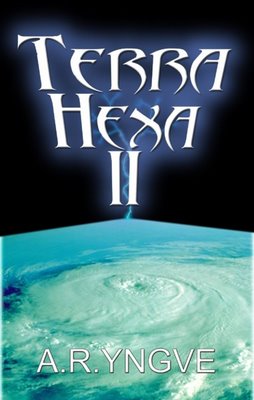
The sequel to my young-adult SF novel TERRA HEXA, aptly titled TERRA HEXA II, has just been released in Sweden.
A sample has been posted on the publisher's website, HERE.
If you can't read Swedish, there are English text and audio samples from the first book HERE.
The sequel features the female protagonists from the first Terra Hexa novel, the sisters Henna and Gala. They explore the planet Terra Hexa's third continent, and confront a terrible invisible menace...
If you want to know more, you'll have to buy the book. ;-)
Thursday, June 08, 2006
My FLICKR page
I started a Flickr page and put some photos on it.
And why? For the crass reason that I might get more attention for my books, by mugging for the camera.
;-)
And why? For the crass reason that I might get more attention for my books, by mugging for the camera.
;-)
Friday, June 02, 2006
Tragedy Is Easy, Comedy Is #¤%*#*¤ Hard
I've volunteered to do a standup-comedy act at the science-fiction convention NORCON (June 3-5)...
It's hard to be funny on purpose. And much easier to be unintentionally funny (as I've accomplished countless times).
Someone warned me: the convention guests won't be able to take you seriously as a writer AFTER they see you as a goofy funnyman on stage.
Who knows... ;-)
What do you think? I write "genre" fiction, so I don't have that much of a reputation to ruin in the first place...
If a Really Serious Writer like Margaret Atwood appeared on a comedy club and made fart jokes, would people then say: "I can't read her books now. She's ruined her image!"
Is it all about image?
Then again: Why should writers take themselves so #*#¤%* seriously?
The worst that can happen is that the audience won't laugh...
:)
Thursday, June 01, 2006
Book Tip...
I love non-fiction books just as much as good fiction, and I read lots of it.
And as I get older and the world changes ever faster, it gets increasingly important to stay informed. I'm still "hip" and "with it", "Daddy-O"! ;-)
Here are two interesting books I read recently...
PURPLE COW by Seth Godin
Seth Godin is a "marketing guru". His book explains how the game of marketing has changed, and how you can use this knowledge to create successful products and services.
So why should writers and aspiring writers learn about such things?
One: PURPLE COW may help you figure out how to sell your own books.
Two: It also points out the power of originality and creativity in a media-crowded, affluent society.
ON SF by Thomas M. Disch
Disch is also a fiction writer and has worked in various genres (his greatest success may be THE BRAVE LITTLE TOASTER childrens' books). This book is a collection of his literary criticism.
"Literary criticism," you think. "That sounds so dull." But Disch's writing is damn funny. He often attacks his subject from an unusual angle, offers original insights.. and is one of the funniest literary critics around. You learn something and laugh at the same time.
Monday, May 08, 2006
Who Says Publishing Is Fair?
So, once you have your mansucript done, revised, proofed, ready for publication... what do you do?
You send away your manuscript to a Big Publisher, and think it will succeed or fail on its own merits.
SUCKER!
Getting published by a large publisher, unless your name is already well-known, is a completely randomized process. Michael Allen reveals how manuscripts are REALLY selected (or not), in his tell-all book On the Survival of Rats in the Slush Pile.
It's recommended reading for writers. Honestly, I didn't think the state of Big Corporate Publishing was THIS bad -- until I read Allen's book. I learned several useful lessons:
1. "Nobody knows anything." Modern Big Publishing is a complete lottery, and the odds are stacked against writers.
2. The best way to keep a cool head is to write what YOU enjoy writing, and not write for money/fame. (Or write for your friends and family.)
3. Ignore Big Publishers. No, really. S****'em. Find a small publisher that's willing to publish your work at a low cost (read: low financial risk) and nurture your talent over time.
(If, against near-impossible odds, you SHOULD get a deal with a Big Publisher, you are s****d. Because the Big Publisher will give you one chance to sell humongously well with your first published novel... and if you don't, they'll toss you aside like a used Kleenex. You don't get to hear about this a lot, because people tend to ignore all the writers who bombed, and focus on the spectacular successes.)
Monday, May 01, 2006
John Scalzi Gives Advice To Teenage Writers
As you may have heard, a teenage writer by the name Christopher Paolini has had huge success with his ERAGON book series. This sort of thing doesn't happen often.
Teenage prodigies are still rare in book-writing. Why is that? John Scalzi explains in "10 Things Teenage Writers Should Know About Writing."
Teenage prodigies are still rare in book-writing. Why is that? John Scalzi explains in "10 Things Teenage Writers Should Know About Writing."
Sunday, April 30, 2006
"As You Know, Bob..."
The Turkey City Lexicon, A Primer for SF Workshops, is an eminently useful checklist of typical errors and bad writing clichés that turn up in science fiction writing workshops.
Bookmark it.
Do you attend writing workshops? They can be a lot of fun, and you can learn a lot. Well, it depends on the people who attend it. Come to the workshop with an open mind and open ears.
This Wikipedia entry lists several well-known writing workshops and links to them.
As for myself... I live in Scandinavia and can't find workshops near where I live. So I'll have to manage with the Baen's Universe Slushpile for peer review...
Monday, April 24, 2006
Stross On 1st, 2nd and 3rd Person Style
Acclaimed SF writer Charles Stross has posted an essay on the perspective-problem in fiction writing:
"Conjugate Characters, Not Verbs"
Authors and would-be authors take note: Stross analyzes one of the most difficult stylistic issues ANY writer can come up against. I wholeheartedly recommend his essay.
-------------
And now for something completely different...
I love satire and parody, but I don't like "fan-fiction". I think it's a ******* immature thing to do. Grownups should not write fanfiction; if they are so ******* eager to be writers, they can ******* make up their own original ******* characters.
And now I read about this sad, sad, sad, sad... sad person who not only wrote her own fan-fiction novel set in the STAR WARS universe... but also published it on Amazon.com.
Someone called it an act of "weapons-grade stupidity". That pretty much sums it up, no?
Why do these things happen? I like to think that people are, on the whole, fairly sane. But apparently insanity can strike anyone, at any time. There you are, walking down the street with a clear eye and a sharp mind... and POW! you fall and hit your head.
When you wake up, dazed and confused, you find yourself possessed by a single hypnotizing notion: "I am INSPIRED! I must write a fan-fiction novel and readers will love it because I am so INSPIRED!"
Do not confuse "obsessed" with "inspired".
And don't even try to defend yourself with Special Pleading: "Yeah, of course I know about copyright and all that... but MY fanfic is different! It's as good as the original, in fact!" (Yadda yadda...)
ADDENDUM:
1. Robin Hobb explains why she is opposed to fanfiction.
2. A huge discussion about fanfiction over at Making Light.
Saturday, April 15, 2006
Mark Twain on Fenimore Cooper
The essay/polemic "Fenimore Cooper's Literary Offenses" (1895) by Mark Twain is a wonderful case of Karmic Retribution.
Have you ever thought that some books earn the author money and fame despite not being very good? Well, it happens. But please, this is no reason to get cynical and nihilistic. Awful books may surf the wave of the Zeitgeist for a while... but eventually the book's true qualities (or lack of them) will catch up. Many novels which were once praised as "masterpieces" and "art" and sold very well, have now fallen into into disrepute or been forgotten.
Take Fenimore Cooper, for example. Cooper's Western/frontier books Pathfinder, Last of the Mohicans and The Deerslayer were immensely popular in the 1800s and well into the 1900s.
But, as Mark Twain pointed out back in 1895, Cooper couldn't write worth ****. His essay is not only laugh-out-loud funny; it also provides several very good examples of writer pitfalls to avoid.
For example, lazy use of clichés:
"A favorite one was to make a moccasined person tread in the tracks of a moccasined enemy, and thus hide his own trail. Cooper wore out barrels and barrels of moccasins in working that trick. Another stage-property that he pulled out of his box pretty frequently was the broken twig. He prized his broken twig above all the rest of his effects, and worked it the hardest.
"It is a restful chapter in any book of his when somebody doesn't step on a dry twig and alarm all the reds and whites for two hundred yards around. Every time a Cooper person is in peril, and absolute silence is worth four dollars a minute, he is sure to step on a dry twig.
"There may be a hundred other handier things to step on, but that wouldn't satisfy Cooper. Cooper requires him to turn out and find a dry twig; and if he can't do it, go and borrow one. In fact, the Leatherstocking Series ought to have been called the Broken Twig Series."
(From "Fenimore Cooper's Literary Offenses" by Mark Twain)
There's more. Much more! Read and be wiser.
Wednesday, April 12, 2006
19th-Century Essay: "How To Fail in Literature
Here's a real gem! Back in 1890, Andrew Lang held a lecture on "How To Fail in Literature", and the book of the lecture is now available for free at the Gutenberg Project.
I cannot do justice to Lang's satirical, often hilarious lecture in a single blog post -- so I suggest you simply dive into it.
Here are a few choice quotes from How To Fail in Literature:
"I regard failure as the goal of ignorance, incompetence, lack of common sense, conceited dullness, and certain practical blunders now to be explained and defined."
"The young author generally writes because he wants to write, either for money, from vanity, or in mere weariness of empty hours and anxiety to astonish his relations. This is well, he who would fail cannot begin better than by having nothing to say."
"The less you observe, the less you reflect, the less you put yourself in the paths of adventure and experience, the less you will have to say, and the more impossible will it be to read your work. Never notice people’s manner, conduct, nor even dress, in real life. Walk through the world with your eyes and ears closed, and embody the negative results in a story or a poem."
"If your book does, in spite of all, get itself published, send it with your compliments to critics and ask them for favourable reviews. It is the publisher’s business to send out books to the editors of critical papers, but never mind that. "
"Go on telling critics that you know praise is only given by favour, that they are all more or less venal and corrupt and members of the Something Club, add that you are no member of a côterie nor clique, but that you hope an exception will be made, and that your volume will be applauded on its merits. You will thus have done what in you lies to secure silence from reviewers, and to make them request that your story may be sent to some other critic. This, again, gives trouble, and makes people detest you and your performance, and contributes to the end which you have steadily in view."
"Perhaps reviewing is not exactly a form of literature. But it has this merit that people who review badly, not only fail themselves, but help others to fail, by giving a bad idea of their works. You will, of course, never read the books you review, and you will be exhaustively ignorant of the subjects which they treat. But you can always find fault with the title of the story which comes into your hands, a stupid reviewer never fails to do this."
(All quotes from HOW TO FAIL IN LITERATURE, by Andrew Lang)
Happy Easter! :)
P.S.: But you don't have to be illiterate to be illiterate! This article points out that even the "highly educated" are often awful writers:
Language Crimes: A Lesson in How Not to Write,
Courtesy of the Professoriate
Friday, April 07, 2006
When Genre Prejudice Spits You In The Face, Spit Back
If you write what you WANT to write, you shouldn't give a damn what people think about it.
At least that's the ideal. Ideals won't pay the rent, though...
If you like to write any kind of "genre" fiction (science fiction, fantasy, horror, romance, crime/detective), you will find people who like those "genres"... and you will also encounter people who dislike your fiction simply because it carries a "genre" label.
Of course, tastes differ. I don't read romance novels (it's a guy thing -- you wouldn't understand)... and resent research seems to prove big differences in men's and women's literary tastes. You can't fight biology. I have no issue with that.
But despite differences in taste, I think "genre" labels are mostly a nuisance. They obscure just as much they illuminate. They perpetuate prejudices, and are often used as an excuse for shoddy workmanship.
Here's the skinny, dudes and dudettes: genre labels exist only to help readers and booksellers sort books by label. There is no inherent quality in the label itself!
It's a familiar complaint among science-fiction fans: as soon as a "mainstream" writer has success with a "genre" novel, the critics will pretend it's not "genre" fiction at all:
"If it's good, it can't be SF. If it's SF, it can't be any good."
But the fans are ALSO wrong. Let's look at genre prejudice from another angle.
There are "genre" fans who uncritically devour any crap that carries their favorite "label" -- be it SF, fantasy, crime, romance or "literary" fiction.
I find that totally unacceptable. Didn't I just tell you that there is no inherent quality in the label itself?
So I say: You cannot truly appreciate quality in fiction, unless you learn to rise above the idea of "genre labels". Someone tells you a book "belongs" to a genre. Why not simply ignore the label and ask: "Well, is the book any good?"
"Genre" fans, critics AND writers should stop being so narrow-minded: Genre is not important. Quality is. If you write pap, it's pap no matter what label you put on it.
Just because I write stories about time-travel, space aliens and supernatural terrors doesn't mean I want to get chummy with every person who writes lousy stories about time-travel, space aliens and supernatural terrors.
The same goes for "literary" fiction (just another "genre" label). I don't care if you won the Booker Prize: VERNON GOD LITTLE bored me and I couldn't drag myself through the entire first chapter.
But let's be nice. Tastes change, don't they? People change. They grow up. Our minds become more refined, more mature. Our favorite "themes" may not change much, but with age we require more depth, more realism... and above all, better grammar.
Monday, April 03, 2006
Short Stories Up For Review in the Baen Slushpile Messageboard
The new magazine BAEN'S UNIVERSE has created an original review system for stories submitted for review.
You might call it "outsourced editing": The writer posts a story on the Baen's Universe Slush messageboard.
Then the readers can log in, read the story and post their comments, suggestions and criticisms in the Slush Comments section. The writer reads the comments, posts revised versions of the story, and the process goes around until the story is deemed good enough for proper submission to the Editor.
The advantage of this system is that it provides writers with free editing. You get fast and specific feedback from readers, instead of waiting weeks or months for a brief reply from an editor.
Is this review system the wave of the future? You tell me...
I have recently posted THREE stories for review there:
"SEE", "The Five Fingers" and "The Battery Vanishes".
(You need to be logged in to read them, but it's free.)
UPDATE: a new, extended and somewhat changed version of "The Battery Vanishes" has been posted here:
http://bar.baen.com/WB/default.asp?action=9&read=80736&fid=65
Thursday, March 23, 2006
My Short Story "Sins Of Our Fathers" in THE FIRST BEWILDERING STORIES ANTHOLOGY
The editors of the webzine BEWILDERING STORIES, Jerry Wright and Don Webb, have released THE FIRST BEWILDERING STORIES ANTHOLOGY: "Twenty-eight illustrated stories drawn from the first 180 issues of Bewildering Stories Magazine."
My story "Sins of Our Fathers" is included in the anthology.
"Sins of Our Fathers" originally appeared in the Indian webzine ADBHUT (February 2004), then in Bewildering Stories #113, then in my self-published collection THE FACE IN THE DOOR And Other Stories (2006).
It is a straightforward "extrapolation" type of story: take a current tendency and project it forward in time. "If people in Asia keep aborting unborn girls and favoring the birth of sons, how will the gender balance have changed a generation from now?"
This subgenre is also often called the "If This Goes On..." Story.
Tuesday, March 21, 2006
"From Which Hell-Pit Of Despair Do You Get Your Ideas?"
Check out the blog Query Letters I Love. It posts actual "pitch letters" from wannabe Hollywood scriptwriters.
In movie-industry slang, a "pitch" is the brief summary of the plot. I think the quotes on the blog are real... because you can't make this stuff up.
These beyond horrible quotes prove that creative incompetence, laziness and megalomania go hand in hand. Reading them, I realize that most of these wannabes aren't really TRYING to write fiction.
Their foremost concern is apparently to "make big money" while having absolutely no idea how. It's like playing the lottery and believing it will make you rich without effort.
"Where do you get your ideas?"
In this case, it's more like "From which hell-pit of despair do you get your ideas?"
Thursday, March 09, 2006
Nebula Nominee short "A Rocket For the Republic"
American writer Lou Antonelli's short story "A Rocket for the Republic" is one of the nominees for this year's Nebula Award.
The story was published in ASIMOV's Science Fiction Magazine last year, but the author has now kindly made "A Rocket for the Republic" available for free reading on his website, here.
It's a fun story, and a prime example of the most natural format (or style) of fiction: the first-person account. This is how the art of storytelling began: someone says "You should have seen what happened when I..."
Maybe this is how everyone who wants to be a writer should begin: don't bother with the fancy stuff -- start with what makes it fun! As an exercise, tell a story first-person. Even if the character in a story isn't YOU, you can open your mouth and speak it: "One day I was walking through the forest, on my way to see a sick relative, when I saw an animal caught in a bear trap..."
If you're the parent of a small child, you may already be this kind of storyteller: if you improvise a bedtime story for your kid. The next step is to write your tale down. (Don't laugh: J.K. Rowling started out by making up stories to entertain her kids.)
Friday, March 03, 2006
The Science Fiction Plot Generator
Try this amazing (and very funny) Science Fiction Plot Generator and you'll never get stuck on the plotting again.
Speaking of which: Do you sometimes get the feeling "I've heard this plot before"? Chances are, you have. When all else fails, the writer can always fall back on clichés and plain cheating.
For further studies in Generic Science Fiction Plotting, read Nick Lowe's hilarious essay "The Well-Tempered Plot Device".
Thursday, March 02, 2006
Was, Was, Was...
Read this excellent post on Jonathan Sherwood's writing blog. It points out a problem I've had with my writing for a long time: excessive use of "was" and "were".
Quote: "Put the power of the sentence into the verbs."
Quote: "Put the power of the sentence into the verbs."
Thursday, February 23, 2006
"Sex, Sex, Sex... That's All You Ever Think About!"
OK, how does one write sex in fiction?
It's so easy to write sex awkwardly (or unintentionally comical)... and you might end up winning the Bad Sex Award. (Go ahead, look. There are no pictures.)
Two challenges of writing sex in fiction:
1. Knowing your audience.
Do you hope to win an all-ages audience? What genre are you writing in?
Readers tend to approach genres with strict genre expectations. Sex will only upset them if they are "surprised" by it.
(Will puberty wizard Harry Potter ever lose his virginity? Probably not. Most of the readers are just not ready for that.)
2. Realism Vs. Romanticism Vs. Pornography.
Real-life consensual sex is glamorous only in the subjective sense -- i.e. for the participants (hopefully). What the participants find "hot", the reader may not. Should you convey what the participants experience, or a give an "objective" seen-from-outside account? You must decide this yourself.
And of course there is non-consensual sex too -- even more difficult to write, since it is offensive and painful on several levels. (This subject is so thorny, I'm not even going to go into it.)
The writer who decides to write about sex, either the implicit or the explicit kind, should have a clear set of objectives:
A) Who is supposed to read this? (People my own age? People of all ages? Men? Women?)
B) Why should the reader want to read this? (To follow the plot? To understand the characters? To get aroused? Or a combination of all three?)
C) Why do I want to write this? (Does it matter to the plot? To the character development? Am I just trying to arouse myself?)
If you don't know why you're writing, if you're not thinking consciously, you will fall into "automatic writing", guided by hormones. The body takes over. The result could end up as pornography (that's "erotica" if you're a woman), and unintentionally comical -- "Bad Sex" writing.
Or you could chicken out, and not mention sex at all. (Chicken.)
Saturday, February 11, 2006
The Renaissance In European Art
During the European Renaissance, the depiction of the human form became more realistic. One could say this trend preceded the realism in fiction: before you could write "the human condition", you had to visualize it.
Here are some examples of Renaissance paintings. (Bear in mind that in those days there wasn't television or computers, so people gave these paintings a lot more attention than we'd do today.).
A 16th-century painting by Botticelli.
A 16th-century painting by Bosch.
A 16th-century painting by d'Aleccio.
Here are some examples of Renaissance paintings. (Bear in mind that in those days there wasn't television or computers, so people gave these paintings a lot more attention than we'd do today.).
A 16th-century painting by Botticelli.

A 16th-century painting by Bosch.
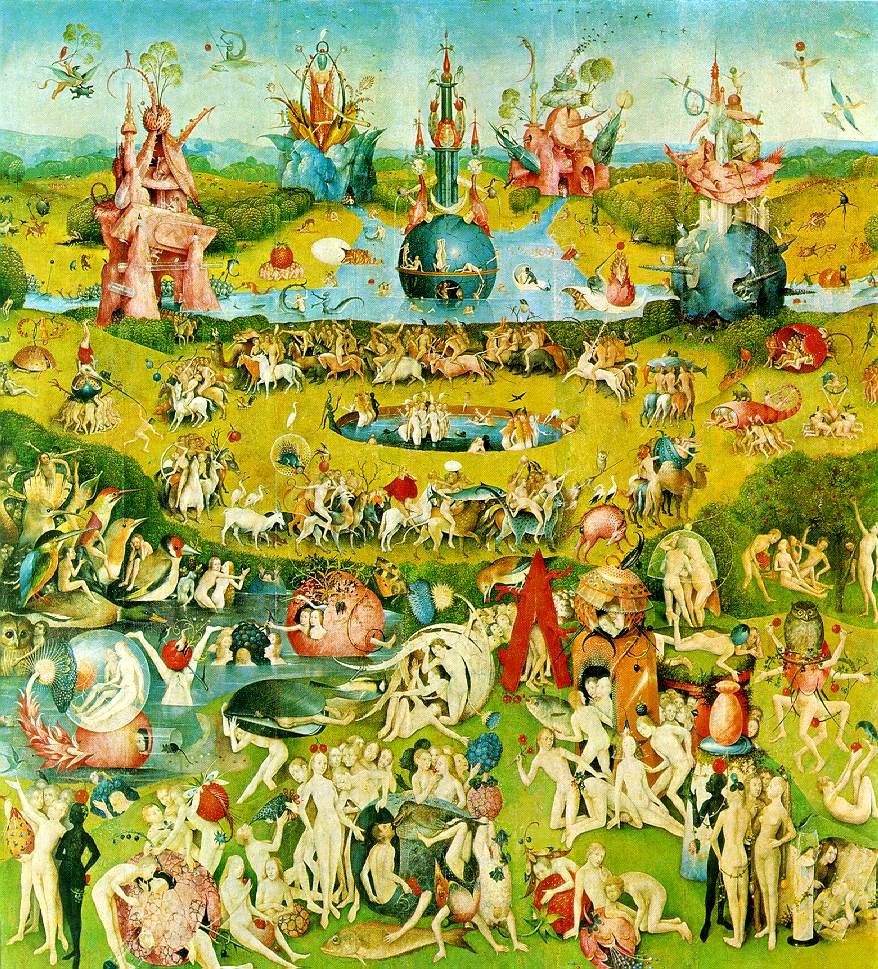
A 16th-century painting by d'Aleccio.
Thursday, February 09, 2006
The Frog And The Ox
There has been a lot of huffing and puffing in the media over some newspaper cartoons.
Let me tell you this fable by Aesop, and then ponder its meaning...
---------------------------
The Frog and the Ox
"Oh Father," said a little Frog to the big one sitting by the side of a pool, "I have seen such a terrible monster! It was as big as a mountain, with horns on its head, and a long tail, and it had hoofs divided in two."
"Tush, child, tush," said the old Frog, "that was only Farmer White's Ox. It isn't so big either; he may be a little bit taller than I, but I could easily make myself quite as broad; just you
see."
So the old Frog blew himself out, and blew himself out, and blew
himself out.
"Was he as big as that?" asked he.
"Oh, much bigger than that," said the young Frog.
Again the old one blew himself out, and asked the young one if the Ox was as big as that.
"Bigger, father, bigger," was the reply.
So the Frog took a deep breath, and blew and blew and blew,
and swelled and swelled and swelled.
And then he said: "I'm sure the Ox is not as big as --"
But at that moment he burst.
Self-conceit may lead to self-destruction.
---------------------------
Monday, January 30, 2006
Quote: "Phony Review Writers Are The Dumbest On The Planet"
The above quote is taken from a discussion thread on the ASIMOV's Messageboard.
Phony book-reviews on Amazon.com are legion - but they are easy to spot. So why are they so badly written, so tacky, so transparently fake?
Because of stupidity. If a writer is so dumb as to not see the faults of his self-published books, he will be more than dumb enough to think he can write fake self-praise and get away with it.
It's like the old joke: "Why did the idiot jump from the Empire State Building? He wanted to be a big hit on Broadway."
How to spot phony reviews:
* Look for absurd comparisons like "Better than Harry Potter!", "up there with the Bible!";
* Fakers use weird phrasings like "the conclusion is implosive" or "this year's classic" or "philosophically action-packed";
* ANY book review that trumpets a book's great philosophical breakthroughs is a bit suspect;
* Fake or dubious credentials (i.e. referring to non-existent magazines or critics);
* Aggressive attacks on negative reviews;
* If you compare the reviewer's OTHER reviews, they are the same inflated praise of one single writer;
* The reviewer uses reviews of famous writers (such as J.K. Rowling) to sneak in "plugs" for the writer he fakes for (i.e. "Harry Potter is not as good as this book by X");
* The reviewer's name sounds phony, or he uses a pseudonym;
* He consistently gives 5 stars out of 5 for every book by a single writer.
If you are even THINKING of writing phony reviews of your own stuff... get out of my blog right now!
Saturday, January 28, 2006
The BONANZA Plot Problem
I'm sitting here by the computer, while the TV is showing an old BONANZA episode in the background... and suddenly it hits me:
The Cartwright Family is living in the most violent place on Earth.
I mean, people there get shot to death or otherwise killed EVERY WEEK! And it all happens in one small region of Nevada between Virginia City and the Ponderosa ranch.
Their ranch is supposed to be near Virginia City, Nevada, in the late 19th century.... but it looks much more like Bogota, Colombia, today. The Cartwrights are a regular death squad! They must have killed more people than Wyatt Earp. (If you're in a morbid mood, search on Wikipedia how many characters got killed over the course of the entire BONANZA series...)
If one watches a whole season of BONANZA, one gets the impression that every dysfunctional family with a violent patriarch, every gang of bank-robbers and cattle-thieves, every rapist, cutthroat, lowlife and scumbag, is just flocking to the Cartwrights' spacious back yard.
(Which begs the question: why don't the Cartwrights move to a more peaceful county?)
And if we were to take the BONANZA Situation realistically, all this violence would have consequences:
1. Law-abiding families and businesses would move out in droves, making Virginia City an
impoverished slum -- or worse, a ghost town;
2. The local Congressman would go to Washington, D.C. and ask for Federal intervention: "Every seven days it's the same -- The Cartwrights kill people! We need a permanent U.S. Cavalry base to keep the order in this den of crime and gunfire!"
3. Someone would start a criminal investigation of the Cartwrights: "The whole area is littered with spent casings from Colt cartridges. A firing test shows that they match the guns of the Cartwright brothers. Take'em in for questioning!"
4. The psychological stress of living in this world of almost constant shootings, beatings and deaths would cause the brothers to go crazy, suicidally depressed, or psychopathic. But considering the ease with which they kill people and shrug it off -- plus the fact that all their girlfriends get killed or escape -- they may always have been psychopaths.
Jokes aside... this is a generic plot problem with almost any TV series, and sometimes shows up in novels too. If you concentrate too many dramatic events in a very small time and space, the plot becomes too far-fetched. (*COUGH*24*COUGH*)
(The exception is if the story is meant to be comedy, spoof, send-up, camp or satire.)
Now, the real reason why TV shows have too little "space" for the action is that locations and sets cost money. Money is the big "hidden variable" of television, and causes TV scriptwriters great headaches:
"How can we afford to send our heroes to Paris this week? I know: Let's skip new locations and travel entirely! We'll have everything happen in L.A. in realtime!"
(And thus, 24 was born...)
Written fiction, on the other hand, can afford its characters to travel around a lot more. And travel itself extends the time of the story, which eliminates much of the "time-compression" problem seen in BONANZA and other shows. (*COUGH*24*COUGH*).
Even so: novel writers watch TV (I do -- way too much ;-)), and thus they might pick up some bad plotting habits from television writers.
You shouldn't compress too much action and plot into too little space and time.
In the real world, the space of a normal human lifetime includes very few dramatic events like fights, violent deaths, dramatic accidents and such.
If you want to write a plot full of action, you must set up a situation in which this makes sense. (War is one such situation where lots of drama and violence is credible. Other situations with dramatic potential are revolution, social upheaval, or natural disasters.)
Sunday, January 22, 2006
Listen To Jonathan Sherwood..
Jonathan Sherwood, an American writer who's been published in ASIMOV's, has a great column on writing. If you are the least bit serious about writing fiction, read it.
Here is a quote from Sherwood's column "Forget the Audience, Who Are You Writing For?" which ought to be required reading:
------------------------
1) You’re writing so readers will say, “You’re cool.”
2) You’re writing so readers will say, “This story is cool.”
3) You’re writing so readers will say, “Life is cool.”
------------------------
The 3 levels of a writer's maturity. Read the rest.
Thursday, January 12, 2006
The Soundtrack Of Our Lives
Tell you a secret: I don't really write stories.
I make music videos in my mind.
Then I try to transfer them into written text. (It doesn't always succeed.) The result is a novel, or short story.
That's why I almost never write a longer story or novel without listening to inspirational music. It's the soundtrack of the video I'm composing in my head.
(You should ask other people who write, if they also work this way... I'd really like to know.)
Right now I'm listening to Robyn's latest album, and thinking: "Now, what stories would go with these songs...?" I'm sure I'll think of something. (Thanks, Robyn.)
Sunday, January 08, 2006
Actual Quotes From The Slushpile...
Whenever my confidence in my writing abilities gets low (such as when I proofread my own stuff), it helps to think that many others are more confident but less talented...
Look at these actual quotes from the slushpile of magazine ASIMOV's Science Fiction. You can't make this stuff up! (From the blog of Miss Snark, the literary agent.)
My favorite quotes from the collection:
"Weston was known for the firm but genital hold he had on his men. It was one of the reasons he was chosen for this mission over six other equally qualified men. "
(Ouch!)
"The two naked bodies, which were lying beneath the satin sheets, were no longer the people whom everyone, who was anyone, knew whenever reality was in existance. "
(Say what??)
"Sudenly, all the eyes in the room rose from their fixed positions on the floor to stare at him. "
(That last one MIGHT have been quoted from a science-fiction story about a planet of living floors... but I'm not sure. ;-))
Wednesday, January 04, 2006
Humiliation Of Writers
Writers who are experiencing their first success must be prepared for humiliating experiences.
Well-meaning persons will ask you things like, "So you'll be rich now?" (Though I think that's thinly disguised sarcasm.)
Tobias S. Buckell and Justine Larbalestier share their humiliations with us. I salute their courage.
Well-meaning persons will ask you things like, "So you'll be rich now?" (Though I think that's thinly disguised sarcasm.)
Tobias S. Buckell and Justine Larbalestier share their humiliations with us. I salute their courage.
Sunday, January 01, 2006
Happy New Year!
My 2006 New Year's resolutions:
1. Lose 10 kilos overweight.
2. Finish my first "military SF" novel, THE TALE OF THE SOLDIESSE.
3. Get more fiction published in China.
4. Start working on my third TERRA HEXA novel to come out in Sweden.
5. Sell my first TERRA HEXA novel to a publisher outside Sweden (perhaps China???)
6. Sell my SF movie script, THE FATHER MACHINE.
7. Start working on an SF novel for the India market.
8. Piss on Saddam Hussein's grave. ;-)
9. Get a new girlfriend.
Aaand...
10. Read through my pile of unread books and magazines.
Happy New Year, folks!
Thursday, December 29, 2005
King Kong As A Dirty Old Man
During the Xmas holidays, I and some of my relatives went to the cinema. My sister and her hubby went to see Disney's NARNIA movie, while me and my old mother went to see Peter Jackson's KING KONG remake.
Mom walked out halfway through KING KONG, saying out loud: "This is ridiculous."
(That was a bad sign. Normally she loves science fiction films.)
When the heroine started climbing after Kong up the skyscraper, I was tempted to walk out, too.
And just before Kong fell off the skyscraper, when Kong and the heroine exchanged looooooong teary-eyed looks, I thought: "If they start French-kissing, I'm OUTTA here." But, having paid good money (and being a cheapskate) I stayed through the entire film. It didn't improve.
Why does this remake fail as a coherent piece of storytelling? The easy answer is, it's too badly pieced together, overlong, and full of inconsistencies. (For example, how did the natives suddenly disappear from Skull Island?)
But personally, I reacted most strongly to the significance of making Kong an old, aging gorilla instead of a monster-as-primal-force-of-nature. Briefly put, Peter Jackson's KING KONG is a "Horny Old Man" plot.
Look: here you've got this hot young thing visibly and explicitly falling in love with a grumpy, scarred old gorilla with a human personality. This is a completely different Kong from the 1933 and 1976 versions. Both previous versions made Kong a beast in his prime, a larger-than-life figure.
Also, in Jackson's version, the young heroine is more in love with than she's sensibly afraid of a giant hungry monster who might kill her just as well as play with her.
In other words, when you ask yourself "What's it all about?" you think "It's about an ugly old man needing the love of a much younger and prettier person, and how to make this seem noble, romantic and rebellious - despite the fact that it's so overwrought, self-righteous and downright perverse."
It's the kind of plot that Bernardo Bertolucci did in LAST TANGO IN PARIS, or perhaps Thomas Mann with DEATH IN VENICE.
I loathe "Horny Old Man" plots! They pander to dirty old men, and I'm not one.
Also, the ending of Jackson's KING KONG is a big stinking lie. It wasn't "Beauty killed the Beast" in this version. It's the director Carl Denham - a metaphor for the director of KING KONG if there ever was one - who, against the forceful protests of the heroine, captured Kong and brought him to New York. And yet he says "It was Beauty killed the Beast" and we're supposed to believe it. I didn't.
So what went wrong?
Well, it appears the scriptwriters and the director got confused about what their story is "about"... and precisely for that reason, because they didn't really know the meaning of the story they wanted to tell, it turned into a "Horny Old Man" story. How exactly this came to pass is beyond me (Peter Jackson isn't that old) ... but maybe they took the "Kong" character too literally - he's supposed to be a monster, not a real person.
And what are monsters? Emblems of fear and guilt...
When you miss the point of a metaphor and interpret it literally - "he's this big gorilla, and there's just one of him, so logically he must be old and lonely"- you get fundamentalism, shallowness and ultimately stupidity.
Now go see the original version. It makes more sense - and it's less racist, too. Yes, it's true. Watch that scene in the 1933 version, where the Skull Island natives and Denham's expedition work together to block the gate that keeps Kong out. It shows, without the need for lofty speeches, that the natives and the "whites" are in the same boat.
But in Jackson's version, the natives are monsters - mindless, vicious murderers, totally without redeeming features, barely human - and so Jackson tacks on an idiotic, phony "message" bit just at the end, and thinks he's taken a stand against racism.
(Yeah, it's the scene where a bystander says Kong pointlessly climbed the tower because he was one of those dumb animals who can't think... while a single African-American man walks past to imply that the bystander is "really" talking about him. The pot calling the kettle black, eh, Mr. Jackson?)
-----------------------------
UPDATE:
Lucius Shepard has a very good (negative) review of the film here:
"Everybody Loves-a Da Big Monkey"
Thursday, December 22, 2005
My Short Story in BYZARIUM
The webzine BYZARIUM bought and published my short horror story "Nightmare Number Six" in it December 2005 issue.
Read it for free here.
(The story's title was inspired by Robert Bloch's story-poem "Nightmare Number Four".)
Read it for free here.
(The story's title was inspired by Robert Bloch's story-poem "Nightmare Number Four".)
Films About Writers & Writing
I like film just as much as reading and writing. Trying to depict the writing process on film is rarely successful, since most of the "action" takes place in the writer's mind.
But here are some interesting, entertaining (and scary) movies about writers and the writing process:
WONDER BOYS (2000) - Based on the novel by Michael Chabon, this movie is really about procrastination and aging. The protagonist has been stuck on his unfinished Great American Novel for years, while younger and hungrier colleagues are experiencing their first major success. How does one fail gracefully? A love song to the loser in every writer.
IN THE MOUTH OF MADNESS, (a.k.a. JOHN CARPENTER'S IN THE MOUTH OF MADNESS (1994)) - This is a guilty pleasure. A horror hackwriter, inspired by Stephen King and H.P.Lovecraft, becomes so successful that his books become real. Silly, yes, but makes you think about what fiction means to people.
MISERY (2000) - based on Stephen King's novel, this is a writer's own personal nightmare: the crazed fan who won't let him "bury" a popular character - she'd rather bury him!
BARTON FINK (1991) - may not be to everyone's taste, but it has several interesting things to say. First, this writer protagonist is an unpleasant, pretentious character - he thinks he's writing for "the common man" but he's not. Second, it portrays a writer who sells out to Hollywood - and fails. Third, it deals with writer's block.
Enjoy these movies when you're stuck in your own writing...
Wednesday, December 21, 2005
Feedback - Rules Of Thumb
Not all editors give you a pre-written rejection slip.
Some offer substantial constructive feedback, and suggestions for improvement. I'm glad when I receive such feedback, even when I don't agree with all suggestions.
Now, receiving reader/editor feedback is a test of your true character....
If you can't bring yourself to listen to ANY suggestion, no matter how trivial, you're a crank. Cranks rarely write stuff that others want to read.
If you mindlessly accept ANY suggestion, no matter how absurd, you're spineless. You'll become a rich, successful Hollywood script-hack -- but you'll never be a good writer. (Cry all the way to the bank.)
So how do you know if a suggestion is worth listening to? A few rules of thumb:
1. Always, ALWAYS take spelling advice seriously. I don't care if you've got a degree in linguistics, I don't care if you won the 1994 national spelling bee - look it up in a dictionary.
2. When someone suggests that a character name or the story/novel title should be changed, it could be either good or bad advice. People can show unbelievably bad judgment in their choice of names - just look at the names some people give their own babies! Trust your instincts.
3. Plot changes: If the suggested change makes the plot more difficult to follow, REJECT it. If the suggested change makes the plot easier to follow, CONSIDER or ACCEPT it.
4. Never take writing advice from your parents. (Never ask them.)
Tuesday, November 29, 2005
Men Writing Women, Women Writing Men
Should you expect male writers to be better at depicting male characters than female characters? What about women writers? Does every writer reveal his/her gender bias in prose?
This is a fascinating subject - read the discussion thread on the ASIMOV's Messageboard, where I put in a comment.
The gist of my argument in that thread is that any character must be placed in a believable context(setting) to make sense. Stereotypes become all the more glaring if they occur in a setting where you wouldn't expect to find them in the first place.
Of course a female character can be wimpy, helpless and neurotic - if you put her in a credible setting. For example in the upper middle class, a mental institution, or in serious trouble.
But if you place her in a spaceship crew going to Mars, she's a stereotype. (Helpless, neurotic persons can't become astronauts.)
Another common example is when characters in a historical context behave in a way that is too modern for the setting. I read one of Jean M. Auel's novel Stone Age romances (as a teenager, you learned to find the sexy parts), I reacted to this: one Stone Age character talks about being "depressed".
The term "depressed" implies a whole apparatus of knowledge, culture and ideas of the human psyche which plain couldn't exist 30-50,000 years ago. Prehistoric people didn't know what a "mind" was, and the earliest written stories (THE ILIAD, GILGAMESH etc.) suggest very different concept of the "soul".
Homer would not speak of "depression". With that word, the character reveals itself as out-of-place in the Stone Age setting, just as if she had said "Got some Prozac?"
When you write a character, remember: the more out-of-place your characters seem, the more your story resembles comedy. If it is comedy you want to write, that's fine...
Friday, October 28, 2005
"Nobody Sleeps With The Writer"(2)
Well, the script reader turned down THE FATHER MACHINE... but she had lots of really good advice on how to improve it, and encouraged me to do so.
Considering it was my first movie script ever, I'm upbeat. I'll rewrite the script... :)
Considering it was my first movie script ever, I'm upbeat. I'll rewrite the script... :)
Saturday, October 22, 2005
"Nobody Sleeps With The Writer"
There's a saying in Hollywood: "Nobody sleeps with the writer."
I try to bear that in mind while I wait for the response from a minor movie-production company.
Said company asked my agent to send over my movie script THE FATHER MACHINE.
The script was based on a comic-strip I published in the 1990s in the defunct Swedish comic-book SVENSKA SERIER (literally "Swedish Comics"). A plot summary can be found here.
Will they buy the script? I'm not going to lose sleep over that! But it was fun to try and write a script... I Googled the websites that post classic movie manuscripts, so I could learn how the pros write.
Monday, October 03, 2005
Notes From The BOK & BIBLIOTEK 2005 Tradeshow
I was in the booth of Wela Förlag at the BOK & BIBLIOTEK book tradeshow during the last days of September+first days of October. It's a pretty big event held in Gothenburg, Sweden every year.
I'm rather tired after standing there in the booth for 4 days straight, but some memories are still vivid:
-A woman told me that both her husband AND daughter are reading my novel TERRA HEXA with equal enthusiasm... from a portable computer (PDA) screen. (They wanted her to buy the printed book, though.)
-An old man in a dirty overcoat asked me whether the title "TERRA HEXA" has something to do with witches ("häxa" in Swedish means "witch").
When I gently explained that "Hexa" is Latin for "six"(pronounced "sex" in Swedish), he then said the book must have "sexy" content. I asked him (not so gently) to leave.
-A young woman who had read my novel and liked it, asked me when the sequel would be out. (Next year.)
-A strange, fat young man said I should hire him to draw a comic-book based on my novel. He showed me drawings that would have embarrassed a 7-year-old. When I gently (honestly!) told him I'd prefer a more experienced artist, he walked three steps to the booth right next to ours, and repeated his sales pitch!
-People really liked the marzipan I had made for the occasion and was giving away for free. (It was supposed to be blue, like my book-cover, but turned out poison-green.)
-A sales rep from the big distributor Richters (a.k.a. Damm) was impressed by hearing I'd been published in China, and received a copy of TERRA HEXA for review.
-I met some people I hadn't seen in a while, and located an old classmate I had been trying to find for several years. (He has a very common name. Imagine trying to find "Tom Smith" in a U.S. phonebook.)
All in all a nice experience, and I'll be there again next year.
:)
Monday, September 19, 2005
Avast, mates! 'Tis Talk Like A Pirate Day!
Ahoy, landlubbers! If ye happen to see many pirates in yer town today, it be because September 19 be Talk Like A Pirate Day.
So be a mate, lads and lasses, and talk like a pirate today! Arrr!
:)
So be a mate, lads and lasses, and talk like a pirate today! Arrr!
:)
Saturday, September 03, 2005
All Writers Are Liars, Especially If They Claim To Be Exiled Nigerians
I get a load of Nigerian Banking Scam e-mails every day... today I received the first one which actually used my name.
I was insulted and annoyed, that a fellow writer of outrageous fictions could think I wouldn't be able to tell a fiction from the truth. How unprofessional! How gauche!
Now, I'm not saying the "Banking Scam" people aren't gifted writers, in their narrow field. They have a certain skill in coming up with variations on the tired theme "I can make you rich tomorrow if you send me money today." And it's hard to really feel sorry for the fools who are greedy enough to fall for such an obvious lie.
I even wrote a satire of the email scam, in the horror story "The Last Weblog Of Jonathan Lippincott."
But I would never go so far as to suggest, as in this bizarre tale, that a paid agent should seek out the scammers and... make them go away.
No, I'm convinced that a little voodoo curse I picked up from my relatives in Kap Verde will suffice. Soon, grave and inexplicable misfortune will befall the Nigerian Banking scammers who tried to approach me. Their teeth will rot and fall out. Their children will fall sick. Their parents will die in mysterious accidents. The scammer who wrote the email to me will suffer the greatest curse of all: his genitals will shrivel and die away, and his body will emit a disgusting smell which drives away all people around him.
This will happen, and nothing can stop it. Would I lie to a con artist?
Wednesday, August 31, 2005
Happy Blog Day!
Today, Aug.31 2005, is Blog Day - so here are five links to weblogs which I think deserve attention (and which relate to the theme of this blog - the craft of writing).
Have a Bloggerful Day!
1. GapingVoid: "How To Be Creative"
2. 14theditch - the weblog of writer Jeffrey Ford
3. Iowahawk: "Ingmar Bergman's 'Hazardous Dukes'" (a parody in which the Swedish film classic THE SEVENTH SEAL is crossed with the redneck TV-show THE DUKES OF HAZZARD)
4. MoorishGirl - the weblog of writer Laila Lalami
5. Conversational Reading - the weblog of writer Scott Esposito
Subscribe to:
Posts (Atom)