Check out the blog Query Letters I Love. It posts actual "pitch letters" from wannabe Hollywood scriptwriters.
In movie-industry slang, a "pitch" is the brief summary of the plot. I think the quotes on the blog are real... because you can't make this stuff up.
These beyond horrible quotes prove that creative incompetence, laziness and megalomania go hand in hand. Reading them, I realize that most of these wannabes aren't really TRYING to write fiction.
Their foremost concern is apparently to "make big money" while having absolutely no idea how. It's like playing the lottery and believing it will make you rich without effort.
"Where do you get your ideas?"
In this case, it's more like "From which hell-pit of despair do you get your ideas?"
Tuesday, March 21, 2006


Thursday, March 09, 2006
Nebula Nominee short "A Rocket For the Republic"
American writer Lou Antonelli's short story "A Rocket for the Republic" is one of the nominees for this year's Nebula Award.
The story was published in ASIMOV's Science Fiction Magazine last year, but the author has now kindly made "A Rocket for the Republic" available for free reading on his website, here.
It's a fun story, and a prime example of the most natural format (or style) of fiction: the first-person account. This is how the art of storytelling began: someone says "You should have seen what happened when I..."
Maybe this is how everyone who wants to be a writer should begin: don't bother with the fancy stuff -- start with what makes it fun! As an exercise, tell a story first-person. Even if the character in a story isn't YOU, you can open your mouth and speak it: "One day I was walking through the forest, on my way to see a sick relative, when I saw an animal caught in a bear trap..."
If you're the parent of a small child, you may already be this kind of storyteller: if you improvise a bedtime story for your kid. The next step is to write your tale down. (Don't laugh: J.K. Rowling started out by making up stories to entertain her kids.)
The story was published in ASIMOV's Science Fiction Magazine last year, but the author has now kindly made "A Rocket for the Republic" available for free reading on his website, here.
It's a fun story, and a prime example of the most natural format (or style) of fiction: the first-person account. This is how the art of storytelling began: someone says "You should have seen what happened when I..."
Maybe this is how everyone who wants to be a writer should begin: don't bother with the fancy stuff -- start with what makes it fun! As an exercise, tell a story first-person. Even if the character in a story isn't YOU, you can open your mouth and speak it: "One day I was walking through the forest, on my way to see a sick relative, when I saw an animal caught in a bear trap..."
If you're the parent of a small child, you may already be this kind of storyteller: if you improvise a bedtime story for your kid. The next step is to write your tale down. (Don't laugh: J.K. Rowling started out by making up stories to entertain her kids.)
Friday, March 03, 2006
The Science Fiction Plot Generator
Try this amazing (and very funny) Science Fiction Plot Generator and you'll never get stuck on the plotting again.
Speaking of which: Do you sometimes get the feeling "I've heard this plot before"? Chances are, you have. When all else fails, the writer can always fall back on clichés and plain cheating.
For further studies in Generic Science Fiction Plotting, read Nick Lowe's hilarious essay "The Well-Tempered Plot Device".
Speaking of which: Do you sometimes get the feeling "I've heard this plot before"? Chances are, you have. When all else fails, the writer can always fall back on clichés and plain cheating.
For further studies in Generic Science Fiction Plotting, read Nick Lowe's hilarious essay "The Well-Tempered Plot Device".
Thursday, March 02, 2006
Was, Was, Was...
Read this excellent post on Jonathan Sherwood's writing blog. It points out a problem I've had with my writing for a long time: excessive use of "was" and "were".
Quote: "Put the power of the sentence into the verbs."
Quote: "Put the power of the sentence into the verbs."
Thursday, February 23, 2006
"Sex, Sex, Sex... That's All You Ever Think About!"
OK, how does one write sex in fiction?
It's so easy to write sex awkwardly (or unintentionally comical)... and you might end up winning the Bad Sex Award. (Go ahead, look. There are no pictures.)
Two challenges of writing sex in fiction:
1. Knowing your audience.
Do you hope to win an all-ages audience? What genre are you writing in?
Readers tend to approach genres with strict genre expectations. Sex will only upset them if they are "surprised" by it.
(Will puberty wizard Harry Potter ever lose his virginity? Probably not. Most of the readers are just not ready for that.)
2. Realism Vs. Romanticism Vs. Pornography.
Real-life consensual sex is glamorous only in the subjective sense -- i.e. for the participants (hopefully). What the participants find "hot", the reader may not. Should you convey what the participants experience, or a give an "objective" seen-from-outside account? You must decide this yourself.
And of course there is non-consensual sex too -- even more difficult to write, since it is offensive and painful on several levels. (This subject is so thorny, I'm not even going to go into it.)
The writer who decides to write about sex, either the implicit or the explicit kind, should have a clear set of objectives:
A) Who is supposed to read this? (People my own age? People of all ages? Men? Women?)
B) Why should the reader want to read this? (To follow the plot? To understand the characters? To get aroused? Or a combination of all three?)
C) Why do I want to write this? (Does it matter to the plot? To the character development? Am I just trying to arouse myself?)
If you don't know why you're writing, if you're not thinking consciously, you will fall into "automatic writing", guided by hormones. The body takes over. The result could end up as pornography (that's "erotica" if you're a woman), and unintentionally comical -- "Bad Sex" writing.
Or you could chicken out, and not mention sex at all. (Chicken.)
It's so easy to write sex awkwardly (or unintentionally comical)... and you might end up winning the Bad Sex Award. (Go ahead, look. There are no pictures.)
Two challenges of writing sex in fiction:
1. Knowing your audience.
Do you hope to win an all-ages audience? What genre are you writing in?
Readers tend to approach genres with strict genre expectations. Sex will only upset them if they are "surprised" by it.
(Will puberty wizard Harry Potter ever lose his virginity? Probably not. Most of the readers are just not ready for that.)
2. Realism Vs. Romanticism Vs. Pornography.
Real-life consensual sex is glamorous only in the subjective sense -- i.e. for the participants (hopefully). What the participants find "hot", the reader may not. Should you convey what the participants experience, or a give an "objective" seen-from-outside account? You must decide this yourself.
And of course there is non-consensual sex too -- even more difficult to write, since it is offensive and painful on several levels. (This subject is so thorny, I'm not even going to go into it.)
The writer who decides to write about sex, either the implicit or the explicit kind, should have a clear set of objectives:
A) Who is supposed to read this? (People my own age? People of all ages? Men? Women?)
B) Why should the reader want to read this? (To follow the plot? To understand the characters? To get aroused? Or a combination of all three?)
C) Why do I want to write this? (Does it matter to the plot? To the character development? Am I just trying to arouse myself?)
If you don't know why you're writing, if you're not thinking consciously, you will fall into "automatic writing", guided by hormones. The body takes over. The result could end up as pornography (that's "erotica" if you're a woman), and unintentionally comical -- "Bad Sex" writing.
Or you could chicken out, and not mention sex at all. (Chicken.)
Saturday, February 11, 2006
The Renaissance In European Art
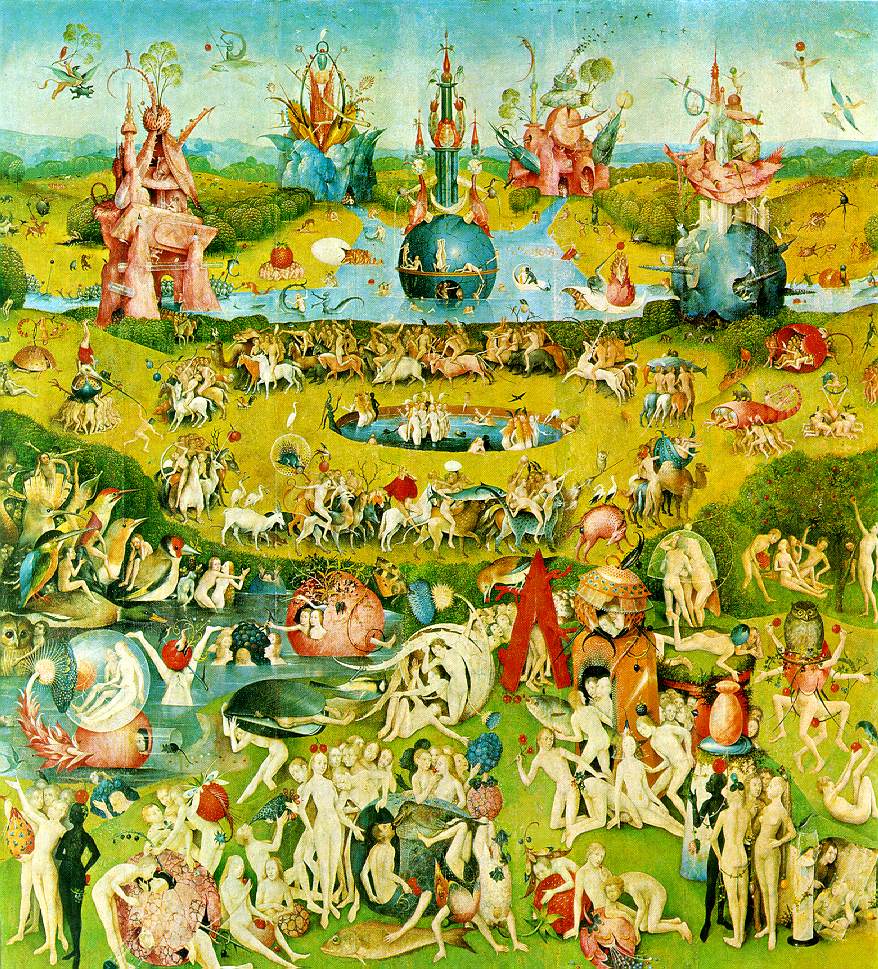
During the European Renaissance, the depiction of the human form became more realistic. One could say this trend preceded the realism in fiction: before you could write "the human condition", you had to visualize it.
Here are some examples of Renaissance paintings. (Bear in mind that in those days there wasn't television or computers, so people gave these paintings a lot more attention than we'd do today.).
A 16th-century painting by Botticelli.
A 16th-century painting by Bosch.
A 16th-century painting by d'Aleccio.
Here are some examples of Renaissance paintings. (Bear in mind that in those days there wasn't television or computers, so people gave these paintings a lot more attention than we'd do today.).
A 16th-century painting by Botticelli.

A 16th-century painting by Bosch.
A 16th-century painting by d'Aleccio.
Thursday, February 09, 2006
The Frog And The Ox
There has been a lot of huffing and puffing in the media over some newspaper cartoons.
Let me tell you this fable by Aesop, and then ponder its meaning...
---------------------------
The Frog and the Ox
"Oh Father," said a little Frog to the big one sitting by the side of a pool, "I have seen such a terrible monster! It was as big as a mountain, with horns on its head, and a long tail, and it had hoofs divided in two."
"Tush, child, tush," said the old Frog, "that was only Farmer White's Ox. It isn't so big either; he may be a little bit taller than I, but I could easily make myself quite as broad; just you
see."
So the old Frog blew himself out, and blew himself out, and blew
himself out.
"Was he as big as that?" asked he.
"Oh, much bigger than that," said the young Frog.
Again the old one blew himself out, and asked the young one if the Ox was as big as that.
"Bigger, father, bigger," was the reply.
So the Frog took a deep breath, and blew and blew and blew,
and swelled and swelled and swelled.
And then he said: "I'm sure the Ox is not as big as --"
But at that moment he burst.
Self-conceit may lead to self-destruction.
---------------------------
Let me tell you this fable by Aesop, and then ponder its meaning...
---------------------------
The Frog and the Ox
"Oh Father," said a little Frog to the big one sitting by the side of a pool, "I have seen such a terrible monster! It was as big as a mountain, with horns on its head, and a long tail, and it had hoofs divided in two."
"Tush, child, tush," said the old Frog, "that was only Farmer White's Ox. It isn't so big either; he may be a little bit taller than I, but I could easily make myself quite as broad; just you
see."
So the old Frog blew himself out, and blew himself out, and blew
himself out.
"Was he as big as that?" asked he.
"Oh, much bigger than that," said the young Frog.
Again the old one blew himself out, and asked the young one if the Ox was as big as that.
"Bigger, father, bigger," was the reply.
So the Frog took a deep breath, and blew and blew and blew,
and swelled and swelled and swelled.
And then he said: "I'm sure the Ox is not as big as --"
But at that moment he burst.
Self-conceit may lead to self-destruction.
---------------------------
Monday, January 30, 2006
Quote: "Phony Review Writers Are The Dumbest On The Planet"
The above quote is taken from a discussion thread on the ASIMOV's Messageboard.
Phony book-reviews on Amazon.com are legion - but they are easy to spot. So why are they so badly written, so tacky, so transparently fake?
Because of stupidity. If a writer is so dumb as to not see the faults of his self-published books, he will be more than dumb enough to think he can write fake self-praise and get away with it.
It's like the old joke: "Why did the idiot jump from the Empire State Building? He wanted to be a big hit on Broadway."
How to spot phony reviews:
* Look for absurd comparisons like "Better than Harry Potter!", "up there with the Bible!";
* Fakers use weird phrasings like "the conclusion is implosive" or "this year's classic" or "philosophically action-packed";
* ANY book review that trumpets a book's great philosophical breakthroughs is a bit suspect;
* Fake or dubious credentials (i.e. referring to non-existent magazines or critics);
* Aggressive attacks on negative reviews;
* If you compare the reviewer's OTHER reviews, they are the same inflated praise of one single writer;
* The reviewer uses reviews of famous writers (such as J.K. Rowling) to sneak in "plugs" for the writer he fakes for (i.e. "Harry Potter is not as good as this book by X");
* The reviewer's name sounds phony, or he uses a pseudonym;
* He consistently gives 5 stars out of 5 for every book by a single writer.
If you are even THINKING of writing phony reviews of your own stuff... get out of my blog right now!
Phony book-reviews on Amazon.com are legion - but they are easy to spot. So why are they so badly written, so tacky, so transparently fake?
Because of stupidity. If a writer is so dumb as to not see the faults of his self-published books, he will be more than dumb enough to think he can write fake self-praise and get away with it.
It's like the old joke: "Why did the idiot jump from the Empire State Building? He wanted to be a big hit on Broadway."
How to spot phony reviews:
* Look for absurd comparisons like "Better than Harry Potter!", "up there with the Bible!";
* Fakers use weird phrasings like "the conclusion is implosive" or "this year's classic" or "philosophically action-packed";
* ANY book review that trumpets a book's great philosophical breakthroughs is a bit suspect;
* Fake or dubious credentials (i.e. referring to non-existent magazines or critics);
* Aggressive attacks on negative reviews;
* If you compare the reviewer's OTHER reviews, they are the same inflated praise of one single writer;
* The reviewer uses reviews of famous writers (such as J.K. Rowling) to sneak in "plugs" for the writer he fakes for (i.e. "Harry Potter is not as good as this book by X");
* The reviewer's name sounds phony, or he uses a pseudonym;
* He consistently gives 5 stars out of 5 for every book by a single writer.
If you are even THINKING of writing phony reviews of your own stuff... get out of my blog right now!
Saturday, January 28, 2006
The BONANZA Plot Problem
I'm sitting here by the computer, while the TV is showing an old BONANZA episode in the background... and suddenly it hits me:
The Cartwright Family is living in the most violent place on Earth.
I mean, people there get shot to death or otherwise killed EVERY WEEK! And it all happens in one small region of Nevada between Virginia City and the Ponderosa ranch.
Their ranch is supposed to be near Virginia City, Nevada, in the late 19th century.... but it looks much more like Bogota, Colombia, today. The Cartwrights are a regular death squad! They must have killed more people than Wyatt Earp. (If you're in a morbid mood, search on Wikipedia how many characters got killed over the course of the entire BONANZA series...)
If one watches a whole season of BONANZA, one gets the impression that every dysfunctional family with a violent patriarch, every gang of bank-robbers and cattle-thieves, every rapist, cutthroat, lowlife and scumbag, is just flocking to the Cartwrights' spacious back yard.
(Which begs the question: why don't the Cartwrights move to a more peaceful county?)
And if we were to take the BONANZA Situation realistically, all this violence would have consequences:
1. Law-abiding families and businesses would move out in droves, making Virginia City an
impoverished slum -- or worse, a ghost town;
2. The local Congressman would go to Washington, D.C. and ask for Federal intervention: "Every seven days it's the same -- The Cartwrights kill people! We need a permanent U.S. Cavalry base to keep the order in this den of crime and gunfire!"
3. Someone would start a criminal investigation of the Cartwrights: "The whole area is littered with spent casings from Colt cartridges. A firing test shows that they match the guns of the Cartwright brothers. Take'em in for questioning!"
4. The psychological stress of living in this world of almost constant shootings, beatings and deaths would cause the brothers to go crazy, suicidally depressed, or psychopathic. But considering the ease with which they kill people and shrug it off -- plus the fact that all their girlfriends get killed or escape -- they may always have been psychopaths.
Jokes aside... this is a generic plot problem with almost any TV series, and sometimes shows up in novels too. If you concentrate too many dramatic events in a very small time and space, the plot becomes too far-fetched. (*COUGH*24*COUGH*)
(The exception is if the story is meant to be comedy, spoof, send-up, camp or satire.)
Now, the real reason why TV shows have too little "space" for the action is that locations and sets cost money. Money is the big "hidden variable" of television, and causes TV scriptwriters great headaches:
"How can we afford to send our heroes to Paris this week? I know: Let's skip new locations and travel entirely! We'll have everything happen in L.A. in realtime!"
(And thus, 24 was born...)
Written fiction, on the other hand, can afford its characters to travel around a lot more. And travel itself extends the time of the story, which eliminates much of the "time-compression" problem seen in BONANZA and other shows. (*COUGH*24*COUGH*).
Even so: novel writers watch TV (I do -- way too much ;-)), and thus they might pick up some bad plotting habits from television writers.
You shouldn't compress too much action and plot into too little space and time.
In the real world, the space of a normal human lifetime includes very few dramatic events like fights, violent deaths, dramatic accidents and such.
If you want to write a plot full of action, you must set up a situation in which this makes sense. (War is one such situation where lots of drama and violence is credible. Other situations with dramatic potential are revolution, social upheaval, or natural disasters.)
The Cartwright Family is living in the most violent place on Earth.
I mean, people there get shot to death or otherwise killed EVERY WEEK! And it all happens in one small region of Nevada between Virginia City and the Ponderosa ranch.
Their ranch is supposed to be near Virginia City, Nevada, in the late 19th century.... but it looks much more like Bogota, Colombia, today. The Cartwrights are a regular death squad! They must have killed more people than Wyatt Earp. (If you're in a morbid mood, search on Wikipedia how many characters got killed over the course of the entire BONANZA series...)
If one watches a whole season of BONANZA, one gets the impression that every dysfunctional family with a violent patriarch, every gang of bank-robbers and cattle-thieves, every rapist, cutthroat, lowlife and scumbag, is just flocking to the Cartwrights' spacious back yard.
(Which begs the question: why don't the Cartwrights move to a more peaceful county?)
And if we were to take the BONANZA Situation realistically, all this violence would have consequences:
1. Law-abiding families and businesses would move out in droves, making Virginia City an
impoverished slum -- or worse, a ghost town;
2. The local Congressman would go to Washington, D.C. and ask for Federal intervention: "Every seven days it's the same -- The Cartwrights kill people! We need a permanent U.S. Cavalry base to keep the order in this den of crime and gunfire!"
3. Someone would start a criminal investigation of the Cartwrights: "The whole area is littered with spent casings from Colt cartridges. A firing test shows that they match the guns of the Cartwright brothers. Take'em in for questioning!"
4. The psychological stress of living in this world of almost constant shootings, beatings and deaths would cause the brothers to go crazy, suicidally depressed, or psychopathic. But considering the ease with which they kill people and shrug it off -- plus the fact that all their girlfriends get killed or escape -- they may always have been psychopaths.
Jokes aside... this is a generic plot problem with almost any TV series, and sometimes shows up in novels too. If you concentrate too many dramatic events in a very small time and space, the plot becomes too far-fetched. (*COUGH*24*COUGH*)
(The exception is if the story is meant to be comedy, spoof, send-up, camp or satire.)
Now, the real reason why TV shows have too little "space" for the action is that locations and sets cost money. Money is the big "hidden variable" of television, and causes TV scriptwriters great headaches:
"How can we afford to send our heroes to Paris this week? I know: Let's skip new locations and travel entirely! We'll have everything happen in L.A. in realtime!"
(And thus, 24 was born...)
Written fiction, on the other hand, can afford its characters to travel around a lot more. And travel itself extends the time of the story, which eliminates much of the "time-compression" problem seen in BONANZA and other shows. (*COUGH*24*COUGH*).
Even so: novel writers watch TV (I do -- way too much ;-)), and thus they might pick up some bad plotting habits from television writers.
You shouldn't compress too much action and plot into too little space and time.
In the real world, the space of a normal human lifetime includes very few dramatic events like fights, violent deaths, dramatic accidents and such.
If you want to write a plot full of action, you must set up a situation in which this makes sense. (War is one such situation where lots of drama and violence is credible. Other situations with dramatic potential are revolution, social upheaval, or natural disasters.)
Sunday, January 22, 2006
Listen To Jonathan Sherwood..
Jonathan Sherwood, an American writer who's been published in ASIMOV's, has a great column on writing. If you are the least bit serious about writing fiction, read it.
Here is a quote from Sherwood's column "Forget the Audience, Who Are You Writing For?" which ought to be required reading:
------------------------
1) You’re writing so readers will say, “You’re cool.”
2) You’re writing so readers will say, “This story is cool.”
3) You’re writing so readers will say, “Life is cool.”
------------------------
The 3 levels of a writer's maturity. Read the rest.
Here is a quote from Sherwood's column "Forget the Audience, Who Are You Writing For?" which ought to be required reading:
------------------------
1) You’re writing so readers will say, “You’re cool.”
2) You’re writing so readers will say, “This story is cool.”
3) You’re writing so readers will say, “Life is cool.”
------------------------
The 3 levels of a writer's maturity. Read the rest.
Thursday, January 12, 2006
The Soundtrack Of Our Lives
Tell you a secret: I don't really write stories.
I make music videos in my mind.
Then I try to transfer them into written text. (It doesn't always succeed.) The result is a novel, or short story.
That's why I almost never write a longer story or novel without listening to inspirational music. It's the soundtrack of the video I'm composing in my head.
(You should ask other people who write, if they also work this way... I'd really like to know.)
Right now I'm listening to Robyn's latest album, and thinking: "Now, what stories would go with these songs...?" I'm sure I'll think of something. (Thanks, Robyn.)
I make music videos in my mind.
Then I try to transfer them into written text. (It doesn't always succeed.) The result is a novel, or short story.
That's why I almost never write a longer story or novel without listening to inspirational music. It's the soundtrack of the video I'm composing in my head.
(You should ask other people who write, if they also work this way... I'd really like to know.)
Right now I'm listening to Robyn's latest album, and thinking: "Now, what stories would go with these songs...?" I'm sure I'll think of something. (Thanks, Robyn.)
Sunday, January 08, 2006
Actual Quotes From The Slushpile...
Whenever my confidence in my writing abilities gets low (such as when I proofread my own stuff), it helps to think that many others are more confident but less talented...
Look at these actual quotes from the slushpile of magazine ASIMOV's Science Fiction. You can't make this stuff up! (From the blog of Miss Snark, the literary agent.)
My favorite quotes from the collection:
"Weston was known for the firm but genital hold he had on his men. It was one of the reasons he was chosen for this mission over six other equally qualified men. "
(Ouch!)
"The two naked bodies, which were lying beneath the satin sheets, were no longer the people whom everyone, who was anyone, knew whenever reality was in existance. "
(Say what??)
"Sudenly, all the eyes in the room rose from their fixed positions on the floor to stare at him. "
(That last one MIGHT have been quoted from a science-fiction story about a planet of living floors... but I'm not sure. ;-))
Look at these actual quotes from the slushpile of magazine ASIMOV's Science Fiction. You can't make this stuff up! (From the blog of Miss Snark, the literary agent.)
My favorite quotes from the collection:
"Weston was known for the firm but genital hold he had on his men. It was one of the reasons he was chosen for this mission over six other equally qualified men. "
(Ouch!)
"The two naked bodies, which were lying beneath the satin sheets, were no longer the people whom everyone, who was anyone, knew whenever reality was in existance. "
(Say what??)
"Sudenly, all the eyes in the room rose from their fixed positions on the floor to stare at him. "
(That last one MIGHT have been quoted from a science-fiction story about a planet of living floors... but I'm not sure. ;-))
Wednesday, January 04, 2006
Humiliation Of Writers
Writers who are experiencing their first success must be prepared for humiliating experiences.
Well-meaning persons will ask you things like, "So you'll be rich now?" (Though I think that's thinly disguised sarcasm.)
Tobias S. Buckell and Justine Larbalestier share their humiliations with us. I salute their courage.
Well-meaning persons will ask you things like, "So you'll be rich now?" (Though I think that's thinly disguised sarcasm.)
Tobias S. Buckell and Justine Larbalestier share their humiliations with us. I salute their courage.
Sunday, January 01, 2006
Happy New Year!
My 2006 New Year's resolutions:
1. Lose 10 kilos overweight.
2. Finish my first "military SF" novel, THE TALE OF THE SOLDIESSE.
3. Get more fiction published in China.
4. Start working on my third TERRA HEXA novel to come out in Sweden.
5. Sell my first TERRA HEXA novel to a publisher outside Sweden (perhaps China???)
6. Sell my SF movie script, THE FATHER MACHINE.
7. Start working on an SF novel for the India market.
8. Piss on Saddam Hussein's grave. ;-)
9. Get a new girlfriend.
Aaand...
10. Read through my pile of unread books and magazines.
Happy New Year, folks!
1. Lose 10 kilos overweight.
2. Finish my first "military SF" novel, THE TALE OF THE SOLDIESSE.
3. Get more fiction published in China.
4. Start working on my third TERRA HEXA novel to come out in Sweden.
5. Sell my first TERRA HEXA novel to a publisher outside Sweden (perhaps China???)
6. Sell my SF movie script, THE FATHER MACHINE.
7. Start working on an SF novel for the India market.
8. Piss on Saddam Hussein's grave. ;-)
9. Get a new girlfriend.
Aaand...
10. Read through my pile of unread books and magazines.
Happy New Year, folks!
Thursday, December 29, 2005
King Kong As A Dirty Old Man
During the Xmas holidays, I and some of my relatives went to the cinema. My sister and her hubby went to see Disney's NARNIA movie, while me and my old mother went to see Peter Jackson's KING KONG remake.
Mom walked out halfway through KING KONG, saying out loud: "This is ridiculous."
(That was a bad sign. Normally she loves science fiction films.)
When the heroine started climbing after Kong up the skyscraper, I was tempted to walk out, too.
And just before Kong fell off the skyscraper, when Kong and the heroine exchanged looooooong teary-eyed looks, I thought: "If they start French-kissing, I'm OUTTA here." But, having paid good money (and being a cheapskate) I stayed through the entire film. It didn't improve.
Why does this remake fail as a coherent piece of storytelling? The easy answer is, it's too badly pieced together, overlong, and full of inconsistencies. (For example, how did the natives suddenly disappear from Skull Island?)
But personally, I reacted most strongly to the significance of making Kong an old, aging gorilla instead of a monster-as-primal-force-of-nature. Briefly put, Peter Jackson's KING KONG is a "Horny Old Man" plot.
Look: here you've got this hot young thing visibly and explicitly falling in love with a grumpy, scarred old gorilla with a human personality. This is a completely different Kong from the 1933 and 1976 versions. Both previous versions made Kong a beast in his prime, a larger-than-life figure.
Also, in Jackson's version, the young heroine is more in love with than she's sensibly afraid of a giant hungry monster who might kill her just as well as play with her.
In other words, when you ask yourself "What's it all about?" you think "It's about an ugly old man needing the love of a much younger and prettier person, and how to make this seem noble, romantic and rebellious - despite the fact that it's so overwrought, self-righteous and downright perverse."
It's the kind of plot that Bernardo Bertolucci did in LAST TANGO IN PARIS, or perhaps Thomas Mann with DEATH IN VENICE.
I loathe "Horny Old Man" plots! They pander to dirty old men, and I'm not one.
Also, the ending of Jackson's KING KONG is a big stinking lie. It wasn't "Beauty killed the Beast" in this version. It's the director Carl Denham - a metaphor for the director of KING KONG if there ever was one - who, against the forceful protests of the heroine, captured Kong and brought him to New York. And yet he says "It was Beauty killed the Beast" and we're supposed to believe it. I didn't.
So what went wrong?
Well, it appears the scriptwriters and the director got confused about what their story is "about"... and precisely for that reason, because they didn't really know the meaning of the story they wanted to tell, it turned into a "Horny Old Man" story. How exactly this came to pass is beyond me (Peter Jackson isn't that old) ... but maybe they took the "Kong" character too literally - he's supposed to be a monster, not a real person.
And what are monsters? Emblems of fear and guilt...
When you miss the point of a metaphor and interpret it literally - "he's this big gorilla, and there's just one of him, so logically he must be old and lonely"- you get fundamentalism, shallowness and ultimately stupidity.
Now go see the original version. It makes more sense - and it's less racist, too. Yes, it's true. Watch that scene in the 1933 version, where the Skull Island natives and Denham's expedition work together to block the gate that keeps Kong out. It shows, without the need for lofty speeches, that the natives and the "whites" are in the same boat.
But in Jackson's version, the natives are monsters - mindless, vicious murderers, totally without redeeming features, barely human - and so Jackson tacks on an idiotic, phony "message" bit just at the end, and thinks he's taken a stand against racism.
(Yeah, it's the scene where a bystander says Kong pointlessly climbed the tower because he was one of those dumb animals who can't think... while a single African-American man walks past to imply that the bystander is "really" talking about him. The pot calling the kettle black, eh, Mr. Jackson?)
-----------------------------
UPDATE:
Lucius Shepard has a very good (negative) review of the film here:
"Everybody Loves-a Da Big Monkey"
Mom walked out halfway through KING KONG, saying out loud: "This is ridiculous."
(That was a bad sign. Normally she loves science fiction films.)
When the heroine started climbing after Kong up the skyscraper, I was tempted to walk out, too.
And just before Kong fell off the skyscraper, when Kong and the heroine exchanged looooooong teary-eyed looks, I thought: "If they start French-kissing, I'm OUTTA here." But, having paid good money (and being a cheapskate) I stayed through the entire film. It didn't improve.
Why does this remake fail as a coherent piece of storytelling? The easy answer is, it's too badly pieced together, overlong, and full of inconsistencies. (For example, how did the natives suddenly disappear from Skull Island?)
But personally, I reacted most strongly to the significance of making Kong an old, aging gorilla instead of a monster-as-primal-force-of-nature. Briefly put, Peter Jackson's KING KONG is a "Horny Old Man" plot.
Look: here you've got this hot young thing visibly and explicitly falling in love with a grumpy, scarred old gorilla with a human personality. This is a completely different Kong from the 1933 and 1976 versions. Both previous versions made Kong a beast in his prime, a larger-than-life figure.
Also, in Jackson's version, the young heroine is more in love with than she's sensibly afraid of a giant hungry monster who might kill her just as well as play with her.
In other words, when you ask yourself "What's it all about?" you think "It's about an ugly old man needing the love of a much younger and prettier person, and how to make this seem noble, romantic and rebellious - despite the fact that it's so overwrought, self-righteous and downright perverse."
It's the kind of plot that Bernardo Bertolucci did in LAST TANGO IN PARIS, or perhaps Thomas Mann with DEATH IN VENICE.
I loathe "Horny Old Man" plots! They pander to dirty old men, and I'm not one.
Also, the ending of Jackson's KING KONG is a big stinking lie. It wasn't "Beauty killed the Beast" in this version. It's the director Carl Denham - a metaphor for the director of KING KONG if there ever was one - who, against the forceful protests of the heroine, captured Kong and brought him to New York. And yet he says "It was Beauty killed the Beast" and we're supposed to believe it. I didn't.
So what went wrong?
Well, it appears the scriptwriters and the director got confused about what their story is "about"... and precisely for that reason, because they didn't really know the meaning of the story they wanted to tell, it turned into a "Horny Old Man" story. How exactly this came to pass is beyond me (Peter Jackson isn't that old) ... but maybe they took the "Kong" character too literally - he's supposed to be a monster, not a real person.
And what are monsters? Emblems of fear and guilt...
When you miss the point of a metaphor and interpret it literally - "he's this big gorilla, and there's just one of him, so logically he must be old and lonely"- you get fundamentalism, shallowness and ultimately stupidity.
Now go see the original version. It makes more sense - and it's less racist, too. Yes, it's true. Watch that scene in the 1933 version, where the Skull Island natives and Denham's expedition work together to block the gate that keeps Kong out. It shows, without the need for lofty speeches, that the natives and the "whites" are in the same boat.
But in Jackson's version, the natives are monsters - mindless, vicious murderers, totally without redeeming features, barely human - and so Jackson tacks on an idiotic, phony "message" bit just at the end, and thinks he's taken a stand against racism.
(Yeah, it's the scene where a bystander says Kong pointlessly climbed the tower because he was one of those dumb animals who can't think... while a single African-American man walks past to imply that the bystander is "really" talking about him. The pot calling the kettle black, eh, Mr. Jackson?)
-----------------------------
UPDATE:
Lucius Shepard has a very good (negative) review of the film here:
"Everybody Loves-a Da Big Monkey"
Thursday, December 22, 2005
My Short Story in BYZARIUM
The webzine BYZARIUM bought and published my short horror story "Nightmare Number Six" in it December 2005 issue.
Read it for free here.
(The story's title was inspired by Robert Bloch's story-poem "Nightmare Number Four".)
Read it for free here.
(The story's title was inspired by Robert Bloch's story-poem "Nightmare Number Four".)
Films About Writers & Writing
I like film just as much as reading and writing. Trying to depict the writing process on film is rarely successful, since most of the "action" takes place in the writer's mind.
But here are some interesting, entertaining (and scary) movies about writers and the writing process:
WONDER BOYS (2000) - Based on the novel by Michael Chabon, this movie is really about procrastination and aging. The protagonist has been stuck on his unfinished Great American Novel for years, while younger and hungrier colleagues are experiencing their first major success. How does one fail gracefully? A love song to the loser in every writer.
IN THE MOUTH OF MADNESS, (a.k.a. JOHN CARPENTER'S IN THE MOUTH OF MADNESS (1994)) - This is a guilty pleasure. A horror hackwriter, inspired by Stephen King and H.P.Lovecraft, becomes so successful that his books become real. Silly, yes, but makes you think about what fiction means to people.
MISERY (2000) - based on Stephen King's novel, this is a writer's own personal nightmare: the crazed fan who won't let him "bury" a popular character - she'd rather bury him!
BARTON FINK (1991) - may not be to everyone's taste, but it has several interesting things to say. First, this writer protagonist is an unpleasant, pretentious character - he thinks he's writing for "the common man" but he's not. Second, it portrays a writer who sells out to Hollywood - and fails. Third, it deals with writer's block.
Enjoy these movies when you're stuck in your own writing...
But here are some interesting, entertaining (and scary) movies about writers and the writing process:
WONDER BOYS (2000) - Based on the novel by Michael Chabon, this movie is really about procrastination and aging. The protagonist has been stuck on his unfinished Great American Novel for years, while younger and hungrier colleagues are experiencing their first major success. How does one fail gracefully? A love song to the loser in every writer.
IN THE MOUTH OF MADNESS, (a.k.a. JOHN CARPENTER'S IN THE MOUTH OF MADNESS (1994)) - This is a guilty pleasure. A horror hackwriter, inspired by Stephen King and H.P.Lovecraft, becomes so successful that his books become real. Silly, yes, but makes you think about what fiction means to people.
MISERY (2000) - based on Stephen King's novel, this is a writer's own personal nightmare: the crazed fan who won't let him "bury" a popular character - she'd rather bury him!
BARTON FINK (1991) - may not be to everyone's taste, but it has several interesting things to say. First, this writer protagonist is an unpleasant, pretentious character - he thinks he's writing for "the common man" but he's not. Second, it portrays a writer who sells out to Hollywood - and fails. Third, it deals with writer's block.
Enjoy these movies when you're stuck in your own writing...
Wednesday, December 21, 2005
Feedback - Rules Of Thumb
Not all editors give you a pre-written rejection slip.
Some offer substantial constructive feedback, and suggestions for improvement. I'm glad when I receive such feedback, even when I don't agree with all suggestions.
Now, receiving reader/editor feedback is a test of your true character....
If you can't bring yourself to listen to ANY suggestion, no matter how trivial, you're a crank. Cranks rarely write stuff that others want to read.
If you mindlessly accept ANY suggestion, no matter how absurd, you're spineless. You'll become a rich, successful Hollywood script-hack -- but you'll never be a good writer. (Cry all the way to the bank.)
So how do you know if a suggestion is worth listening to? A few rules of thumb:
1. Always, ALWAYS take spelling advice seriously. I don't care if you've got a degree in linguistics, I don't care if you won the 1994 national spelling bee - look it up in a dictionary.
2. When someone suggests that a character name or the story/novel title should be changed, it could be either good or bad advice. People can show unbelievably bad judgment in their choice of names - just look at the names some people give their own babies! Trust your instincts.
3. Plot changes: If the suggested change makes the plot more difficult to follow, REJECT it. If the suggested change makes the plot easier to follow, CONSIDER or ACCEPT it.
4. Never take writing advice from your parents. (Never ask them.)
Some offer substantial constructive feedback, and suggestions for improvement. I'm glad when I receive such feedback, even when I don't agree with all suggestions.
Now, receiving reader/editor feedback is a test of your true character....
If you can't bring yourself to listen to ANY suggestion, no matter how trivial, you're a crank. Cranks rarely write stuff that others want to read.
If you mindlessly accept ANY suggestion, no matter how absurd, you're spineless. You'll become a rich, successful Hollywood script-hack -- but you'll never be a good writer. (Cry all the way to the bank.)
So how do you know if a suggestion is worth listening to? A few rules of thumb:
1. Always, ALWAYS take spelling advice seriously. I don't care if you've got a degree in linguistics, I don't care if you won the 1994 national spelling bee - look it up in a dictionary.
2. When someone suggests that a character name or the story/novel title should be changed, it could be either good or bad advice. People can show unbelievably bad judgment in their choice of names - just look at the names some people give their own babies! Trust your instincts.
3. Plot changes: If the suggested change makes the plot more difficult to follow, REJECT it. If the suggested change makes the plot easier to follow, CONSIDER or ACCEPT it.
4. Never take writing advice from your parents. (Never ask them.)
Tuesday, November 29, 2005
Men Writing Women, Women Writing Men
Should you expect male writers to be better at depicting male characters than female characters? What about women writers? Does every writer reveal his/her gender bias in prose?
This is a fascinating subject - read the discussion thread on the ASIMOV's Messageboard, where I put in a comment.
The gist of my argument in that thread is that any character must be placed in a believable context(setting) to make sense. Stereotypes become all the more glaring if they occur in a setting where you wouldn't expect to find them in the first place.
Of course a female character can be wimpy, helpless and neurotic - if you put her in a credible setting. For example in the upper middle class, a mental institution, or in serious trouble.
But if you place her in a spaceship crew going to Mars, she's a stereotype. (Helpless, neurotic persons can't become astronauts.)
Another common example is when characters in a historical context behave in a way that is too modern for the setting. I read one of Jean M. Auel's novel Stone Age romances (as a teenager, you learned to find the sexy parts), I reacted to this: one Stone Age character talks about being "depressed".
The term "depressed" implies a whole apparatus of knowledge, culture and ideas of the human psyche which plain couldn't exist 30-50,000 years ago. Prehistoric people didn't know what a "mind" was, and the earliest written stories (THE ILIAD, GILGAMESH etc.) suggest very different concept of the "soul".
Homer would not speak of "depression". With that word, the character reveals itself as out-of-place in the Stone Age setting, just as if she had said "Got some Prozac?"
When you write a character, remember: the more out-of-place your characters seem, the more your story resembles comedy. If it is comedy you want to write, that's fine...
This is a fascinating subject - read the discussion thread on the ASIMOV's Messageboard, where I put in a comment.
The gist of my argument in that thread is that any character must be placed in a believable context(setting) to make sense. Stereotypes become all the more glaring if they occur in a setting where you wouldn't expect to find them in the first place.
Of course a female character can be wimpy, helpless and neurotic - if you put her in a credible setting. For example in the upper middle class, a mental institution, or in serious trouble.
But if you place her in a spaceship crew going to Mars, she's a stereotype. (Helpless, neurotic persons can't become astronauts.)
Another common example is when characters in a historical context behave in a way that is too modern for the setting. I read one of Jean M. Auel's novel Stone Age romances (as a teenager, you learned to find the sexy parts), I reacted to this: one Stone Age character talks about being "depressed".
The term "depressed" implies a whole apparatus of knowledge, culture and ideas of the human psyche which plain couldn't exist 30-50,000 years ago. Prehistoric people didn't know what a "mind" was, and the earliest written stories (THE ILIAD, GILGAMESH etc.) suggest very different concept of the "soul".
Homer would not speak of "depression". With that word, the character reveals itself as out-of-place in the Stone Age setting, just as if she had said "Got some Prozac?"
When you write a character, remember: the more out-of-place your characters seem, the more your story resembles comedy. If it is comedy you want to write, that's fine...
Subscribe to:
Posts (Atom)