So, once you have your mansucript done, revised, proofed, ready for publication... what do you do?
You send away your manuscript to a Big Publisher, and think it will succeed or fail on its own merits.
SUCKER!
Getting published by a large publisher, unless your name is already well-known, is a completely randomized process. Michael Allen reveals how manuscripts are REALLY selected (or not), in his tell-all book On the Survival of Rats in the Slush Pile.
It's recommended reading for writers. Honestly, I didn't think the state of Big Corporate Publishing was THIS bad -- until I read Allen's book. I learned several useful lessons:
1. "Nobody knows anything." Modern Big Publishing is a complete lottery, and the odds are stacked against writers.
2. The best way to keep a cool head is to write what YOU enjoy writing, and not write for money/fame. (Or write for your friends and family.)
3. Ignore Big Publishers. No, really. S****'em. Find a small publisher that's willing to publish your work at a low cost (read: low financial risk) and nurture your talent over time.
(If, against near-impossible odds, you SHOULD get a deal with a Big Publisher, you are s****d. Because the Big Publisher will give you one chance to sell humongously well with your first published novel... and if you don't, they'll toss you aside like a used Kleenex. You don't get to hear about this a lot, because people tend to ignore all the writers who bombed, and focus on the spectacular successes.)
Monday, May 08, 2006


Monday, May 01, 2006
John Scalzi Gives Advice To Teenage Writers
As you may have heard, a teenage writer by the name Christopher Paolini has had huge success with his ERAGON book series. This sort of thing doesn't happen often.
Teenage prodigies are still rare in book-writing. Why is that? John Scalzi explains in "10 Things Teenage Writers Should Know About Writing."
Teenage prodigies are still rare in book-writing. Why is that? John Scalzi explains in "10 Things Teenage Writers Should Know About Writing."
Sunday, April 30, 2006
"As You Know, Bob..."
The Turkey City Lexicon, A Primer for SF Workshops, is an eminently useful checklist of typical errors and bad writing clichés that turn up in science fiction writing workshops.
Bookmark it.
Do you attend writing workshops? They can be a lot of fun, and you can learn a lot. Well, it depends on the people who attend it. Come to the workshop with an open mind and open ears.
This Wikipedia entry lists several well-known writing workshops and links to them.
As for myself... I live in Scandinavia and can't find workshops near where I live. So I'll have to manage with the Baen's Universe Slushpile for peer review...
Bookmark it.
Do you attend writing workshops? They can be a lot of fun, and you can learn a lot. Well, it depends on the people who attend it. Come to the workshop with an open mind and open ears.
This Wikipedia entry lists several well-known writing workshops and links to them.
As for myself... I live in Scandinavia and can't find workshops near where I live. So I'll have to manage with the Baen's Universe Slushpile for peer review...
Monday, April 24, 2006
Stross On 1st, 2nd and 3rd Person Style
Acclaimed SF writer Charles Stross has posted an essay on the perspective-problem in fiction writing:
"Conjugate Characters, Not Verbs"
Authors and would-be authors take note: Stross analyzes one of the most difficult stylistic issues ANY writer can come up against. I wholeheartedly recommend his essay.
-------------
And now for something completely different...
I love satire and parody, but I don't like "fan-fiction". I think it's a ******* immature thing to do. Grownups should not write fanfiction; if they are so ******* eager to be writers, they can ******* make up their own original ******* characters.
And now I read about this sad, sad, sad, sad... sad person who not only wrote her own fan-fiction novel set in the STAR WARS universe... but also published it on Amazon.com.
Someone called it an act of "weapons-grade stupidity". That pretty much sums it up, no?
Why do these things happen? I like to think that people are, on the whole, fairly sane. But apparently insanity can strike anyone, at any time. There you are, walking down the street with a clear eye and a sharp mind... and POW! you fall and hit your head.
When you wake up, dazed and confused, you find yourself possessed by a single hypnotizing notion: "I am INSPIRED! I must write a fan-fiction novel and readers will love it because I am so INSPIRED!"
Do not confuse "obsessed" with "inspired".
And don't even try to defend yourself with Special Pleading: "Yeah, of course I know about copyright and all that... but MY fanfic is different! It's as good as the original, in fact!" (Yadda yadda...)
ADDENDUM:
1. Robin Hobb explains why she is opposed to fanfiction.
2. A huge discussion about fanfiction over at Making Light.
"Conjugate Characters, Not Verbs"
Authors and would-be authors take note: Stross analyzes one of the most difficult stylistic issues ANY writer can come up against. I wholeheartedly recommend his essay.
-------------
And now for something completely different...
I love satire and parody, but I don't like "fan-fiction". I think it's a ******* immature thing to do. Grownups should not write fanfiction; if they are so ******* eager to be writers, they can ******* make up their own original ******* characters.
And now I read about this sad, sad, sad, sad... sad person who not only wrote her own fan-fiction novel set in the STAR WARS universe... but also published it on Amazon.com.
Someone called it an act of "weapons-grade stupidity". That pretty much sums it up, no?
Why do these things happen? I like to think that people are, on the whole, fairly sane. But apparently insanity can strike anyone, at any time. There you are, walking down the street with a clear eye and a sharp mind... and POW! you fall and hit your head.
When you wake up, dazed and confused, you find yourself possessed by a single hypnotizing notion: "I am INSPIRED! I must write a fan-fiction novel and readers will love it because I am so INSPIRED!"
Do not confuse "obsessed" with "inspired".
And don't even try to defend yourself with Special Pleading: "Yeah, of course I know about copyright and all that... but MY fanfic is different! It's as good as the original, in fact!" (Yadda yadda...)
ADDENDUM:
1. Robin Hobb explains why she is opposed to fanfiction.
2. A huge discussion about fanfiction over at Making Light.
Saturday, April 15, 2006
Mark Twain on Fenimore Cooper
The essay/polemic "Fenimore Cooper's Literary Offenses" (1895) by Mark Twain is a wonderful case of Karmic Retribution.
Have you ever thought that some books earn the author money and fame despite not being very good? Well, it happens. But please, this is no reason to get cynical and nihilistic. Awful books may surf the wave of the Zeitgeist for a while... but eventually the book's true qualities (or lack of them) will catch up. Many novels which were once praised as "masterpieces" and "art" and sold very well, have now fallen into into disrepute or been forgotten.
Take Fenimore Cooper, for example. Cooper's Western/frontier books Pathfinder, Last of the Mohicans and The Deerslayer were immensely popular in the 1800s and well into the 1900s.
But, as Mark Twain pointed out back in 1895, Cooper couldn't write worth ****. His essay is not only laugh-out-loud funny; it also provides several very good examples of writer pitfalls to avoid.
For example, lazy use of clichés:
"A favorite one was to make a moccasined person tread in the tracks of a moccasined enemy, and thus hide his own trail. Cooper wore out barrels and barrels of moccasins in working that trick. Another stage-property that he pulled out of his box pretty frequently was the broken twig. He prized his broken twig above all the rest of his effects, and worked it the hardest.
"It is a restful chapter in any book of his when somebody doesn't step on a dry twig and alarm all the reds and whites for two hundred yards around. Every time a Cooper person is in peril, and absolute silence is worth four dollars a minute, he is sure to step on a dry twig.
"There may be a hundred other handier things to step on, but that wouldn't satisfy Cooper. Cooper requires him to turn out and find a dry twig; and if he can't do it, go and borrow one. In fact, the Leatherstocking Series ought to have been called the Broken Twig Series."
(From "Fenimore Cooper's Literary Offenses" by Mark Twain)
There's more. Much more! Read and be wiser.
Have you ever thought that some books earn the author money and fame despite not being very good? Well, it happens. But please, this is no reason to get cynical and nihilistic. Awful books may surf the wave of the Zeitgeist for a while... but eventually the book's true qualities (or lack of them) will catch up. Many novels which were once praised as "masterpieces" and "art" and sold very well, have now fallen into into disrepute or been forgotten.
Take Fenimore Cooper, for example. Cooper's Western/frontier books Pathfinder, Last of the Mohicans and The Deerslayer were immensely popular in the 1800s and well into the 1900s.
But, as Mark Twain pointed out back in 1895, Cooper couldn't write worth ****. His essay is not only laugh-out-loud funny; it also provides several very good examples of writer pitfalls to avoid.
For example, lazy use of clichés:
"A favorite one was to make a moccasined person tread in the tracks of a moccasined enemy, and thus hide his own trail. Cooper wore out barrels and barrels of moccasins in working that trick. Another stage-property that he pulled out of his box pretty frequently was the broken twig. He prized his broken twig above all the rest of his effects, and worked it the hardest.
"It is a restful chapter in any book of his when somebody doesn't step on a dry twig and alarm all the reds and whites for two hundred yards around. Every time a Cooper person is in peril, and absolute silence is worth four dollars a minute, he is sure to step on a dry twig.
"There may be a hundred other handier things to step on, but that wouldn't satisfy Cooper. Cooper requires him to turn out and find a dry twig; and if he can't do it, go and borrow one. In fact, the Leatherstocking Series ought to have been called the Broken Twig Series."
(From "Fenimore Cooper's Literary Offenses" by Mark Twain)
There's more. Much more! Read and be wiser.
Wednesday, April 12, 2006
19th-Century Essay: "How To Fail in Literature
Here's a real gem! Back in 1890, Andrew Lang held a lecture on "How To Fail in Literature", and the book of the lecture is now available for free at the Gutenberg Project.
I cannot do justice to Lang's satirical, often hilarious lecture in a single blog post -- so I suggest you simply dive into it.
Here are a few choice quotes from How To Fail in Literature:
"I regard failure as the goal of ignorance, incompetence, lack of common sense, conceited dullness, and certain practical blunders now to be explained and defined."
"The young author generally writes because he wants to write, either for money, from vanity, or in mere weariness of empty hours and anxiety to astonish his relations. This is well, he who would fail cannot begin better than by having nothing to say."
"The less you observe, the less you reflect, the less you put yourself in the paths of adventure and experience, the less you will have to say, and the more impossible will it be to read your work. Never notice people’s manner, conduct, nor even dress, in real life. Walk through the world with your eyes and ears closed, and embody the negative results in a story or a poem."
"If your book does, in spite of all, get itself published, send it with your compliments to critics and ask them for favourable reviews. It is the publisher’s business to send out books to the editors of critical papers, but never mind that. "
"Go on telling critics that you know praise is only given by favour, that they are all more or less venal and corrupt and members of the Something Club, add that you are no member of a côterie nor clique, but that you hope an exception will be made, and that your volume will be applauded on its merits. You will thus have done what in you lies to secure silence from reviewers, and to make them request that your story may be sent to some other critic. This, again, gives trouble, and makes people detest you and your performance, and contributes to the end which you have steadily in view."
"Perhaps reviewing is not exactly a form of literature. But it has this merit that people who review badly, not only fail themselves, but help others to fail, by giving a bad idea of their works. You will, of course, never read the books you review, and you will be exhaustively ignorant of the subjects which they treat. But you can always find fault with the title of the story which comes into your hands, a stupid reviewer never fails to do this."
(All quotes from HOW TO FAIL IN LITERATURE, by Andrew Lang)
Happy Easter! :)
P.S.: But you don't have to be illiterate to be illiterate! This article points out that even the "highly educated" are often awful writers:
Language Crimes: A Lesson in How Not to Write,
Courtesy of the Professoriate
I cannot do justice to Lang's satirical, often hilarious lecture in a single blog post -- so I suggest you simply dive into it.
Here are a few choice quotes from How To Fail in Literature:
"I regard failure as the goal of ignorance, incompetence, lack of common sense, conceited dullness, and certain practical blunders now to be explained and defined."
"The young author generally writes because he wants to write, either for money, from vanity, or in mere weariness of empty hours and anxiety to astonish his relations. This is well, he who would fail cannot begin better than by having nothing to say."
"The less you observe, the less you reflect, the less you put yourself in the paths of adventure and experience, the less you will have to say, and the more impossible will it be to read your work. Never notice people’s manner, conduct, nor even dress, in real life. Walk through the world with your eyes and ears closed, and embody the negative results in a story or a poem."
"If your book does, in spite of all, get itself published, send it with your compliments to critics and ask them for favourable reviews. It is the publisher’s business to send out books to the editors of critical papers, but never mind that. "
"Go on telling critics that you know praise is only given by favour, that they are all more or less venal and corrupt and members of the Something Club, add that you are no member of a côterie nor clique, but that you hope an exception will be made, and that your volume will be applauded on its merits. You will thus have done what in you lies to secure silence from reviewers, and to make them request that your story may be sent to some other critic. This, again, gives trouble, and makes people detest you and your performance, and contributes to the end which you have steadily in view."
"Perhaps reviewing is not exactly a form of literature. But it has this merit that people who review badly, not only fail themselves, but help others to fail, by giving a bad idea of their works. You will, of course, never read the books you review, and you will be exhaustively ignorant of the subjects which they treat. But you can always find fault with the title of the story which comes into your hands, a stupid reviewer never fails to do this."
(All quotes from HOW TO FAIL IN LITERATURE, by Andrew Lang)
Happy Easter! :)
P.S.: But you don't have to be illiterate to be illiterate! This article points out that even the "highly educated" are often awful writers:
Language Crimes: A Lesson in How Not to Write,
Courtesy of the Professoriate
Friday, April 07, 2006
When Genre Prejudice Spits You In The Face, Spit Back
If you write what you WANT to write, you shouldn't give a damn what people think about it.
At least that's the ideal. Ideals won't pay the rent, though...
If you like to write any kind of "genre" fiction (science fiction, fantasy, horror, romance, crime/detective), you will find people who like those "genres"... and you will also encounter people who dislike your fiction simply because it carries a "genre" label.
Of course, tastes differ. I don't read romance novels (it's a guy thing -- you wouldn't understand)... and resent research seems to prove big differences in men's and women's literary tastes. You can't fight biology. I have no issue with that.
But despite differences in taste, I think "genre" labels are mostly a nuisance. They obscure just as much they illuminate. They perpetuate prejudices, and are often used as an excuse for shoddy workmanship.
Here's the skinny, dudes and dudettes: genre labels exist only to help readers and booksellers sort books by label. There is no inherent quality in the label itself!
It's a familiar complaint among science-fiction fans: as soon as a "mainstream" writer has success with a "genre" novel, the critics will pretend it's not "genre" fiction at all:
"If it's good, it can't be SF. If it's SF, it can't be any good."
But the fans are ALSO wrong. Let's look at genre prejudice from another angle.
There are "genre" fans who uncritically devour any crap that carries their favorite "label" -- be it SF, fantasy, crime, romance or "literary" fiction.
I find that totally unacceptable. Didn't I just tell you that there is no inherent quality in the label itself?
So I say: You cannot truly appreciate quality in fiction, unless you learn to rise above the idea of "genre labels". Someone tells you a book "belongs" to a genre. Why not simply ignore the label and ask: "Well, is the book any good?"
"Genre" fans, critics AND writers should stop being so narrow-minded: Genre is not important. Quality is. If you write pap, it's pap no matter what label you put on it.
Just because I write stories about time-travel, space aliens and supernatural terrors doesn't mean I want to get chummy with every person who writes lousy stories about time-travel, space aliens and supernatural terrors.
The same goes for "literary" fiction (just another "genre" label). I don't care if you won the Booker Prize: VERNON GOD LITTLE bored me and I couldn't drag myself through the entire first chapter.
But let's be nice. Tastes change, don't they? People change. They grow up. Our minds become more refined, more mature. Our favorite "themes" may not change much, but with age we require more depth, more realism... and above all, better grammar.
At least that's the ideal. Ideals won't pay the rent, though...
If you like to write any kind of "genre" fiction (science fiction, fantasy, horror, romance, crime/detective), you will find people who like those "genres"... and you will also encounter people who dislike your fiction simply because it carries a "genre" label.
Of course, tastes differ. I don't read romance novels (it's a guy thing -- you wouldn't understand)... and resent research seems to prove big differences in men's and women's literary tastes. You can't fight biology. I have no issue with that.
But despite differences in taste, I think "genre" labels are mostly a nuisance. They obscure just as much they illuminate. They perpetuate prejudices, and are often used as an excuse for shoddy workmanship.
Here's the skinny, dudes and dudettes: genre labels exist only to help readers and booksellers sort books by label. There is no inherent quality in the label itself!
It's a familiar complaint among science-fiction fans: as soon as a "mainstream" writer has success with a "genre" novel, the critics will pretend it's not "genre" fiction at all:
"If it's good, it can't be SF. If it's SF, it can't be any good."
But the fans are ALSO wrong. Let's look at genre prejudice from another angle.
There are "genre" fans who uncritically devour any crap that carries their favorite "label" -- be it SF, fantasy, crime, romance or "literary" fiction.
I find that totally unacceptable. Didn't I just tell you that there is no inherent quality in the label itself?
So I say: You cannot truly appreciate quality in fiction, unless you learn to rise above the idea of "genre labels". Someone tells you a book "belongs" to a genre. Why not simply ignore the label and ask: "Well, is the book any good?"
"Genre" fans, critics AND writers should stop being so narrow-minded: Genre is not important. Quality is. If you write pap, it's pap no matter what label you put on it.
Just because I write stories about time-travel, space aliens and supernatural terrors doesn't mean I want to get chummy with every person who writes lousy stories about time-travel, space aliens and supernatural terrors.
The same goes for "literary" fiction (just another "genre" label). I don't care if you won the Booker Prize: VERNON GOD LITTLE bored me and I couldn't drag myself through the entire first chapter.
But let's be nice. Tastes change, don't they? People change. They grow up. Our minds become more refined, more mature. Our favorite "themes" may not change much, but with age we require more depth, more realism... and above all, better grammar.
Monday, April 03, 2006
Short Stories Up For Review in the Baen Slushpile Messageboard
The new magazine BAEN'S UNIVERSE has created an original review system for stories submitted for review.
You might call it "outsourced editing": The writer posts a story on the Baen's Universe Slush messageboard.
Then the readers can log in, read the story and post their comments, suggestions and criticisms in the Slush Comments section. The writer reads the comments, posts revised versions of the story, and the process goes around until the story is deemed good enough for proper submission to the Editor.
The advantage of this system is that it provides writers with free editing. You get fast and specific feedback from readers, instead of waiting weeks or months for a brief reply from an editor.
Is this review system the wave of the future? You tell me...
I have recently posted THREE stories for review there:
"SEE", "The Five Fingers" and "The Battery Vanishes".
(You need to be logged in to read them, but it's free.)
UPDATE: a new, extended and somewhat changed version of "The Battery Vanishes" has been posted here:
http://bar.baen.com/WB/default.asp?action=9&read=80736&fid=65
You might call it "outsourced editing": The writer posts a story on the Baen's Universe Slush messageboard.
Then the readers can log in, read the story and post their comments, suggestions and criticisms in the Slush Comments section. The writer reads the comments, posts revised versions of the story, and the process goes around until the story is deemed good enough for proper submission to the Editor.
The advantage of this system is that it provides writers with free editing. You get fast and specific feedback from readers, instead of waiting weeks or months for a brief reply from an editor.
Is this review system the wave of the future? You tell me...
I have recently posted THREE stories for review there:
"SEE", "The Five Fingers" and "The Battery Vanishes".
(You need to be logged in to read them, but it's free.)
UPDATE: a new, extended and somewhat changed version of "The Battery Vanishes" has been posted here:
http://bar.baen.com/WB/default.asp?action=9&read=80736&fid=65
Thursday, March 23, 2006
My Short Story "Sins Of Our Fathers" in THE FIRST BEWILDERING STORIES ANTHOLOGY
The editors of the webzine BEWILDERING STORIES, Jerry Wright and Don Webb, have released THE FIRST BEWILDERING STORIES ANTHOLOGY: "Twenty-eight illustrated stories drawn from the first 180 issues of Bewildering Stories Magazine."
My story "Sins of Our Fathers" is included in the anthology.
"Sins of Our Fathers" originally appeared in the Indian webzine ADBHUT (February 2004), then in Bewildering Stories #113, then in my self-published collection THE FACE IN THE DOOR And Other Stories (2006).
It is a straightforward "extrapolation" type of story: take a current tendency and project it forward in time. "If people in Asia keep aborting unborn girls and favoring the birth of sons, how will the gender balance have changed a generation from now?"
This subgenre is also often called the "If This Goes On..." Story.
My story "Sins of Our Fathers" is included in the anthology.
"Sins of Our Fathers" originally appeared in the Indian webzine ADBHUT (February 2004), then in Bewildering Stories #113, then in my self-published collection THE FACE IN THE DOOR And Other Stories (2006).
It is a straightforward "extrapolation" type of story: take a current tendency and project it forward in time. "If people in Asia keep aborting unborn girls and favoring the birth of sons, how will the gender balance have changed a generation from now?"
This subgenre is also often called the "If This Goes On..." Story.
Tuesday, March 21, 2006
"From Which Hell-Pit Of Despair Do You Get Your Ideas?"
Check out the blog Query Letters I Love. It posts actual "pitch letters" from wannabe Hollywood scriptwriters.
In movie-industry slang, a "pitch" is the brief summary of the plot. I think the quotes on the blog are real... because you can't make this stuff up.
These beyond horrible quotes prove that creative incompetence, laziness and megalomania go hand in hand. Reading them, I realize that most of these wannabes aren't really TRYING to write fiction.
Their foremost concern is apparently to "make big money" while having absolutely no idea how. It's like playing the lottery and believing it will make you rich without effort.
"Where do you get your ideas?"
In this case, it's more like "From which hell-pit of despair do you get your ideas?"
In movie-industry slang, a "pitch" is the brief summary of the plot. I think the quotes on the blog are real... because you can't make this stuff up.
These beyond horrible quotes prove that creative incompetence, laziness and megalomania go hand in hand. Reading them, I realize that most of these wannabes aren't really TRYING to write fiction.
Their foremost concern is apparently to "make big money" while having absolutely no idea how. It's like playing the lottery and believing it will make you rich without effort.
"Where do you get your ideas?"
In this case, it's more like "From which hell-pit of despair do you get your ideas?"
Thursday, March 09, 2006
Nebula Nominee short "A Rocket For the Republic"
American writer Lou Antonelli's short story "A Rocket for the Republic" is one of the nominees for this year's Nebula Award.
The story was published in ASIMOV's Science Fiction Magazine last year, but the author has now kindly made "A Rocket for the Republic" available for free reading on his website, here.
It's a fun story, and a prime example of the most natural format (or style) of fiction: the first-person account. This is how the art of storytelling began: someone says "You should have seen what happened when I..."
Maybe this is how everyone who wants to be a writer should begin: don't bother with the fancy stuff -- start with what makes it fun! As an exercise, tell a story first-person. Even if the character in a story isn't YOU, you can open your mouth and speak it: "One day I was walking through the forest, on my way to see a sick relative, when I saw an animal caught in a bear trap..."
If you're the parent of a small child, you may already be this kind of storyteller: if you improvise a bedtime story for your kid. The next step is to write your tale down. (Don't laugh: J.K. Rowling started out by making up stories to entertain her kids.)
The story was published in ASIMOV's Science Fiction Magazine last year, but the author has now kindly made "A Rocket for the Republic" available for free reading on his website, here.
It's a fun story, and a prime example of the most natural format (or style) of fiction: the first-person account. This is how the art of storytelling began: someone says "You should have seen what happened when I..."
Maybe this is how everyone who wants to be a writer should begin: don't bother with the fancy stuff -- start with what makes it fun! As an exercise, tell a story first-person. Even if the character in a story isn't YOU, you can open your mouth and speak it: "One day I was walking through the forest, on my way to see a sick relative, when I saw an animal caught in a bear trap..."
If you're the parent of a small child, you may already be this kind of storyteller: if you improvise a bedtime story for your kid. The next step is to write your tale down. (Don't laugh: J.K. Rowling started out by making up stories to entertain her kids.)
Friday, March 03, 2006
The Science Fiction Plot Generator
Try this amazing (and very funny) Science Fiction Plot Generator and you'll never get stuck on the plotting again.
Speaking of which: Do you sometimes get the feeling "I've heard this plot before"? Chances are, you have. When all else fails, the writer can always fall back on clichés and plain cheating.
For further studies in Generic Science Fiction Plotting, read Nick Lowe's hilarious essay "The Well-Tempered Plot Device".
Speaking of which: Do you sometimes get the feeling "I've heard this plot before"? Chances are, you have. When all else fails, the writer can always fall back on clichés and plain cheating.
For further studies in Generic Science Fiction Plotting, read Nick Lowe's hilarious essay "The Well-Tempered Plot Device".
Thursday, March 02, 2006
Was, Was, Was...
Read this excellent post on Jonathan Sherwood's writing blog. It points out a problem I've had with my writing for a long time: excessive use of "was" and "were".
Quote: "Put the power of the sentence into the verbs."
Quote: "Put the power of the sentence into the verbs."
Thursday, February 23, 2006
"Sex, Sex, Sex... That's All You Ever Think About!"
OK, how does one write sex in fiction?
It's so easy to write sex awkwardly (or unintentionally comical)... and you might end up winning the Bad Sex Award. (Go ahead, look. There are no pictures.)
Two challenges of writing sex in fiction:
1. Knowing your audience.
Do you hope to win an all-ages audience? What genre are you writing in?
Readers tend to approach genres with strict genre expectations. Sex will only upset them if they are "surprised" by it.
(Will puberty wizard Harry Potter ever lose his virginity? Probably not. Most of the readers are just not ready for that.)
2. Realism Vs. Romanticism Vs. Pornography.
Real-life consensual sex is glamorous only in the subjective sense -- i.e. for the participants (hopefully). What the participants find "hot", the reader may not. Should you convey what the participants experience, or a give an "objective" seen-from-outside account? You must decide this yourself.
And of course there is non-consensual sex too -- even more difficult to write, since it is offensive and painful on several levels. (This subject is so thorny, I'm not even going to go into it.)
The writer who decides to write about sex, either the implicit or the explicit kind, should have a clear set of objectives:
A) Who is supposed to read this? (People my own age? People of all ages? Men? Women?)
B) Why should the reader want to read this? (To follow the plot? To understand the characters? To get aroused? Or a combination of all three?)
C) Why do I want to write this? (Does it matter to the plot? To the character development? Am I just trying to arouse myself?)
If you don't know why you're writing, if you're not thinking consciously, you will fall into "automatic writing", guided by hormones. The body takes over. The result could end up as pornography (that's "erotica" if you're a woman), and unintentionally comical -- "Bad Sex" writing.
Or you could chicken out, and not mention sex at all. (Chicken.)
It's so easy to write sex awkwardly (or unintentionally comical)... and you might end up winning the Bad Sex Award. (Go ahead, look. There are no pictures.)
Two challenges of writing sex in fiction:
1. Knowing your audience.
Do you hope to win an all-ages audience? What genre are you writing in?
Readers tend to approach genres with strict genre expectations. Sex will only upset them if they are "surprised" by it.
(Will puberty wizard Harry Potter ever lose his virginity? Probably not. Most of the readers are just not ready for that.)
2. Realism Vs. Romanticism Vs. Pornography.
Real-life consensual sex is glamorous only in the subjective sense -- i.e. for the participants (hopefully). What the participants find "hot", the reader may not. Should you convey what the participants experience, or a give an "objective" seen-from-outside account? You must decide this yourself.
And of course there is non-consensual sex too -- even more difficult to write, since it is offensive and painful on several levels. (This subject is so thorny, I'm not even going to go into it.)
The writer who decides to write about sex, either the implicit or the explicit kind, should have a clear set of objectives:
A) Who is supposed to read this? (People my own age? People of all ages? Men? Women?)
B) Why should the reader want to read this? (To follow the plot? To understand the characters? To get aroused? Or a combination of all three?)
C) Why do I want to write this? (Does it matter to the plot? To the character development? Am I just trying to arouse myself?)
If you don't know why you're writing, if you're not thinking consciously, you will fall into "automatic writing", guided by hormones. The body takes over. The result could end up as pornography (that's "erotica" if you're a woman), and unintentionally comical -- "Bad Sex" writing.
Or you could chicken out, and not mention sex at all. (Chicken.)
Saturday, February 11, 2006
The Renaissance In European Art
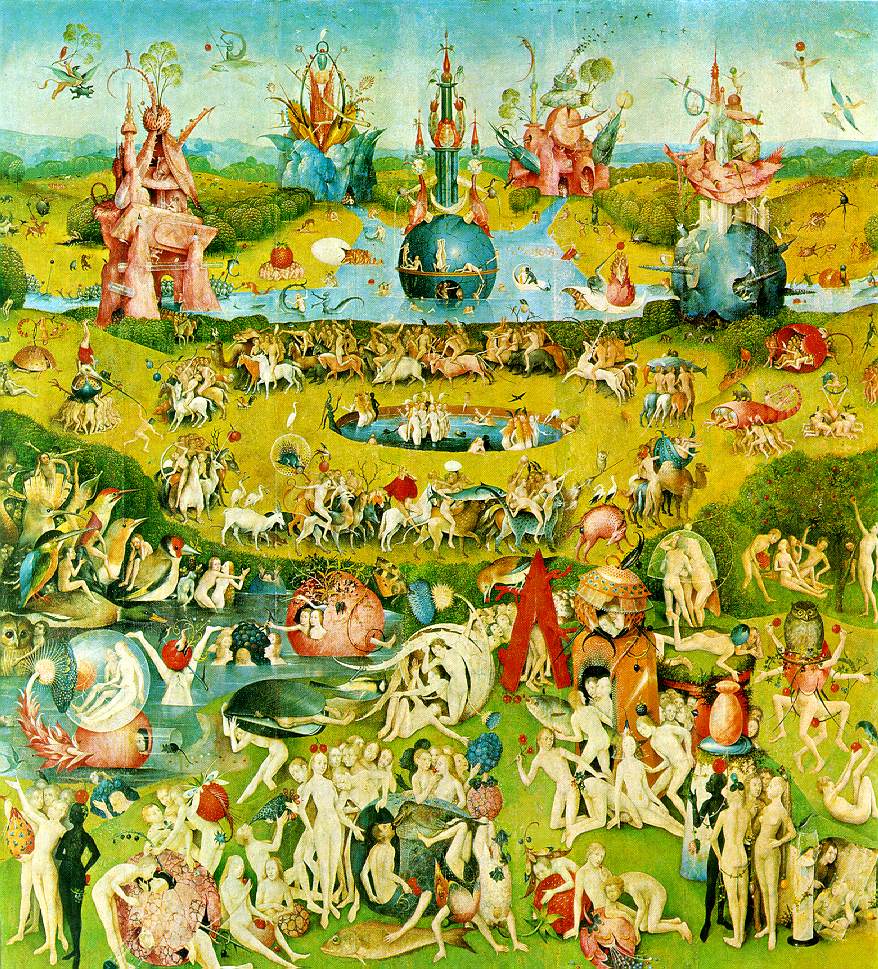
During the European Renaissance, the depiction of the human form became more realistic. One could say this trend preceded the realism in fiction: before you could write "the human condition", you had to visualize it.
Here are some examples of Renaissance paintings. (Bear in mind that in those days there wasn't television or computers, so people gave these paintings a lot more attention than we'd do today.).
A 16th-century painting by Botticelli.
A 16th-century painting by Bosch.
A 16th-century painting by d'Aleccio.
Here are some examples of Renaissance paintings. (Bear in mind that in those days there wasn't television or computers, so people gave these paintings a lot more attention than we'd do today.).
A 16th-century painting by Botticelli.

A 16th-century painting by Bosch.
A 16th-century painting by d'Aleccio.
Thursday, February 09, 2006
The Frog And The Ox
There has been a lot of huffing and puffing in the media over some newspaper cartoons.
Let me tell you this fable by Aesop, and then ponder its meaning...
---------------------------
The Frog and the Ox
"Oh Father," said a little Frog to the big one sitting by the side of a pool, "I have seen such a terrible monster! It was as big as a mountain, with horns on its head, and a long tail, and it had hoofs divided in two."
"Tush, child, tush," said the old Frog, "that was only Farmer White's Ox. It isn't so big either; he may be a little bit taller than I, but I could easily make myself quite as broad; just you
see."
So the old Frog blew himself out, and blew himself out, and blew
himself out.
"Was he as big as that?" asked he.
"Oh, much bigger than that," said the young Frog.
Again the old one blew himself out, and asked the young one if the Ox was as big as that.
"Bigger, father, bigger," was the reply.
So the Frog took a deep breath, and blew and blew and blew,
and swelled and swelled and swelled.
And then he said: "I'm sure the Ox is not as big as --"
But at that moment he burst.
Self-conceit may lead to self-destruction.
---------------------------
Let me tell you this fable by Aesop, and then ponder its meaning...
---------------------------
The Frog and the Ox
"Oh Father," said a little Frog to the big one sitting by the side of a pool, "I have seen such a terrible monster! It was as big as a mountain, with horns on its head, and a long tail, and it had hoofs divided in two."
"Tush, child, tush," said the old Frog, "that was only Farmer White's Ox. It isn't so big either; he may be a little bit taller than I, but I could easily make myself quite as broad; just you
see."
So the old Frog blew himself out, and blew himself out, and blew
himself out.
"Was he as big as that?" asked he.
"Oh, much bigger than that," said the young Frog.
Again the old one blew himself out, and asked the young one if the Ox was as big as that.
"Bigger, father, bigger," was the reply.
So the Frog took a deep breath, and blew and blew and blew,
and swelled and swelled and swelled.
And then he said: "I'm sure the Ox is not as big as --"
But at that moment he burst.
Self-conceit may lead to self-destruction.
---------------------------
Monday, January 30, 2006
Quote: "Phony Review Writers Are The Dumbest On The Planet"
The above quote is taken from a discussion thread on the ASIMOV's Messageboard.
Phony book-reviews on Amazon.com are legion - but they are easy to spot. So why are they so badly written, so tacky, so transparently fake?
Because of stupidity. If a writer is so dumb as to not see the faults of his self-published books, he will be more than dumb enough to think he can write fake self-praise and get away with it.
It's like the old joke: "Why did the idiot jump from the Empire State Building? He wanted to be a big hit on Broadway."
How to spot phony reviews:
* Look for absurd comparisons like "Better than Harry Potter!", "up there with the Bible!";
* Fakers use weird phrasings like "the conclusion is implosive" or "this year's classic" or "philosophically action-packed";
* ANY book review that trumpets a book's great philosophical breakthroughs is a bit suspect;
* Fake or dubious credentials (i.e. referring to non-existent magazines or critics);
* Aggressive attacks on negative reviews;
* If you compare the reviewer's OTHER reviews, they are the same inflated praise of one single writer;
* The reviewer uses reviews of famous writers (such as J.K. Rowling) to sneak in "plugs" for the writer he fakes for (i.e. "Harry Potter is not as good as this book by X");
* The reviewer's name sounds phony, or he uses a pseudonym;
* He consistently gives 5 stars out of 5 for every book by a single writer.
If you are even THINKING of writing phony reviews of your own stuff... get out of my blog right now!
Phony book-reviews on Amazon.com are legion - but they are easy to spot. So why are they so badly written, so tacky, so transparently fake?
Because of stupidity. If a writer is so dumb as to not see the faults of his self-published books, he will be more than dumb enough to think he can write fake self-praise and get away with it.
It's like the old joke: "Why did the idiot jump from the Empire State Building? He wanted to be a big hit on Broadway."
How to spot phony reviews:
* Look for absurd comparisons like "Better than Harry Potter!", "up there with the Bible!";
* Fakers use weird phrasings like "the conclusion is implosive" or "this year's classic" or "philosophically action-packed";
* ANY book review that trumpets a book's great philosophical breakthroughs is a bit suspect;
* Fake or dubious credentials (i.e. referring to non-existent magazines or critics);
* Aggressive attacks on negative reviews;
* If you compare the reviewer's OTHER reviews, they are the same inflated praise of one single writer;
* The reviewer uses reviews of famous writers (such as J.K. Rowling) to sneak in "plugs" for the writer he fakes for (i.e. "Harry Potter is not as good as this book by X");
* The reviewer's name sounds phony, or he uses a pseudonym;
* He consistently gives 5 stars out of 5 for every book by a single writer.
If you are even THINKING of writing phony reviews of your own stuff... get out of my blog right now!
Saturday, January 28, 2006
The BONANZA Plot Problem
I'm sitting here by the computer, while the TV is showing an old BONANZA episode in the background... and suddenly it hits me:
The Cartwright Family is living in the most violent place on Earth.
I mean, people there get shot to death or otherwise killed EVERY WEEK! And it all happens in one small region of Nevada between Virginia City and the Ponderosa ranch.
Their ranch is supposed to be near Virginia City, Nevada, in the late 19th century.... but it looks much more like Bogota, Colombia, today. The Cartwrights are a regular death squad! They must have killed more people than Wyatt Earp. (If you're in a morbid mood, search on Wikipedia how many characters got killed over the course of the entire BONANZA series...)
If one watches a whole season of BONANZA, one gets the impression that every dysfunctional family with a violent patriarch, every gang of bank-robbers and cattle-thieves, every rapist, cutthroat, lowlife and scumbag, is just flocking to the Cartwrights' spacious back yard.
(Which begs the question: why don't the Cartwrights move to a more peaceful county?)
And if we were to take the BONANZA Situation realistically, all this violence would have consequences:
1. Law-abiding families and businesses would move out in droves, making Virginia City an
impoverished slum -- or worse, a ghost town;
2. The local Congressman would go to Washington, D.C. and ask for Federal intervention: "Every seven days it's the same -- The Cartwrights kill people! We need a permanent U.S. Cavalry base to keep the order in this den of crime and gunfire!"
3. Someone would start a criminal investigation of the Cartwrights: "The whole area is littered with spent casings from Colt cartridges. A firing test shows that they match the guns of the Cartwright brothers. Take'em in for questioning!"
4. The psychological stress of living in this world of almost constant shootings, beatings and deaths would cause the brothers to go crazy, suicidally depressed, or psychopathic. But considering the ease with which they kill people and shrug it off -- plus the fact that all their girlfriends get killed or escape -- they may always have been psychopaths.
Jokes aside... this is a generic plot problem with almost any TV series, and sometimes shows up in novels too. If you concentrate too many dramatic events in a very small time and space, the plot becomes too far-fetched. (*COUGH*24*COUGH*)
(The exception is if the story is meant to be comedy, spoof, send-up, camp or satire.)
Now, the real reason why TV shows have too little "space" for the action is that locations and sets cost money. Money is the big "hidden variable" of television, and causes TV scriptwriters great headaches:
"How can we afford to send our heroes to Paris this week? I know: Let's skip new locations and travel entirely! We'll have everything happen in L.A. in realtime!"
(And thus, 24 was born...)
Written fiction, on the other hand, can afford its characters to travel around a lot more. And travel itself extends the time of the story, which eliminates much of the "time-compression" problem seen in BONANZA and other shows. (*COUGH*24*COUGH*).
Even so: novel writers watch TV (I do -- way too much ;-)), and thus they might pick up some bad plotting habits from television writers.
You shouldn't compress too much action and plot into too little space and time.
In the real world, the space of a normal human lifetime includes very few dramatic events like fights, violent deaths, dramatic accidents and such.
If you want to write a plot full of action, you must set up a situation in which this makes sense. (War is one such situation where lots of drama and violence is credible. Other situations with dramatic potential are revolution, social upheaval, or natural disasters.)
The Cartwright Family is living in the most violent place on Earth.
I mean, people there get shot to death or otherwise killed EVERY WEEK! And it all happens in one small region of Nevada between Virginia City and the Ponderosa ranch.
Their ranch is supposed to be near Virginia City, Nevada, in the late 19th century.... but it looks much more like Bogota, Colombia, today. The Cartwrights are a regular death squad! They must have killed more people than Wyatt Earp. (If you're in a morbid mood, search on Wikipedia how many characters got killed over the course of the entire BONANZA series...)
If one watches a whole season of BONANZA, one gets the impression that every dysfunctional family with a violent patriarch, every gang of bank-robbers and cattle-thieves, every rapist, cutthroat, lowlife and scumbag, is just flocking to the Cartwrights' spacious back yard.
(Which begs the question: why don't the Cartwrights move to a more peaceful county?)
And if we were to take the BONANZA Situation realistically, all this violence would have consequences:
1. Law-abiding families and businesses would move out in droves, making Virginia City an
impoverished slum -- or worse, a ghost town;
2. The local Congressman would go to Washington, D.C. and ask for Federal intervention: "Every seven days it's the same -- The Cartwrights kill people! We need a permanent U.S. Cavalry base to keep the order in this den of crime and gunfire!"
3. Someone would start a criminal investigation of the Cartwrights: "The whole area is littered with spent casings from Colt cartridges. A firing test shows that they match the guns of the Cartwright brothers. Take'em in for questioning!"
4. The psychological stress of living in this world of almost constant shootings, beatings and deaths would cause the brothers to go crazy, suicidally depressed, or psychopathic. But considering the ease with which they kill people and shrug it off -- plus the fact that all their girlfriends get killed or escape -- they may always have been psychopaths.
Jokes aside... this is a generic plot problem with almost any TV series, and sometimes shows up in novels too. If you concentrate too many dramatic events in a very small time and space, the plot becomes too far-fetched. (*COUGH*24*COUGH*)
(The exception is if the story is meant to be comedy, spoof, send-up, camp or satire.)
Now, the real reason why TV shows have too little "space" for the action is that locations and sets cost money. Money is the big "hidden variable" of television, and causes TV scriptwriters great headaches:
"How can we afford to send our heroes to Paris this week? I know: Let's skip new locations and travel entirely! We'll have everything happen in L.A. in realtime!"
(And thus, 24 was born...)
Written fiction, on the other hand, can afford its characters to travel around a lot more. And travel itself extends the time of the story, which eliminates much of the "time-compression" problem seen in BONANZA and other shows. (*COUGH*24*COUGH*).
Even so: novel writers watch TV (I do -- way too much ;-)), and thus they might pick up some bad plotting habits from television writers.
You shouldn't compress too much action and plot into too little space and time.
In the real world, the space of a normal human lifetime includes very few dramatic events like fights, violent deaths, dramatic accidents and such.
If you want to write a plot full of action, you must set up a situation in which this makes sense. (War is one such situation where lots of drama and violence is credible. Other situations with dramatic potential are revolution, social upheaval, or natural disasters.)
Sunday, January 22, 2006
Listen To Jonathan Sherwood..
Jonathan Sherwood, an American writer who's been published in ASIMOV's, has a great column on writing. If you are the least bit serious about writing fiction, read it.
Here is a quote from Sherwood's column "Forget the Audience, Who Are You Writing For?" which ought to be required reading:
------------------------
1) You’re writing so readers will say, “You’re cool.”
2) You’re writing so readers will say, “This story is cool.”
3) You’re writing so readers will say, “Life is cool.”
------------------------
The 3 levels of a writer's maturity. Read the rest.
Here is a quote from Sherwood's column "Forget the Audience, Who Are You Writing For?" which ought to be required reading:
------------------------
1) You’re writing so readers will say, “You’re cool.”
2) You’re writing so readers will say, “This story is cool.”
3) You’re writing so readers will say, “Life is cool.”
------------------------
The 3 levels of a writer's maturity. Read the rest.
Thursday, January 12, 2006
The Soundtrack Of Our Lives
Tell you a secret: I don't really write stories.
I make music videos in my mind.
Then I try to transfer them into written text. (It doesn't always succeed.) The result is a novel, or short story.
That's why I almost never write a longer story or novel without listening to inspirational music. It's the soundtrack of the video I'm composing in my head.
(You should ask other people who write, if they also work this way... I'd really like to know.)
Right now I'm listening to Robyn's latest album, and thinking: "Now, what stories would go with these songs...?" I'm sure I'll think of something. (Thanks, Robyn.)
I make music videos in my mind.
Then I try to transfer them into written text. (It doesn't always succeed.) The result is a novel, or short story.
That's why I almost never write a longer story or novel without listening to inspirational music. It's the soundtrack of the video I'm composing in my head.
(You should ask other people who write, if they also work this way... I'd really like to know.)
Right now I'm listening to Robyn's latest album, and thinking: "Now, what stories would go with these songs...?" I'm sure I'll think of something. (Thanks, Robyn.)
Subscribe to:
Posts (Atom)